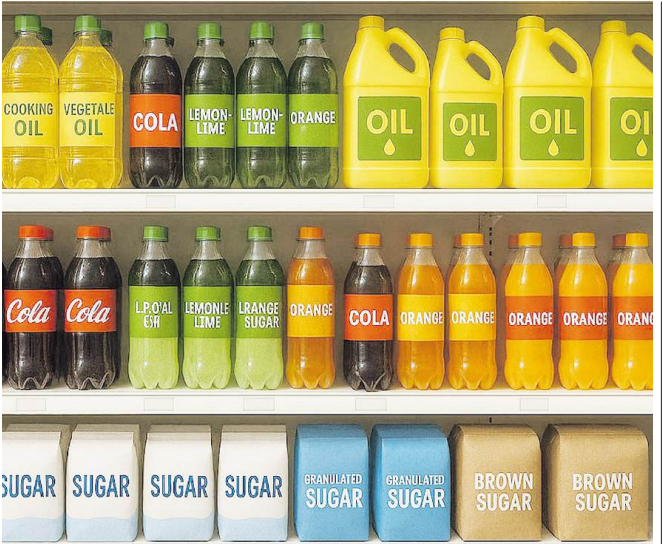
A host of related trends—including the proliferation of modern food retail outlets—has led to increased consumption of unhealthy processed packaged foods.
The report by the non-profit Access to Nutrition Initiative found that under those rules, 90 per cent of products sold by both international and local companies contained too much salt, sugar, or saturated fat.
Around 75 per cent of the products would also be deemed "unhealthy" based on models used internationally, like Nutri-Score, which, unlike the Kenyan model, also takes into account positive nutrients.
The first independent assessment of the healthiness of the product portfolios of 30 major food and beverage companies by Nutrition Markets Impact in Kenya shows that between 2017 and 2023, sales of (ultra-) processed packaged foods have increased by 16 per cent.
This shift is contributing to rising obesity and non-communicable diseases (NCDs): adult obesity has tripled since 2000.
Kenya has shown limited progress towards achieving the diet-related non-communicable disease (NCD) targets. 13.4 per cent of adult (aged 18 years and over) women and 3.6 per cent of adult men are living with obesity.
Even so, the country’s obesity prevalence is lower than the regional average of 20.8 per cent for women and 9.2 per cent for men. At the same time, diabetes is estimated to affect 7.3 per cent of adult women and seven per cent of adult men.
“Kenya is at this tipping point where they could follow in the path of countries like the U.S., where we are seeing high levels of obesity and overweight, or they could act now to try to prevent that,” ATNI's head of Policy, Katherine Pittore, said.
According to her, the nutrient model and the Kenyan government’s commitment to using it to put in place a warning label, one of the first African governments to take such steps, were signs that they are taking action.
At the same time, undernutrition and micronutrient deficiencies persist, with 79 per cent of Kenyans unable to afford a healthy diet.
The situation is so dire that the government has drafted rules requiring a health warning label.
While specific legislation is still under consideration, the country is working towards increased regulation of food labelling to promote public health.
Seven out of 12 assessed companies fortify their products, including Bidco and Kapa Oil, which fortify edible oils with vitamins A & D; Capwell fortifies maize and wheat flour, in line with Kenyan regulations.
Only Flora FG was found to have a public global commitment to fortify only ‘healthy’ products based on their criteria, and to fortify in line with Codex and WHO/FAO guidelines.
Among the 746 products assessed, 140 (19 per cent) were fortified, including 120 (11 per cent) that were voluntarily fortified. Only 32 per cent of fortified products meet the HSR ‘healthy’ threshold.
Overall healthiness is low across 30 companies, with substantial variation between companies: only 33 per cent of 746 products meet the ‘healthy’ threshold under HSR (≥3.5 stars), rising to 38 per cent when weighted by sales.
Incorporation of micronutrients is low across 30 companies, with substantial variation between companies: only 33 per cent of 746 products meet the ‘healthy’ threshold under HSR 3.5, rising to 38 per cent when weighted by sales.
Incorporating micronutrients increases these figures to 36 and 42 per cent, respectively.
The World Health Organization (WHO) flags just 14 of the products (23 per cent sales-weighted) are eligible to be marketed to children.
At least 10 per cent “pass” the Kenyan NPM, meaning that they would not require one or more warning labels.
According to the report, Bidco, New KCC, and Capwell were found to market their products as affordable, healthy, or nutritious.
However, they had not published a nutrition strategy with specific criteria for defining affordability or healthiness.
Kapa Oil reports tracking product prices relative to competitors in Kenyan supermarkets. Flora FG measured affordability by tracking household penetration of their products among lower-income groups in Kenya.
Five companies—Coca-Cola, Flora FG, Kapa Oil, Kevian, and Nestlé—disclosed practices aligned with at least one pillar of workforce nutrition: healthy food at work, nutrition-focused health checks, nutrition education, and breastfeeding support.
Three Kenya-headquartered companies—Brookside, Capwell, and Kevian—mention their role in providing nutritious or healthy foods on their websites.
ATNI has previously tracked products globally and in countries like the U.S. and India, but the Kenya report, alongside one from Tanzania, is the first of its kind in Africa.
It urges investors to prioritise investment in companies that demonstrate progress, including transparency in nutrition-related policies, responsible marketing, and workforce nutrition initiatives.
Furthermore, ATNI supports companies aligning with national and international nutrition standards and those offering healthier product portfolios that contribute to Kenya’s public health goals.