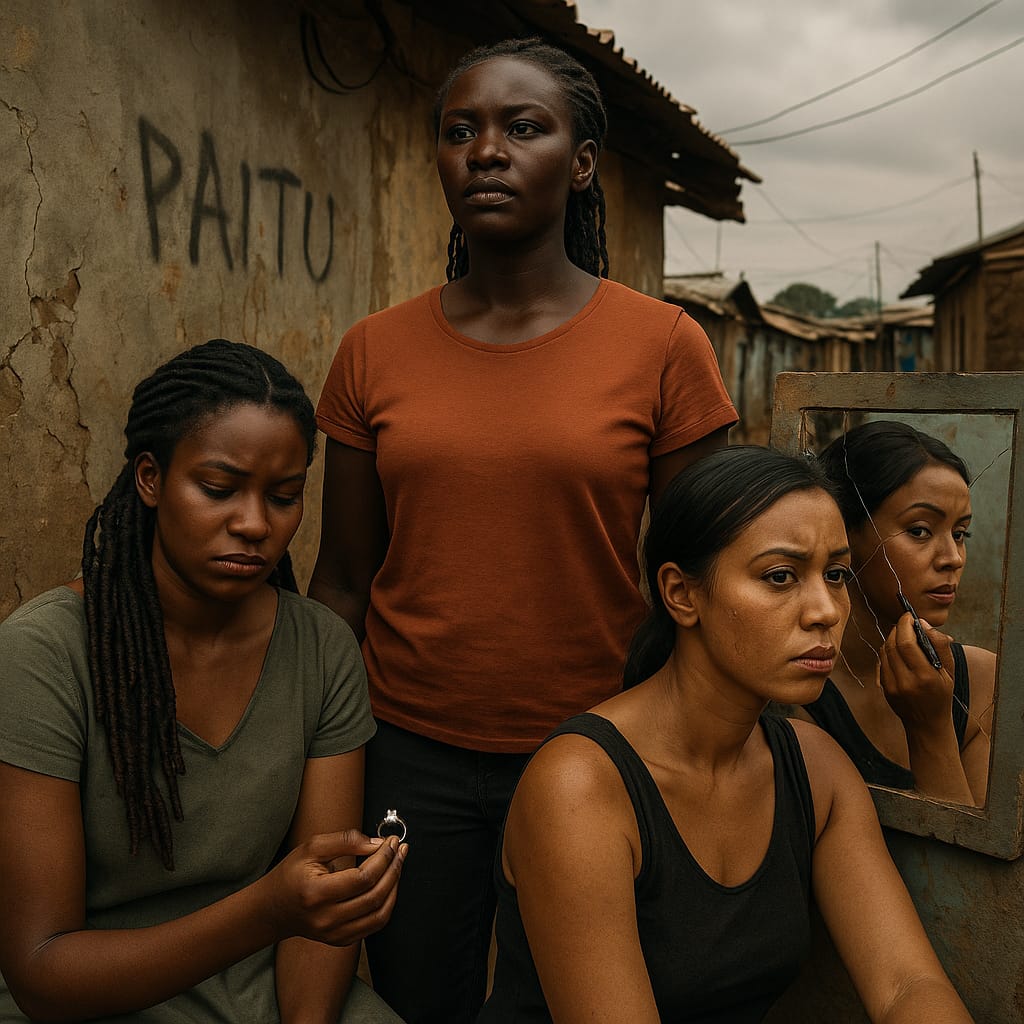
 AI-generated photo
“Living in Korogocho as a woman is not for the faint-hearted. However, living in Korogocho as a dark-skinned woman is more deplorable.”
These are the sentiments of Gloria Chelimo, a dark skinned woman residing in Korogocho. Speaking to The Star, Chelimo details the ordeal she faces daily simply because she is dark-skinned.
“I have learned to have a tough skin. Even though most of the ridicule comes from men, the silence of the women who are normally around is what cuts deep.
One morning, I stood at the bus stop, waiting patiently for a ride into town. I’m usually quite selective about the buses I take, so I was prepared to wait—no matter how long it took—for the one I preferred.
For about twenty minutes, a tout from another bus had been calling out tirelessly, trying to convince the bustling crowd to board.
He signalled to me several times, urging me to get on, but I politely declined each time.
Out of the blue, he commented with malice that I was a rude person. The statement ‘unajifanya kama light-skinned na hujafika bei’ was, however, what got the whole stage bellowing in laughter.
Trying to put on a strong front, I coldly stared at him, biting my tongue from making a snarky comment.
Taking a deep breath, I looked to my side and saw a woman beside herself with laughter. That was what broke me. Following this, I just went back home disheartened by the ordeal,” she describes.
For Salome Mukami, one of her experiences of colourism was from someone close to her.
Before this, she never saw herself in such a predicament, one where the call came from inside the house.
“For several years, I had been in a relationship. Our relationship was described by our peers as dreamy, often being referred to as ‘couple goals’.
Weekly dates at expensive restaurants, cute picnic dates, singing along off-key and proudly to songs of our favourite artists at concerts, pictures of us happily posing together in aesthetic poses inspired by Pinterest being posted on our Instagram pages were our thing.
We were giving the single people in our social group pressure, and everyone assumed that wedding bells would be ringing soon.
Sentiments like ‘nimeanza kushona kitenge’ from my female friends just affirmed to me that I was set for life, romantically.
Though I can’t deny that I enjoyed the constant compliments, that was not my source of contentment in my relationship.
On our fifth relationship anniversary, my boyfriend had organised a special weekend in Diani with the promise of total relaxation and enjoyment.
The day before we travelled to Diani, he even insisted on my going to a nail parlour to get my nails,” she explains.
Pausing for a while to recollect her thoughts, Mukami continues, “Any woman would think that the day had come for her fairy tale to come true. I naively thought that he was going to propose to me at the end of the weekend.
When it dawned on me that he wasn’t going to do so, I asked for his reasons for not wanting to propose.
Looking at me as if I had told the world’s best joke, he told me that we both knew that the relationship would never be long-term.
What added salt to the injury was his saying that he could never marry a dark skinned woman. That esteemed position in his life would only be given to a light-skinned babe.
My self-esteem plummeted further when his ‘boys’ jabbed at me after I broke up with him, saying that I should consider myself lucky. According to them, dark-skinned women do not deserve princess treatment.”
Some dark-skinned women in Kenya have resorted to using skin-lightening products. According to them, if you can’t beat them, then join them.
“I started using skin lightening products two years ago. The reason for me taking that route was my bottle service girl.
Before my skin lightening, I realised that the tips given to my co-workers who were light-skinned surpassed my tips by far.
Though I knew that it wasn’t fair, I refused to wallow in self-pity. After all, I had dealt with colourism from a young age.
Having done a thorough research on TikTok and Instagram, I decided on where I would buy my skin lightening products from.
It took two months of consistently using the products for me to see some change. Friends and family whispered behind my back after I became lighter in complexion.
"I simply did not care. My focus has always been chasing the bag. The day self-esteem pays my bills is the day I’ll stop using the products," Helen categorically states.
According to Calvin Njogu, a dermatologist at Dermallure Skin Clinic, concerns about the widespread use of skin lightening products, particularly among women, should be taken seriously.
“One of the complications that can occur is mercury poisoning. Mercury is a highly toxic chemical banned in skin-lightening products."
However, many skin-lightening products containing mercury are still available on the market.
Signs and symptoms of mercury poisoning include: numbness, high blood pressure, fatigue, sensitivity to light and kidney damage.
In addition, research has linked skin whitening products to dermatitis, an inflammatory condition caused by exposure to certain chemicals.
Symptoms of dermatitis range from mild to severe and include: redness, blistering, skin ulcers, rash, dry scaly skin, swelling, itching, increased skin sensitivity and burning,” he cautions.
Talking to The Star, Dr. Mary Nafula, a psychologist at Mind Clarity Centre, emphasises the importance of having high self-esteem when coping with colourism as a dark-skinned woman in Kenya.
“Kenyan women should not have to deal with colourism just because they are dark-skinned. However, the war against colourism is yet to be won.
Colourism can lead to the internalisation of negative stereotypes about dark skin, impacting self-perception and self-worth.
High self-esteem would play a key role in challenging these internalised biases in the minds of dark-skinned Kenyan women and developing a more positive self-image, regardless of societal preferences for lighter skin.
"Strong self-esteem acts as a buffer, allowing dark-skinned women to recognise their inherent worth and beauty, resisting the pressure to conform to unrealistic beauty standards,” she affirms.