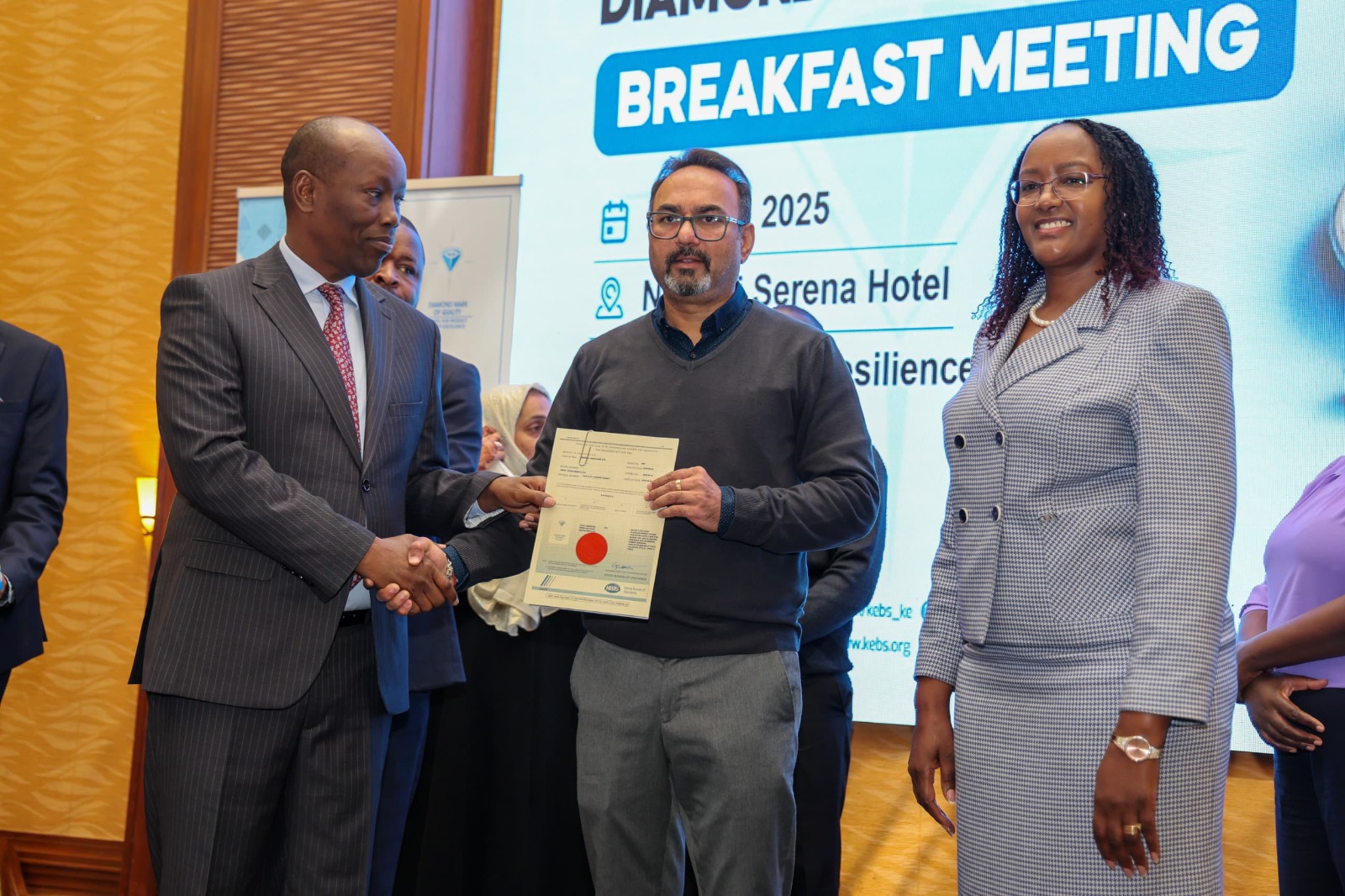
The Cabinet Secretary, Ministry of Investment, Trade & Industry, Lee Kinyanjui, presents a Kenya Bureau of Standards Diamond Mark of Quality certificate to Ravi Varsani of General Industries during an event in Nairobi. Looking on is KEBS Managing Director, Esther Ngari./HANDOUT
Manufacturers could be staring at cheaper raw materials should the government forge ahead with proposed reforms on the Pre-Export Verification of Conformity (PVoC) exemption framework.
Under the proposal by Cabinet Secretary in the Ministry of Investments, Trade and Industry, Lee Kinyanjui, the government is considering reforms aimed at strengthening the Kenya Bureau of Standards’ PVoC exemption framework in a bid to ease access to duty-free raw materials for local manufacturers.
This initiative targets the smoother importation of raw materials, industrial machinery, and spare parts, aiming to reduce costs and lead times for manufacturers.
The PVoC programme is a quality inspection system used to ensure imports meet Kenya’s standards before they arrive at local ports.
"By easing regulatory bottlenecks and prioritising quality as a national goal, we aim to create a supportive environment for local businesses, drive innovation, and promote inclusive economic growth,” said Kinyanjui.
While the exemption is intended to facilitate legitimate importers, especially manufacturers, industry players have complained about inefficiencies and inconsistent application.
The planned changes are expected to streamline the exemption process, reducing delays and costs that have long frustrated industrial players seeking to import critical inputs for production.
The CS challenged local manufacturers to adopt higher quality standards through the Kenya Bureau of Standards (KEBS)’ Diamond Mark of Quality, positioning it as a gateway to improved market competitiveness and expanded trade opportunities.
“Through the quality management frameworks of the Kenya Bureau of Standards, we empower Kenyan industries to compete on a global scale. This, in turn, attracts foreign investment and positions Kenya as a hub for quality-driven development in Africa” he added.
The Cabinet Secretary urged local manufacturers to work closely with KEBS to align their quality and capacity so that they can take advantage of the vast trade opportunities within the ACFTA.
KEBS Managing Director Esther Ngari said since KEBS introduced the Diamond Mark of Quality in 1996, some 1,263 products, both local and international, have been awarded the Mark.
She however pointed out that achieving the Diamond Mark was not an end in itself and there was a need to continue strengthening our certification process by aligning it to the best global practices, including ISO/IEC 17065:2012.
Surveillance, compliance audits, and performance monitoring which are integral to preserving the integrity of the Diamond Mark of Quality.
Principal Secretary in the State Department of Industry, Juma Mukhwana, said harmonization of regional quality standards had made it easier for local products to penetrate regional markets with products bearing the Diamond Mark of Quality enjoying a competitive edge.
He also observed that Kenya’s certification scheme had gained widespread recognition within Africa and beyond, which was helping boost the country’s opportunities for continental trade through the Africa Continental Free Trade Area (ACFTA).
Kinyajui however urged the local enterprises to invest in quality excellence so as to stand a chance of playing at the continental and global level.
“In the pursuit of sustainable development, our industries must adopt best practices and invest in professional development to cultivate a culture where quality is not only a standard to uphold but a value we live by”, he stated.