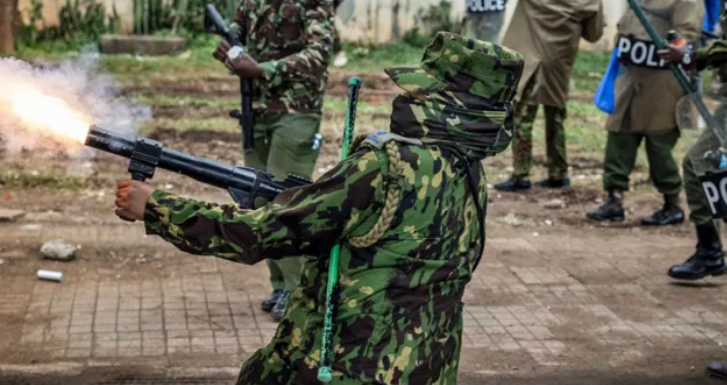
A police officer fires at protesters in Nairobi/FILE
President William Ruto stirred debate when he ordered police to shoot protesters targeting businesses in the legs, ensuring they are incapacitated but not killed.
Ruto issued the order in the wake of a wave of protests over economic stagnation, corruption and police brutality.
"Anyone caught burning another person's business or property should be shot in the leg, hospitalised, and later taken to court. Don't kill them, but ensure their legs are broken," he said.
Thirty-one people were killed during Monday's protests and 107 were injured, according to the Kenya National Commission on Human Rights.
Defending the President's statement, Cabinet Secretary for Health Aden Duale said the instruction was a practical approach to neutralise threats without resulting in fatalities.
“When a criminal enters your house, don’t kill him, shoot him in the leg, immobilize him until the police come. Make sure he doesn’t bleed,” Duale said during a televised interview.
Duale’s remarks attempted to paint the order as a more humane alternative to lethal force, but they have been met with fierce criticism from human rights groups.
Law enforcement professionals, however, argue that the President’s directive reflects a dangerous misunderstanding of police training and the realities of armed engagement.
“The idea of shooting to wound is a Hollywood myth,” Mathew Moore, a US-based police instructor and firearms expert says.
“Police are trained to shoot to stop, not to kill or wound. But in practice, that usually means aiming for the centre of mass—the largest and most stable target.”
Moore warns that shooting at legs or arms is highly impractical.
“Limbs are small, fast-moving targets. Even trained marksmen are likely to miss, and if they do, they risk hitting bystanders,” Moore says.
Dave Lazarick, a former officer from Alberta, Canada, echoes this sentiment.
“If you're drawing your weapon, it's because someone's life is in imminent danger. Shooting to wound doesn’t eliminate the threat—it could leave the assailant able to attack again,” Lazarick says.
Both experts caution that in high-stress, fast-moving situations like riots, the chances of hitting a leg accurately are “slim to none.”
They said police should generally shoot to stop, not to wound, because aiming for limbs in a dynamic, high-stress situation is unreliable and could leave the threat still active.
“Officers are trained to fire towards the centre of mass as it's easiest to hit. Aiming towards a leg or an arm is therefore difficult. If officers start shooting at people's legs they are going to miss more often and the person they are shooting at may not be as restrained,” Moore says.
Human rights organisations believe the President's remarks may further embolden excessive police force.
Under Kenya’s National Police Service Act and international standards such as the UN Basic Principles on the Use of Force, lethal or potentially lethal force must only be used as a last resort when there is an imminent threat to life.
Even as debate continued to rage, National Assembly Defence Committee chairperson, Nelson Koech, has affirmed that police should actually "shoot to kill" and not "shoot to injure," as suggested by Ruto, criminals who infiltrate protests.
"I want to appreciate the president for what he did, but he said that the police should shoot but not kill, but I would like to say that the police should shoot to kill, because there is no way a police officer should just wait for someone to come and threaten him and his family and tell me that you can't shoot to kill," Koech said.
Speaking in Kericho on Thursday, July 10, Koech insisted that law enforcement officers must not hesitate to kill if their lives or the lives of citizens are in danger.
The use of lethal force against protesters came under scrutiny after Interior Cabinet Secretary Kipchumba Murkomen reportedly told officers to shoot-to-kill criminals in demos.
It came in the wake of June 25 violent demonstrations, which left at least 19 people dead and 531 others injured, according to the Kenya National Commission on Human Rights (KNCHR).
Murkomen has since denied reports that he issued a “shoot-to-kill” directive to the police during this week’s deadly protests.
The CS insisted that he has no legal authority to command the Inspector General of Police or any officer in the National Police Service.