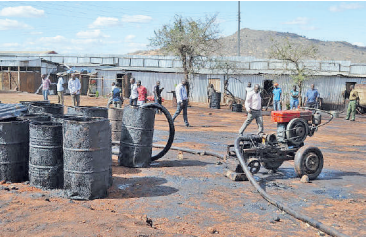
Kenya’s automotive sector is grappling with a surge in counterfeit oil products, with industry players warning that the problem is eating into legitimate sales and threatening engine safety across the country.
Car and General says that a significant portion of its market is being undercut by fake lubricants.
The automobile industry has been grappling with the infiltration of these fake oils, with estimates by the Anti-Counterfeit Authority on the proportion of counterfeit lubricants being sold in the market being as high as 20 per cent as of 2023.
Car and General-general manager George Rubiri pointed out that the firm might be losing millions and they will be looking to ride on technology to curb the losses.
“I think that's a very big industry problem that we are facing, especially in the parts business. And more so for us, it's on the oil business. This has affected us a lot. On a monthly basis, maybe our sales are around Sh50million,” said Rubiri.
“And when you look at it, is that counterfeit oil takes quite a huge chunk of what our actual sales would have been.”
Kenya’s automotive lubricants market is a growing sector, projected to reach a value of approximately $150 million (Sh19.4 billion) in 2025, with a Compound Annual Growth Rate (CAGR) of 5.03 per cent projected between 2025 and 2033, according to Market Report Analytics.
This growth is driven by increased vehicle ownership, infrastructure development, and the expansion of various industries.
The projection by Anti Counterfeit Authority and the total value of the market report analytics means that the sector could be losing up to Sh3.88 billion.
In an effort to tame these losses, the company has partnered with the Anti-Counterfeit Authority and the Kenya Association of Manufacturers to crack down on the syndicates behind the fake oil, but still says enforcement remains a challenge.
“We also engage them through the Kenya Association of Manufacturers. You know, just trying to identify this individual behind that racket. I think it's a very challenging environment,” he added.
To fight back, the company is rolling out a digital authentication system. Each oil can will feature a unique code that buyers can verify by scanning or USSD.
“So when you look at other players, what they are doing and also what we are initiating that will be rolling out in a few couple of months is for every can of oil that we sell out there, the customer will be able to scan a certain code, or if they don't have a smart phone, they can, through USSD, they can send a text of a code,” said Rubiri
The company is also leveraging its digital platform to educate over 1,000 distributors and retailers on identifying counterfeit products and enforcing quality control.
Car and General Group CEO Vijay Gidoomal said that beyond the fight against counterfeits, the company will be looking to ride on the renewed demand for motorbikes and diversification to grow its Kenyan operations.
This is after a glut of repossessed bikes from loan defaulters in 2022–2023 disrupted new sales.
“In 2021, the industry was selling up to 25,000 bikes a month. That dropped to 4,500 by 2024. Now we’re seeing recovery—averaging 8,000 units monthly—and we expect this could hit 15,000 by next year, depending on stable taxes, fuel prices, and the exchange rate,” said Gidoomal.