

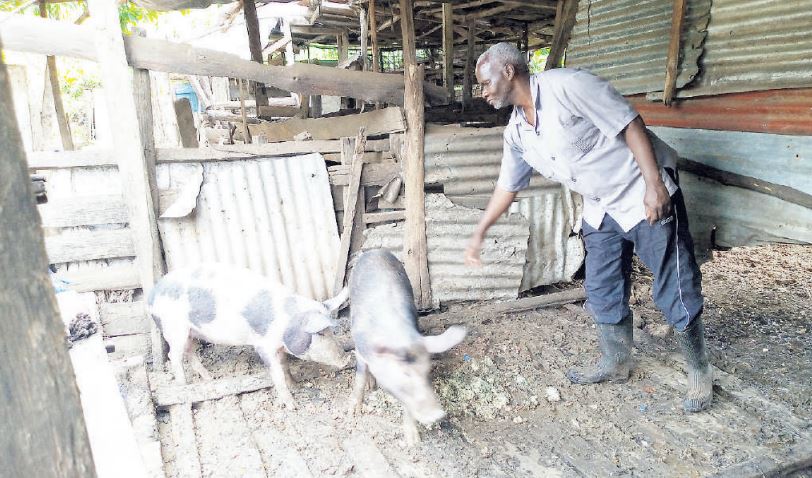
The smell of manure and feed might not be everyone’s cup of tea but for Samuel Chepkwony, it is the opportunity that drew him to seek early retirement from his full-time job as a school bus driver.
Chepkwony, a resident of Asenwet village in Soin/Sigowet, Kericho county, has for a long time had passion for pig farming.
The 55-year old started his now lucrative venture eight years ago while still working as a driver at Kipsigis Girls High School in Kericho but opted to seek early retirement last year to pursue his passion in pig farming.
A visit to his pig farm shows a farmer who has passion for the venture.
The farm has three full grown female pigs and 42 in a pigsty made of wooden planks and mabati walls, with saw dust littered in four compartments for comfort and cleanliness.
It also has two feeding areas outside the wooden structure. The pigsty, measuring four by six feet, is located directly opposite his stone brick house on two and a half acres.
What prompted the idea? A visit to the the school’s kitchen waste prompted him to approach the school’s administration with a proposal that the institution sets up a pig farm to reuse kitchen waste as feeds for the swines.
However, to his dismay, this project was declined, paving way for him to pursue it on his own farm.
“I was disturbed at the amount of food leftovers the school kitchen had. So I approached the then Principal Juliana Kirui with a proposal that the school establishes a pig farm to counter this wastage. To my dismay, the school’s administration declined this project that I had proposed. This added more fuel to my passion to setting up my own pig farming venture,” Chepkwony said.
Armed with a capital of Sh5,000, he bought two female sows of different breeds.
His friends, who reared pigs for pork also provided some mentorship.
“I recall buying my first pigs from a friend in Kericho one was the large white breed and the other an Oxford sandy breed. He gave me one on credit, promising to pay later but bought the second one at Sh4,000," Chepkwony said.
"Both were females. One was gestating and upon taking it home, it gave birth to eight piglets. Since I was still in employment, I had to employ a farm hand to regularly assist and I must admit that my friends who rear pigs have helped a great deal.”
The biggest market for the pigs is the neighbouring county of Kisumu, where demand for pork is relatively high. In a month, he sells five pigs, each weighing 70 kg at Sh15,000.
Sows reproduce twice a year with their gestation period being only 114 days. Pigs are divided into three categories; weaners, who are between two to three months old, growers who are between four to six months old and finishers who are between seven to 12 months old.
Last year, one sow reproduced 100 piglets , making it the highest number of piglets Chepkwoy has reared since he started the venture.
Sometimes he sells three-month old piglets to farmers, who are starting out on pig farming and sells the swines to slaughterhouses in Nyamasaria, Kisumu county.
“A nine-month old swine, weighing around 60kg sells for Sh10,000 and a piglet of three months weighing three kilogrammes sells at Sh4,000. There was a time I sold 10 swines to a slaughterhouse in Nyamasaria in a single day," Chepkwony said.
"Last year, I sold four piglets in a day in the same area. The price range of the pigs depends on the age, breed and weight. Pigs at different stages of growth (weaners, growers and finishers) command different prices and heavier pigs typically fetch higher prices."
“I can confidently say pig farming is incredibly rewarding and profitable. I have managed to pay school fees for my children, including purchasing farm inputs such as fertilisers and seeds for my other crop. I grow lemons and mangoes, coffee and sugarcane.
Chepkwony says pig farming provides a steady income stream and contributes to food security.
"Due to the expensive costs of feeds, I opted to using kitchen waste. Currently I house five swines and one boar in addition to 42 piglets, which I feed twice a day at 9 am and 5 pm. My pigs feed on two kilogrammes of leftover food per day," the farmer says.
He says successful pig farming includes having the right breed, suitable housing, proper feeding and disease management.
"Anyone seeking to get into pig farming must observe all these for better returns," Chepkwony says.
He says the pigsty should be free from rain and sun and wind and the floor should not be slippery. Deworming and iron injection for young piglets should be regular, the farmer says.
“It is important to protect the pigs from harsh elements of the weather be it cold, rain or wind as this can lead to early deaths. I deworm my young piglets every month and the large ones after every three months. I also give an iron injection for the young pigs on the third and the 21st day of the month," Chepkwony says.
The farmer also does tooth clipping to reduce injuries on the mother during nursing. "My pigs rarely get sick but I once lost one some years back due to cold the cold weather,” he said.
Chepkwony says pig farming is rewarding but one has to do research on whether they will realise profit or not.
Feeding is also a critical element but I opted to use kitchen waste as the commercial feeds are expensive.
Chepwkony said he is happy to have ventured into pig farming and has no regrets for having retired early to pursue his lifetime passion.
In the same breath, he urges the county government to offer training opportunities as well as extension services for interested youths and established pig farmers with a view of enhancing their knowledge and capacity on scientific and modern pig farming methods.
“I am one happy pig farmer because I have reaped a lot from the venture. This is my source of livelihood and I am able to provide for my family as well. One can start small and continue building up. Rearing pigs for meat has been a rewarding experience. This work is not for the faint hearted as it requires dedication and care for these animals. Seeing them grow and thriving is fulfilling. The market demand for pork is consistent making it a viable business venture. Challenges such as disease management and market fluctuations exist, but with proper planning and management pig farming can be profitable and satisfying,” he said..







