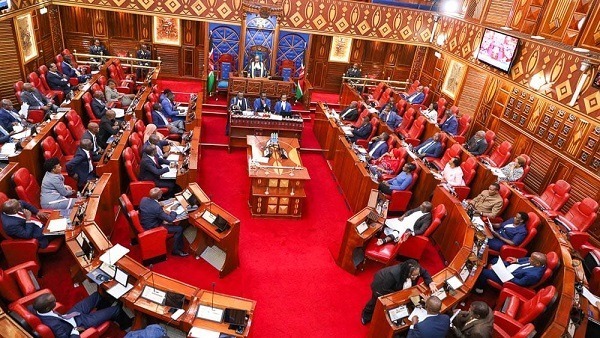
Governors have been dealt a blow after senators moved to curb wasteful and non-essential spending by the county executives.
The lawmakers have slashed the recurrent expenditure ceilings for county executives by Sh10.34 billion for the 2025-26 financial year.
In a landmark decision, the Senate has aimed at what it termed as excessive and non-priority spending by county leadership, particularly governors and senior officials, who have often come under fire for lavish expenditure at the expense of development.
The senators have reduced the ceiling for recurrent expenditure by the county executives from Sh33.75 billion in the last financial year to Sh23.41 billion.
The capping affects recurrent expenses outside the wages and benefits for public officers in the county governments.
The Public Finance Management (PFM) Act mandates the Senate to set these ceilings in a manner that ensures fiscal discipline at the county level.
Governors have argued that the increasing cost of operations—due to inflation, rising fuel prices, and the general increase in the cost of living—necessitates an upward adjustment in the recurrent expenditure ceilings for county executives.
The radical move follows a string of damning reports by the Controller of Budget Margaret Nyakang’o which show that counties continue to channel disproportionate resources to personnel emoluments and perks while development projects stall.
For the county assemblies, however, the senators have expanded their spending window from Sh36.36 billion to Sh38.25 billion, an increase of Sh1.86 billion.
According to the bill, the Nairobi executive has the biggest expenditure window of Sh775.75 million. This is, however, a reduction from Sh924.64 million in the last financial year.
Kiambu will spend up to Sh642.09 million on the recurrent fiscal year, down from 937.94 million, with Kakamega’s spending window slashed to Sh631.90 million from Sh954.36 million.
Nakuru’s budget has been slashed to Sh622.62 million from Sh949.69 million, and Migori’s spending ceiling has been reduced to Sh538.50 million from Sh803.30 million.
In Machakos, the recurrent ceiling has reduced to Sh540.77 million from Sh817.38 million, Kitui’s ceiling has reduced to Sh556.90 million from Sh1.03 billion.
The governors have reduced the ceiling for Meru’s recurrent expenditure from Sh1.04 billion to Sh565.02 million, Murang’a will spend up to Sh515.20 million, down from Sh822.21 million.
Others are Baringo (Sh496.16 million), Bomet (Sh468.73 million), Bungoma (Sh562.05 million), Kisumu (Sh522.10 million), Mombasa (Sh497.26 million), Kajiado (Sh459.20 million) and Mandera (Sh511.94 million).
For the county assemblies, Nairobi is leading with Sh1.56 billion down from Sh1.59 billion, Nakuru with Sh949.69 million down from Sh1.12 billion and Kakamega with Sh1.24 billion from Sh1.27 billion.
Kiambu assembly has been given the leeway to spend Sh1.20 billion from Sh1.12 billion, Kisii will spend Sh1.05 billion from Sh994.07 million, while Meru will spend Sh1.04 billion from Sh1.03 billion.
Other assemblies with big expenditure windows are Narok (Sh878.62 million), Turkana (Sh863.84 million), Wajir (Sh784.44 million), Murang’a (Sh813.71 million) and Migori (Sh936.95 million).
Others are Mandera (Sh917.93 million), Marsabit (Sh741.49 million), Nandi (Sh781.14 million), Machakos (Sh957.19 million), Busia (Sh859.60 million), Garissa (Sh903.12 million) and Homa Bay (Sh801.34 million).