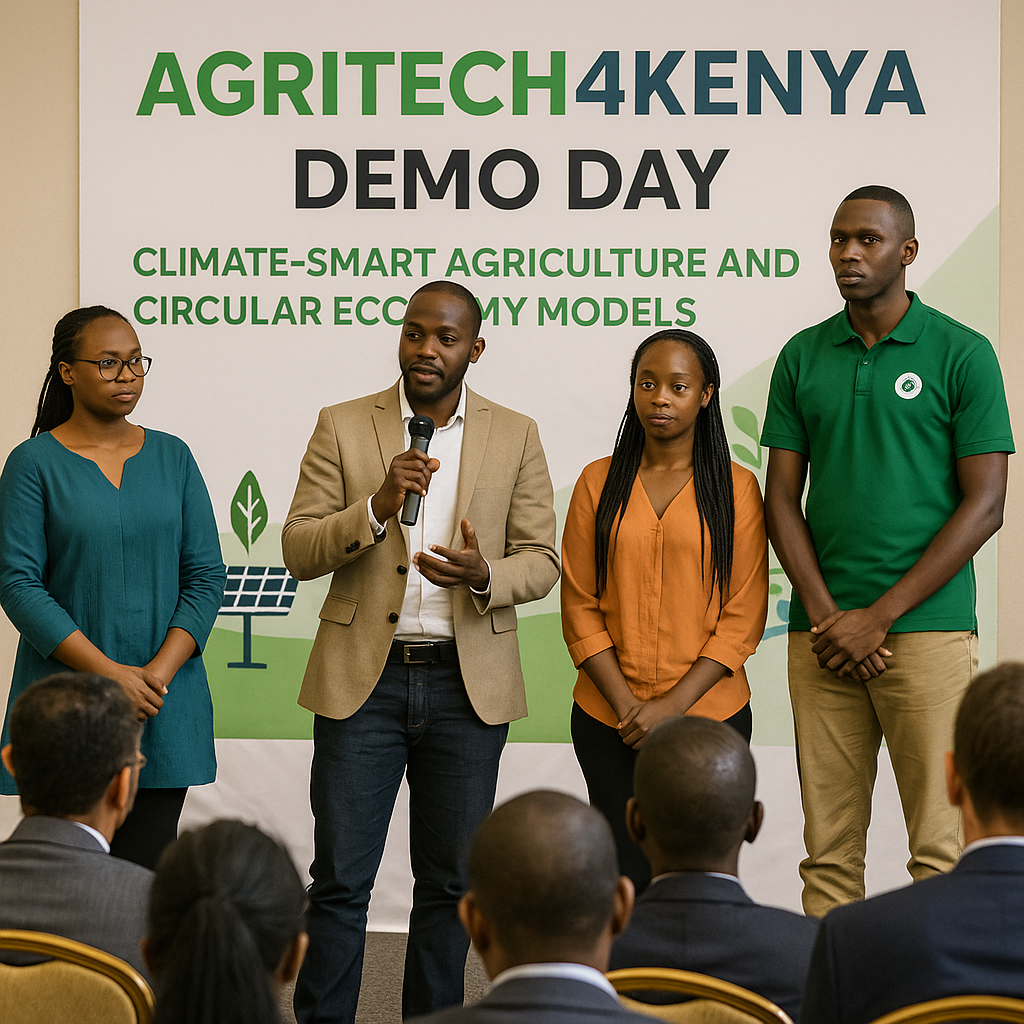
Some 15 agri-tech startups from across Africa are calling for support to bring their innovations to market and help smallholder farmers boost productivity, efficiency and climate resilience.
This came during the AgriTech4Kenya Demo Day, a culmination of a six-month acceleration programme aimed at bridging the gap between science-based innovations and real-world farming needs.
The innovators pitched their solutions to investors, development partners and ecosystem leaders during the AgriTech4Kenya Demo Day, marking the close of the AgriTech4Kenya Innovation Challenge.
Their technologies are designed to support smallholder farmers with solutions that improve productivity, efficiency, sustainability and climate resilience.
The innovations focused on climate-smart agriculture and circular economy models tailored to Kenya’s agricultural challenges. AgriTech4Kenya is powered by CGIAR’s Accelerate for Impact Platform in collaboration with CGIAR Sustainable Farming, the CGIAR Initiative on Nature-Positive Solutions, and key partners such as AGRA, Kenya Agricultural and Livestock Research Organisation, Mercy Corps, SAF-Africa, Daystar University, DoB Equity, and Pangea Accelerator.
The initiative is funded by the Italian Ministry of Foreign Affairs and International Cooperation.
“There’s a lot of value trapped in pre-commercial stages of research innovations that never reach the market or farmers,” said Dr Gianpiero Menza, from CGIAR’s Accelerate for Impact Platform.
“Our goal is to work with partners to understand farmers’ needs and develop solutions that truly benefit them.”
Menza said the AgriTech4Kenya Innovation Challenge began about a year ago with a global call for applications attracted nearly 1,000 entries.
The top 25 were invited to Kenya, and from them, 15 startups were selected for a fully funded six-month acceleration programme. The Demo Day marked the end of this phase.
“The next step is to collaborate directly with farmers to ensure these solutions are adopted on the ground. They are made with farmers, for farmers,” he said.
He noted the need for patient capital to help de-risk early-stage, science-based innovations, which often take longer to reach market due to the complexity of agricultural systems. He mentioned partnerships with entities like the Climate Resilient Africa Fund to support such startups.
“Industry partners are also critical, they help test, refine and scale these innovations based on user feedback,” he added.
Kalro director general Dr Eliud Kireger said the initiative is timely, bringing continent-wide innovations to solve Kenyan-specific problems.
“Agriculture today faces dynamic challenges from climate shocks to shifting socioeconomic conditions. Innovation is necessary, but so are partnerships, feedback mechanisms, and clear pathways to scale what works,” Kireger said in a speech read by Dr Alice Murage, Acting Director of Social Economics and Policy Development at Kalro.
He pointed out the importance of strong innovation ecosystems, not just pitches saying Kalro plays a central role in generating and validating technologies, offering practical solutions to boost productivity and sustainability.
“We are committed to bridging the gap between science, innovation and commercialisation. Currently, we have a geo-referenced digital database of over 6.5 million farmers, classified by value chain and county, helping us link innovations to the right users,” he said.
The DG added that AgriTech4Kenya is not only empowering local innovators but also positioning Kenya as a leader in science-based agri-solutions for global challenges like climate change, food systems transformation and youth employment. “Agricultural transformation is not just about technology.
Real impact happens when innovators understand the cultural, social and environmental realities of the communities they serve,” Kireger said.
“When we combine bold ideas with committed ecosystems, we don’t just build businesses, we build futures.” Francis Okwara, a senior innovation officer at the Kenya National Innovation Agency (KeNIA), pointed out the critical role of agri-tech innovations in addressing agricultural challenges through scalable, practical solutions.
“Agri-tech innovations are essential because they offer viable, scalable solutions to the persistent challenges facing our agricultural sector,” he said.
KeNIA is a government agency mandated to coordinate and manage Kenya’s national innovation system across sectors, including technology, health, and agriculture.
Okwara noted that the agency runs several programmes aimed at supporting the growth of startups and advancing innovation.
“We have five strategic pillars, one of which is commercialisation. This pillar ensures research conducted in universities and other institutions of higher learning is translated into market-ready solutions,” he said.
He urged innovators to align their startups with funders' interests to increase their chances of securing financial support.