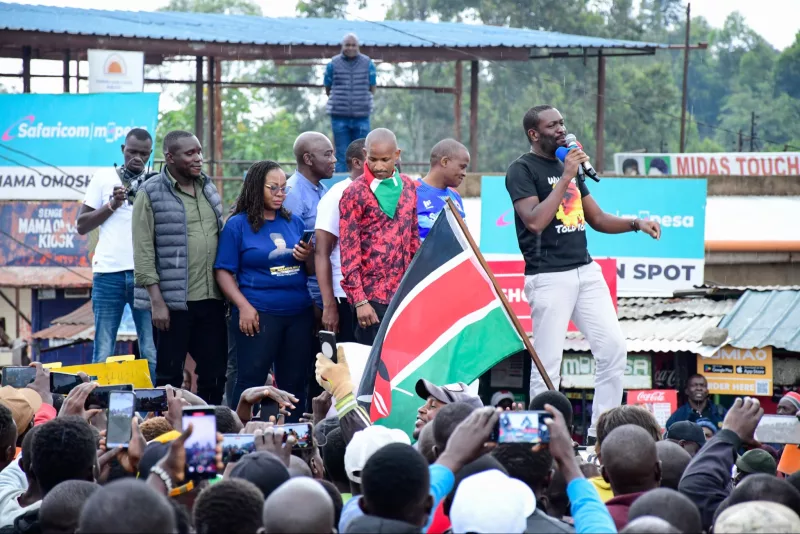
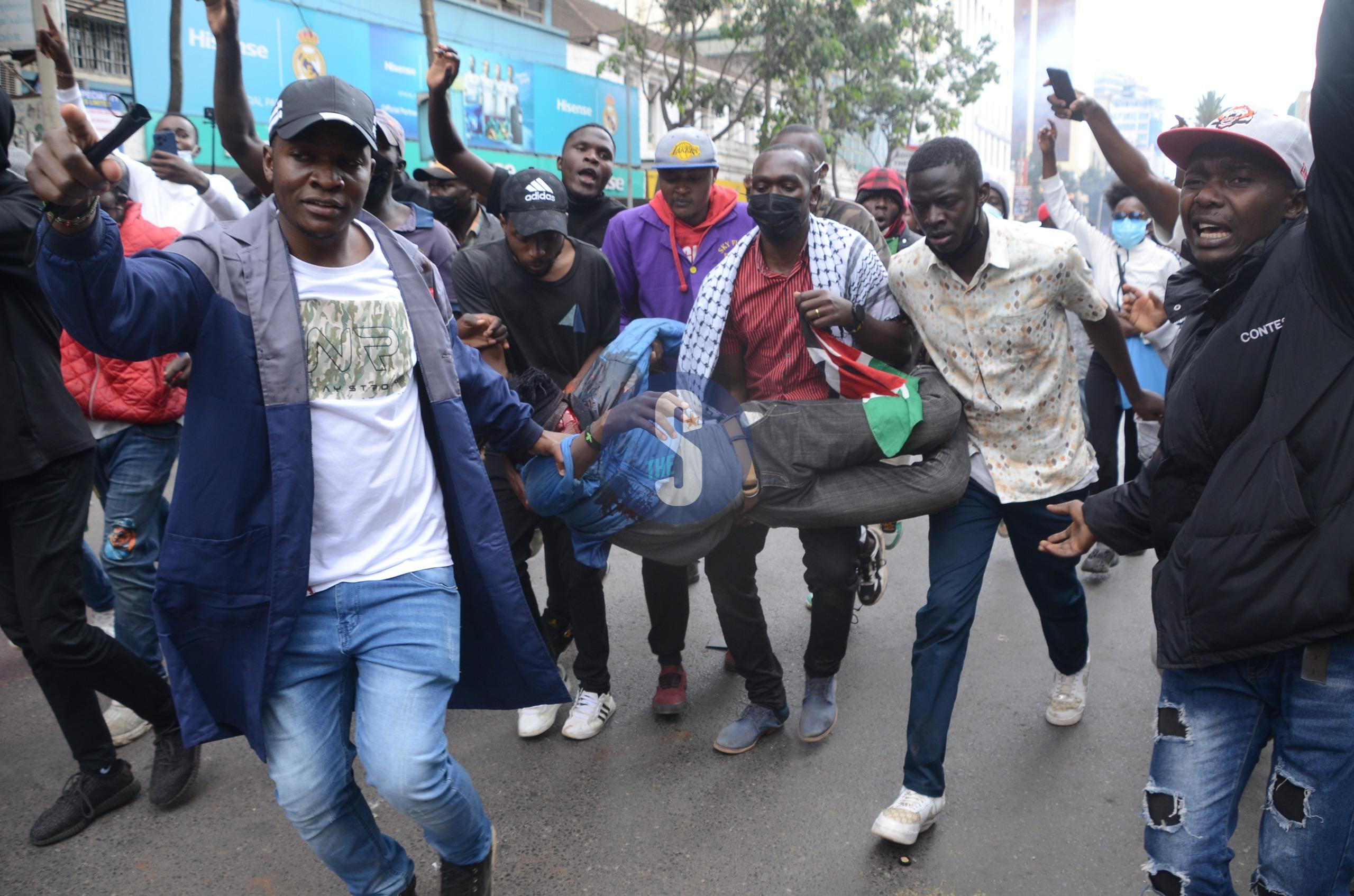
 Protesters carry a man who was shot by a police officer in Nairobi CBD on June 17, 2025./DOUGLAS OKIDDY
Last year, it was the excessive force meted out on protesters, leading to unnecessary deaths of our young people.
The Kenya National Commission on Human Rights reported on July 1 that 39 people died and 361 were injured in relation to the protests countrywide from June 18 to July 1; postmortems were pending.
This year, the tragic death of Albert Ojwang in police custody has again ignited a national conversation about accountability, police brutality and the justice system in Kenya.
With speed, Ojwang’s family was offered gifts: a house presented by the Homa Bay governor, a job for his wife promised by the governor of Nairobi and Sh2 million pledged by the head of state, President William Ruto.
Ojwang’s case is not isolated.
There have been numerous instances in which the families of victims who have suffered harm from politicians and or police receive financial “assistance” or “donations” from the very same allegedly guilty politicians or government entities, particularly when public outcry is high.
These payments are often framed as humanitarian gestures or support for burial expenses, rather than direct compensation or admission of guilt. Their informal nature makes them difficult to track and quantify officially.
And while all these are good gestures, thoughtful even, an interrogation of the motives is inevitable.
Are the gifts a tradeoff for silence? An inducement to ignore justice and “let it be”?
And why the top brass? Well-wishers (God bless them all) came together to support the family with financial contributions—as most Africans are known to do. Is the state simply showing goodwill, competing with the well-wishers, or pacifying the public?
Something doesn’t sit quite right.
This is not about whether or not the family should or shouldn’t have received the offerings.
While there isn’t a specific law that explicitly prohibits a private citizen (the bereaved family member or members) from accepting a gift in such a circumstance, understanding the purpose and effect of such a gift are crucial.
The Bribery Act (2016) defines a bribe as giving or receiving offers, promises, or financial or other advantages, where the person knows or believes that the giving or acceptance would constitute the improper performance of a relevant function or activity.
If the gift is offered with the explicit or implicit understanding that the family will not pursue legal action, or will alter their testimony, or will otherwise “silence” their clamour for and pursuit of justice, then it could arguably qualify as bribery or an attempt to obstruct justice.
The intent behind the gift is key. If the politicians’ aim were to buy silence or prevent prosecution, it would fall under the definition of bribery.
Coercion involves compelling someone to do something through force or threats. While a cash gift might not directly involve threats, if the family is in a vulnerable position (e.g., facing financial hardship due to the loss) and the offer is presented in a way that suggests it’s their only or best option, it could be seen as undue influence or subtle coercion.
This is especially true if there’s an implied condition of dropping the case or not seeking further legal redress.
I’ll leave it at that.
Seeing as Ojwang was a provider and an only child, an obvious gap is left by his death. The gifts will surely be of help and, for the government, good PR.
Especially for a government that has earned a reputation of being on the wrong side of the country’s history with all its broken promises and high trust deficit.
Conversely, should this be a plan to buy forgiveness, it will be no surprise if the family, in the not-so-distant future, conveys their forgiveness and, hence, reluctance to pursue any course of action against the culprits.
It is encouraging to note that the Independent Policing Oversight Authority has been actively investigating and recommending prosecutions for the officers accused of misconduct.
While convictions can be slow and difficult to secure, this case—with President William Ruto admitting police involvement and with two officers arrested so far—demonstrates a potential shift towards greater accountability.