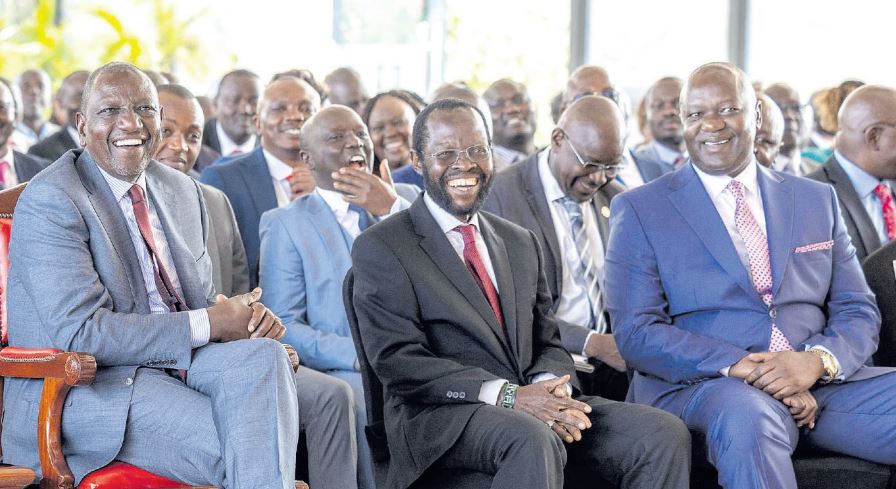
 President William Ruto, Kisumu Governor Anyang’ Nyong’o and Senator Tom Ojienda, when the Head of State hosted leaders from Kisumu county at State House, Nairobi, on Wednesday/PCS
As politicians rev up their engines more than two years before the 2027 presidential election, Kenya is witnessing a fierce prelude marked by coalition manoeuvring, youth activism and a scramble to shape the national narrative.
The high cost of living and persistent inflation have eroded household budgets. Fuel, food and essentials remain unaffordable for many, while unemployment—especially among the youth—looms as a ticking time bomb. Thousands of graduates are struggling to find meaningful employment.
Meanwhile, mounting public debt and fiscal strain have pushed debt-to-GDP ratio to around 58 per cent, far from the targeted 52.8 per cent by 2027-28. Balancing austerity with the need for growth has become a politically delicate act.
The growing mobilisation of Gen Z and millennial voters is at the heart of the 2027 State House race. Active on platforms like X, TikTok and WhatsApp, this demographic is shifting the political landscape.
Analysts point to the 2024 “Reject Finance Bill” protests—and subsequent sustained anti-government demonstrations—as a turning point in youth’s political awakening.
Their demands for social justice and accountability are now central to the national discourse and could significantly influence the 2027 polls.
Several Kenyans have declared their intent to run for presidency, with younger candidates reflecting the influence of Kenya’s youth, particularly following the Gen Z protests.
This includes Morara Kebaso, Jackson Makini (CMB Prezzo), Peter Salasya and Babu Owino.
While many had hoped the 2027 contest would pivot toward issue-based politics, ethnic affiliations continue to rear their head despite public denials.
Speaking recently in Texas, US, former Interior Cabinet Secretary Fred Matiang’i called on Kenyans to reject tribalism and focus on integrity and competence.
“Why are we still having a debate about tribes? When you go to a hospital, you don’t ask what tribe the doctor belongs to—you just want to be treated,” he said.
“The government should be about service, not ethnic alliances.”
Already, the battle lines are drawn.
Though 25 months and 17 days remain before the official campaign period begins, the country has plunged into non-stop electioneering, with opposition and government forces clashing across multiple platforms.
To counter the perception of broken promises, Ruto’s camp has launched a nationwide charm offensive, dishing out donations at harambees and reintroducing the Kazi Mtaani programme.
He has also rolled out new initiatives to support small businesses and appease unemployed youth.
Analysts, however, contend that the 2027 State House battle will ultimately be decided by a host of unresolved issues, including unmet pledges that have placed the Kenya Kwanza administration on the defensive.
Key concerns include economic hardship, youth unemployment and corruption. Navigating these against the backdrop of complex political alliances, civic unrest and declining institutional trust will define the presidential race.
Francis Mwangangi, a diplomacy and international relations expert and Deputy Governor of Machakos, believes the 2027 campaigns will revolve around the economy, social justice, corruption and broken promises.
“2027 will be decided by concrete blueprints. Unlike 2022, the issues now include social justice, which is a major concern for our youth.”
He added: “The opposition manifesto will reflect these issues and become a rallying platform for Kenyans of goodwill to end President Ruto’s reign.”
From churches and harambees to rooftop and roadside rallies, early campaigns are threatening to derail Ruto’s development agenda.
The perpetual campaign mode is taking precedence over governance, as youth activism continues to disrupt ethnic voting blocs through digital mobilisation and street protests.
Still, concerns linger over a fragmented opposition. With leaders like Rigathi Gachagua, Kalonzo Musyoka, Matiang’i and Eugene Wamalwa operating in parallel, there are fears that the anti-Ruto vote could splinter unless alliances consolidate.
Adding to the shake-up, former Chief Justice David Maraga has officially declared his 2027 presidential bid, marking a bold shift from the judiciary to the political arena.
Speaking to NTV, Maraga said he is running to challenge the entrenched culture of impunity, corruption and tribalism.
“After serious reflection, I thought it was time to think about the leadership of this country. We can’t let some people drag our country down,” he said.
“I have made up my mind. I will run in 2027 for the presidency.”
He cited recent incidents of police brutality against youth protesters as a key factor behind his decision.
“As a parent, I’m deeply troubled by how our youth have been treated. It is extremely worrying,” he said.
As the political terrain shifts, personality-driven politics is re-emerging, even as the youth—comprising more than 80 per cent of Kenya’s population—continue to push back.
Protests against abductions, extrajudicial killings and injustice pose a significant threat to entrenched political interests.
“My appeal to Kenyans is this: politics of ethnicity—where you look at me based on where I come from or how many votes I bring—has brought this country to its knees,” Maraga added.
The central themes of the 2027 presidential contest include reviving the economy, fostering national unity, fighting corruption, reducing unemployment, tackling ethnic politics and ending extrajudicial killings.
While Ruto and his allies continue to focus heavily on their economic agenda—the same plank that helped deliver victory in 2022—the opposition appears more concerned with social justice and job creation.
With more than 1,000 days in office as of June 9, Ruto is doubling down on his performance track record. Analysts note that since assuming office on September 13, 2022, more than 200 campaign promises are in various stages of implementation.
According to the Mzalendo Promise Tracker, 14 projects have been completed,120 are ongoing, seven are stalled and 107 have yet to begin.
Despite setbacks, the President insists his administration has stabilised the economy and is now focused on delivering flagship development projects.
These include universal health coverage, affordable housing programme, Lapsset infrastructure corridor, rural road upgrades and fertiliser subsidies.
Notably, Ruto reduced the now defunct National Health Insurance Fund contributions for informal workers from Sh500 to Sh300, fulfilling a campaign promise.
His administration also launched the Lipa SHA Pole Pole initiative to ease access to healthcare and support the broader goal of achieving UHC by 2030, in line with Vision 2030 and the UN’s Sustainable Development Goals.
The affordable housing project, aimed at delivering 250,000 housing units annually, is also underway.
Projects such as Soweto East Zone B in Kibera, Kikuyu, Bahati and Kapsuswa are nearing completion, fulfilling Ruto’s pledge to provide quality, affordable housing.
“There are things we’ve waited decades to achieve—universal health coverage and Affordable Housing. This is the time to do it, and I am the one to deliver,” the President said.
Ruto also recently launched key road projects under the Lapsset Corridor, including the Lamu-Garissa-Isiolo road, completed in February.
This corridor is critical to Vision 2030 and is designed to boost regional trade with Ethiopia and South Sudan.
Following a four-day tour to China in April, Ruto secured a funding deal to extend the Standard Gauge Railway from Naivasha to Malaba.
The new phase will connect Kisumu to Uganda, strengthening Kenya’s position as a regional trade hub.
Still, critics note that numerous projects have stalled due to funding shortages and corruption. Farmers have complained about inadequate input support, and allegations of graft continue to undermine development efforts.
As the country wrestles with deepening questions of justice, integrity and economic inclusion, the 2027 election are shaping up to be a defining moment, driven not just by politicians but also by the powerful voices of an awakened and restless generation.
Campaigns rage despite a recent High Court ruling that declared that carrying out political campaigns outside the election period violates fundamental rights as enshrined in the Constitution.
The three-judge bench — Hedwig Ong’udi, Patricia Gichohi and Heston Nyaga — on Tuesday issued a landmark ruling taming the now infamous roadside rallies being undertaken by the political class.
In their ruling, the judges say carrying out political campaigns outside the election period violates the right to equality and equal protection of the law, the right to life, freedom from violence, the principle of impartiality, the right to development, the principle of the rule of law and free and fair elections.
"A declaration is hereby made that carrying out of political campaigns outside the election period violates the right of equality and equal protection of the law, the right to life freedom from unrest, principal of impartiality, right to development, principal of rule of law and free and fair elections," the ruling read.
The latest High Court ruling is set to spark a chain of events, with the Attorney General having less than a year to comply with the directive.