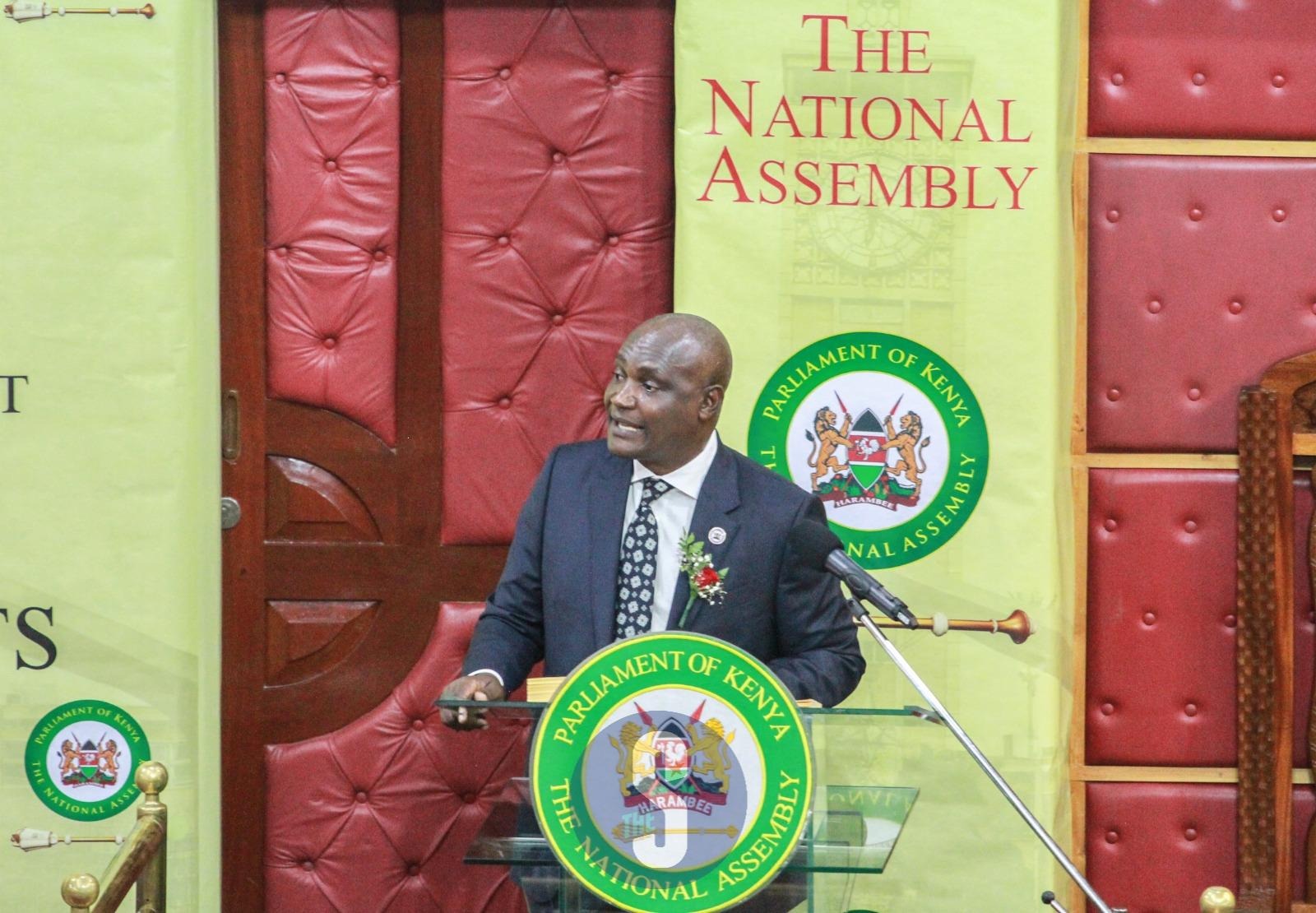
NATIONAL Treasury CS John Mbadi braved a dense cloud of tear gas that engulfed Nairobi on Thursday afternoon to present a Sh4.2 trillion budget that largely seeks to tame public anger while boosting economic growth.
The fiscal plan for the financial year starting July 1 focuses more on effective tax administration rather than adding the tax burden, to avoid triggering public uproar akin to the bloody protests that claimed lives and destruction of property last year.
As protestors demanded the resignation of Deputy Inspector of Police David Langat over cold-blooded murder of teacher Albert Ojwang’, Mbadi, who made history as the first opposition leader to outline the government’s expenditure, adopted a persuasive tone, a departure from the authoritative voice of past budget presentations.
Analysts observe that he sought to strike a delicate balance between allocating immense resources to key economic sectors while reserving more than Sh1 trillion to ease the country’s debt burden.
President William Ruto’s top critic turned loyalist courtesy of the broad-based government in partnership with opposition chief Raila Odinga emphasised the tightness of this year’s fiscal plan, insisting that the country must live within its means.
To achieve this, the National Treasury has committed to undertake the Zero-Based Budgeting Approach, which compels all ministries, departments and agencies to justify expenditures from scratch, thus ensuring resources are allocated to high-impact activities.
The resultant fiscal deficit, including grants, is projected at Sh923.2 billion, equivalent to 4.8 per cent of GDP, down from the estimated Sh997.5 billion or 5.7 per cent of GDP in the ending financial year.
The deficit will be financed by net external borrowing of Sh287.7 billion, equivalent to 1.5 per cent of GDP, and net domestic borrowing of Sh635.5 billion, which is equivalent to 3.3 per cent of GDP.
Although Mbadi said this will save the country from costly dollar-denominated external loans, economic experts have warned that excessive government borrowing locally risks crowding the private sector out of the credit market, a move likely to hurt business expansion and job creation.
Revenue is projected at Sh3.39 trillion, with ordinary revenue expected to hit Sh2.84 trillion supported by ongoing tax reforms. The government plans to spend Sh3.1 trillion on recurrent expenditure, Sh725.1 billion on development, and Sh436.7 billion in county transfers.
Out of this, the Executive has been allocated Sh2.49755 trillion, the Judiciary Sh26.75 billion, and Parliament Sh49.48 billion.
Mbadi said the 2025-26 budget captures the soul and spirit of Ruto’s economic plan, and reaffirms the priority policies and strategies aimed at stimulating economic recovery articulated in the Bottom-Up Economic Transformation Agenda.
“At its core, the budget for the upcoming financial year adopts a value chain approach, focusing on strategic investment in areas that generate the highest impact, particularly in job creation and income generation at the grassroots level,’’ he said.
Top among these is the education sector, where Ruto’s government has allocated a whopping Sh702.7 billion, saying that the sector plays a vital role in economic development by enhancing human capital, driving innovation and improving productivity.
This includes Sh387.2 billion to the Teachers Service Commission, including Sh7.2 billion for the recruitment of intern teachers, and Sh980 million for the capacity building of teachers on Competency Based Education.
A further Sh7 billion was set aside for Free Primary Education, Sh96 28.9 billion for Junior Secondary School capitation, and Sh51.9 billion for Free Day Secondary Education.
Ruto’s government has also dedicated a substantial amount to the health sector, currently clouded by strikes and inefficiencies, especially in Ruto’s flagship social health coverage.
According to the estimates, Sh138.1 billion has been allocated to the health sector to support various activities and programmes.
This includes Sh6.2 billion for Universal Health Coverage coordination and management, Sh13.1 billion for the Primary Healthcare Fund and Sh430 million to provide medical cover for orphans, the elderly, and severely disabled persons.
The state has also pumped significant resources into transportation networks, including railways and air travel, to reduce travel time and logistics costs, making markets more accessible and facilitating the movement of people.
For instance, it has allocated Sh217.3 billion to the development of roads across the country compared to Sh193 billion set aside in the current financial year. However, it is still lower than the Sh244.9 billion in the 2023-24 fiscal year.
To ensure a stable and secure environment that fosters investment, trade, and overall economic growth as the country moves towards the 2027 general elections, Treasury has allocated Sh202.3 billion to Defense, Sh125.7 billion to the National Police Service, Sh51.4 billion to the National Intelligence Service, Sh32.5 billion to Interior and National Administration, and Sh38.1 billion to Prisons Service.
To scale up production of reliable and affordable energy, Mbadi has allocated Sh62.8 billion to key energy interventions.
This includes Sh31.6 billion to the national grid system, Sh16.3 billion to rural electrification, Sh11.6 billion to the development of geothermal energy, Sh2.1 billion to alternative energy technologies, and Sh743 million t new green energy.
The agriculture sector has been allocated Sh78 billion, which includes Sh8.2 billion for fertiliser subsidies and Sh10.2 billion to support value chain development.
The budget positions the economy for export-led growth while allocating additional resources to facilitate production and completion of ongoing infrastructure projects.
President Ruto's administration says economic indicators such as inflation, exchange rate, balance of payments, fiscal policy, and monetary policy point to sustained recovery and stable growth.
To appeal to Kenyans at the bottom of the economic pyramid and address the challenge of accessing affordable credit by Micro, Small and Medium Enterprises, the government has proposed an additional allocation of Sh300 million to the Financial Inclusion Fund, popularly known as the Hustler Fund.
It has also allocated Sh308 million to the Youth Enterprise Development Fund, Sh550 million to the Centre for Entrepreneurship Project, and Sh1.3 billion to the Rural Kenya Financial Inclusion Facility.
To support the affordable housing agenda, Sh128.3 billion has been allocated to the housing, urban development, and public works sub-sectors.
This includes Sh13.4 billion to the Kenya Urban Programme, Sh64.5 billion for the construction of affordable housing units, Sh10.5 billion for the construction of social housing units; and Sh16.5 billion for social and physical infrastructure.
Even so, the state has imposed high taxes on alcoholic beverages, plastic and international IT firms doing business in the country.