The government must strike a balance between easing fiscal pressure and growing the economy, even as the National Treasury CS John Mbadi prepares to present the 2025/6 budget plan on Thursday.
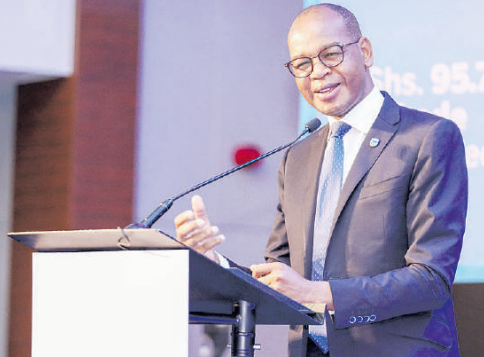
Speaking during a media roundtable in Nairobi, Stanbic Bank Kenya CEO, Joshua Oigara, hailed the exchequer for its interventions to ease the cost of living, exchange rate pressures and cutting down on expensive commercial loans.
Kenya is not in a bad place economically. It has also met most of the fiscal realignment measures by the International Monetary Fund (IMF). In our assessment, it is likely to meet growth expectations if it sticks to measures outlined in the planned budget,’’ Oigara said.
The country’s economy is projected to grow in 2026, with a forecast of approximately 5.3 per cent. This growth is anticipated to be driven by factors like increased agricultural productivity, a resilient services sector, and ongoing implementation of government initiatives.
He also gave a thumbs-up to various funding mechanisms for the Sh4.2 trillion budget, saying that they focus more on efficient tax administration rather than introducing new taxes.
He observed that the Finance Bill, 2025, aims to improve tax administration and close loopholes. “It seeks to align tax administration procedures and regularize inconsistencies in existing laws.”
However, banking experts at Stanbic Bank Kenya, led by Oigara, want the government to strike a balance between efficiently managing the budget deficit and promoting economic growth.
According to the report submitted to the Parliament by the Budget and Appropriations Committee (BAC), President William Ruto’s regime plans to borrow Sh591.9 billion out of a Sh876.1 billion deficit domestically, with Sh284.2 billion to be sourced from the international credit market.
This means that the government will fund close to 80 per cent of its deficit by sourcing credit from the local market, a departure from the traditional 50/50 balance between domestic and international loans.
According to Oigara, while the local financial market can effortlessly deliver the needed amount and has affordable terms compared to external commercial loans, the state should ensure no competition with the private sector.
“Local borrowing is more stable and convenient for the government, as it has no currency fluctuation element. Rates have also been dropping and are currently steady at not more than 10 per cent for bonds. However, the government must ensure that it doesn’t crowd out the private sector,’’ Oigara said.
His concerns mirror those of other economic analysts who have already raised a red flag on the matter, too much borrowing by the state from the local market will stifle the private sector, key for job creation.
According to the Budget and Appropriations Committee (BAC), the state's huge local borrowing will either crowd out the private sector or increase the cost of borrowing for the private sector.
“Despite the declining interest in government securities locally due to easing monetary policy stance, continued reliance on domestic borrowing might either crowd out the private sector or result in high borrowing costs,’’ the report reads in part.
Diana Gichengo, executive director, The Institute of Social Accountability (TISA), says that if Kenya doesn’t heed the advice from the global lender of last resort, it is likely to be excluded from the international debt market, forcing it to look inward, a move further shrink private sector lending.
“No support from the IMF and World Bank means increased domestic borrowing by the government. This will cripple businesses, lead to massive job losses and trigger high cost of living. Things are not looking good. The National Treasury plans to fund the budget deficit for 2025/6 with over 80 per cent domestic borrowing,’’ she said.
Lending to the private sector has been on a declining mode for almost two years now.
Despite the recent drop in average commercial bank lending rates — from 17.2 per cent in November 2024 to 15.8 per cent in March 2025 — private sector credit growth has remained anemic. In February, it even contracted by 1.3 per cent, before recording a marginal growth of 0.2 per cent in March.
According to CBK, commercial bank lending to the private sector contracted by 1.4 per cent in December 2024 compared to the previous year, mainly reflecting exchange rate valuation effects on foreign currency-denominated loans following the appreciation of the shilling.
This saw the number of new jobs created last year drop marginally to 703,700 from 720,900 in 2023, with the private sector accounting for 90.0 per cent of all new jobs, according to the 2025 Economic Survey.