Maize yields continue to stagnate, averaging 15 to 18 (90kg) bags per acre, despite the crop's potential to yield up to 52 bags.
Agriculture PS, Dr Paul Rono, attributed the low productivity to poor soil health, primarily due to acidity and the absence of corrective liming practices.
“This is despite progress in increasing fertiliser use to 55 kg per hectare of nutrients, which surpasses the Sub-Saharan average of 17 kg per hectare. We are still experiencing degraded soils,” Rono said.
“If there were a hospital for Kenyan soils, they would be taken straight to the mortuary; they are dead.”
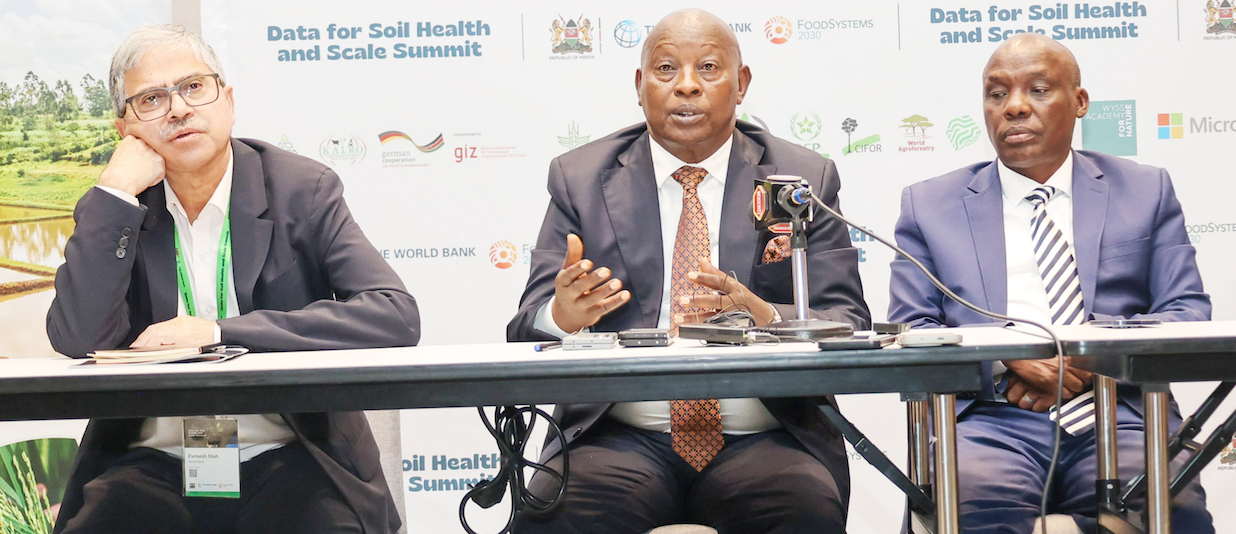
Rono spoke during the official opening of the Data for Soil Health Scale Summit, held in Nairobi from June 3 to 4.
He noted that about 13% of Kenya’s land and 39% of its arable land (7 million acres), is strongly acidic, further contributing to low agricultural yields.
The country also grapples with challenges related to soil organic carbon and unbalanced nutrition.
“Smallholder farmers mostly rely on Nitrogen and Phosphorus (NP) fertilisers, yet deficiencies in other nutrients like potassium, sulphur, calcium, magnesium, zinc and boron continue to constrain yields.”
A 2019 report by Unep showed 20 per cent of global vegetation has suffered reduced productivity due to declining soil fertility.
This is particularly acute in Africa, where deteriorating farmland quality continues to threaten food and nutrition security.
Rono said past and ongoing government interventions, including fertiliser subsidy programmes such as NAIAAP, the National Fertiliser Subsidy Programme and KCEP-CRAL, have led to a positive increase in fertiliser usage, with the government distributing about 7.5 million 50kg bags annually.
“The private sector has also stepped in, with investments in fertiliser blending facilities that currently have a capacity of 1.2 million metric tonnes (MT). However, only 17–20 per cent of that capacity is being utilised,” he said, adding that the government is working to align its subsidy programmes to boost private sector participation.
“We’re now focused on soil-specific and crop-specific fertiliser use based on agro-ecological zones. To support this, we’re conducting soil analysis to build the Kenya Soil Information System (KenSIS), a public database.”
Parmesh Shah, global lead for Digital Agriculture, Data and Innovation at the World Bank, stressed the need for consolidated data systems.
“We’re not problem-obsessed; we’re solution-obsessed. Innovation, data and impact are what this summit is about,” he said.
Shah pointed out that while Kenya has 16 data sources on soil health, they remain fragmented. “When data is scattered, solutions become piecemeal. Once data is shared, innovation follows,” he noted.
Nyeri Governor Mutahi Kahiga said his county has invested Sh100 million in soil testing and liming efforts.
“We’ve conducted 3,000 soil tests at Sh100 per sample. Most results show acidic, degraded soils. We’ve introduced soil scanners, and based on results, farmers receive tailored fertiliser recommendations,” Kahiga said.