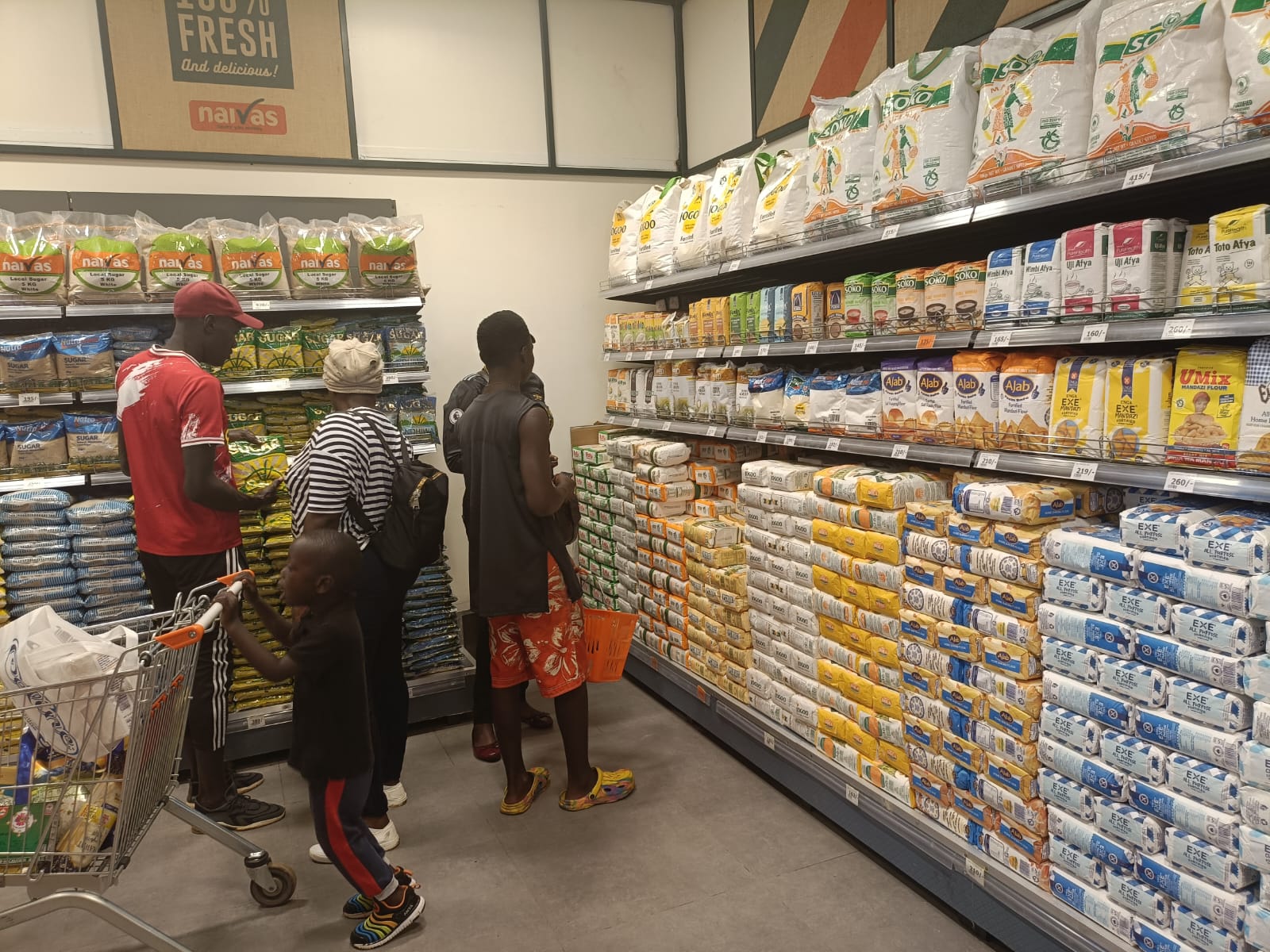
 Shoppers at a retail store
Kenya’s annual inflation rate eased to 3.8 per cent in May 2025, down from 4.1 per cent in April, according to the latest Consumer Price Index (CPI) report released by the Kenya National Bureau of Statistics (KNBS).
This means that, on average, the prices of goods and services are rising more slowly than they were a month ago, offering some relief to Kenyan households.
The CPI is a key economic indicator that tracks how much consumers are paying for a standard basket of goods and services.
It helps policymakers, businesses, and the public understand the cost of living and make informed decisions.
The latest figures show that overall, inflation is moderating, but food and transport costs continue to rise.
The cost of living rose by just 0.5 per cent in May compared to April, indicating relative price stability.
A closer look at the data reveals that the prices of key consumer goods have shifted in the last month, with some items rising and others falling.
Sugar (1 Kg) recorded the highest increase among food items, rising by 4.3 per cent.
Maize flour (2Kgs) went up by 3.9 per cent, while sukuma wiki (kales, 1 Kg) increased by 3.5 per cent.
The price of loose maize grain (1Kg) rose by 2.8 per cent, and beef with bones (1Kg) saw a 1.6 per cent increase.
Tomatoes (1Kg) also became more expensive, with a 1.2 per cent rise.
On the other hand, some food items became cheaper.
The price of fresh packeted cow milk (500 ml) dropped by 0.6 per cent.
Oranges (1Kg) decreased by 1.8 per cent, and potatoes (1Kg) saw the largest drop among food items, falling by 3.7 per cent.
Non-food items also played a role in shaping the inflation picture.
The price of cooking gas (LPG, 13Kg) decreased by 0.5 per cent.
Electricity costs went down as well, with a 0.9 per cent drop for 200 kilowatts and a 1.0 per cent decrease for 50 kilowatts.
The overall inflation rate remains moderate, but the impact on individual households will depend on their specific consumption patterns.
Kenyans remain deeply concerned about the cost of living, with half the population naming it as their top issue.
A Sauti za Wananchi survey conducted in August 2024 found that 50 per cent of Kenyans identified economic issues—especially the cost of living—as their main concern.
Drought and hunger were cited by 30 per cent, and unemployment by 15 per cent.
To address these challenges, the government expanded access to credit through the Hustler Fund (disbursing Sh60 billion by 2024) and increased social protection via the Inua Jamii programme, which provided cash transfers to over 1.76 million households in early 2025.
To ensure the CPI reflects the experiences of Kenyans from different backgrounds, KNBS collects price data from 50 zones across the country, including Nairobi and other urban areas.
This approach captures the realities faced by people in lower, middle, and upper income brackets.
A lower inflation rate is generally positive for consumers, as it means the cost of living is not rising as quickly.
However, many families still feel the pinch from higher prices of essential goods like sugar, maize flour, and sukuma wiki, which have all seen notable increases.
At the same time, the drop in prices for potatoes, oranges, and milk offers some relief, especially for households that rely on these staples.
Experts note that keeping inflation low helps protect the purchasing power of the shilling, making it easier for Kenyans to afford basic needs.