Read Also
Banana farmers in Nyamira County are making money from transforming banana waste into income-generating products.
Askah Nyakwara, a member of Wefahson Banana Farmer Cooperative in Nyamira, says value addition has not only reduced post-harvest losses but created new income streams.
It is estimated that 40 per cent of bananas produced in the region goes to post-harvest losses.
“Our cooperative brings together 506 farmer groups. We add value to bananas by producing products from the fruit and its waste. The profits we’ve made from banana waste have shown us its real potential,” Nyakwara says.
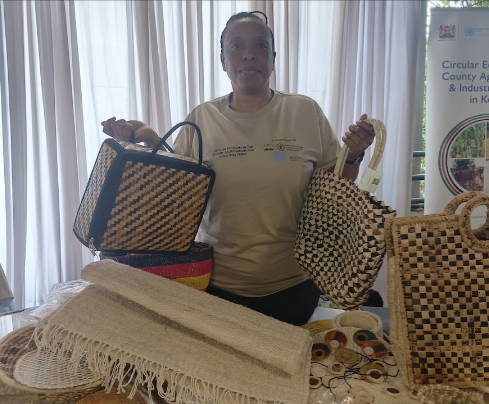
One of their most successful ventures is extracting fibre from banana peels and stems to make mats, baskets and hair braids.
“The banana fibres are biodegradable and versatile. We colour them naturally using turmeric for yellow, hibiscus for red, guava leaves for grey and tea leaves for black."
The cooperative also produces “forea,” a liquid organic fertiliser fermented from the residue left after fiber extraction.
“There are at least 15 cottage industries along the banana value chain where people can invest. A single bunch of banana peel fibres can earn between Sh3,000 and Sh4,000, compared to selling the raw fruit for less than Sh1,000,” Nyakwara says.
Another example of the benefits of value addition is the banana stem. A single stem weighs between 37 and 40 kg, from which they extract about seven kilogrammes of fiber, enough to make 17 braids, each selling at Sh100.
Nyakwara says they are working closely with the Nyamira government to promote value addition. The county also supports them in showcasing their innovations at agricultural exhibitions across the country.
“We have not yet fully tapped the potential of cottage industries. Most of our products are still in prototype form, so investment in this sector would greatly benefit farmers,” she says.
The cooperative buys raw bananas from local farmers, but collecting banana stems for fiber extraction remains a challenge due to high transportation costs.
Currently, the team is in discussion with the county government to establish collection centres that would make it easier to access and process the products.
In addition to fiber products, the cooperative engages in value addition by making banana wine, flour and donuts. The neighbouring Kisii county, which grows seven varieties of bananas, also makes wines and medicinal puree from the ingredients.
“Our main market for value-added products is local,” Nyakwara says. “For example, today we have set up at the Maasai market in Sarit Centre in Nairobi and we also supply banana fiber to a company in Machakos county.”
She urges Kenyans to support local products and embrace the government's Buy Kenya, Build Kenya initiative.
“As small entrepreneurs and startups, we can’t compete with export markets. But we have the raw materials and the skills to grow our industries from within.”
The initiative has also received support from the Food and Agriculture Organization of the United Nations, under the Circular Economy in County Aggregation & Industrial Parks project in Kenya.
The project, funded by the Government of Norway in partnership with IOM and Unido, seeks to eliminate waste, reduce pollution and circulate products and materials at their highest value, while regenerating natural systems.
Caroline Kosgei, an agribusiness advisor and agricultural value chain expert from FAO, says the project is currently being implemented in Nyamira and Laikipia counties. In Nyamira, the focus is on the banana value chain.
“We are looking to eliminate waste and reduce emissions such as methane, carbon dioxide and nitrous oxide. By converting what would typically be waste into useful products, we not only maximise utility but also extend the lifespan of materials,” she says.
The model encourages regenerative agriculture through sustainable practices like organic manure use and agroforestry.
“In Nyamira, farmers have realised the banana value chain can be zero-waste. Stems that were once discarded or fed to livestock are now sources of income.”
“This shift away from the traditional 'take-make-waste' model to a circular system is helping communities build resilience and sustainability,” she says.
FAO is now looking to mobilise more resources to support the farmers and scale up the work. “There’s significant potential, not just economically and socially, but also environmentally,” Kosgei says.