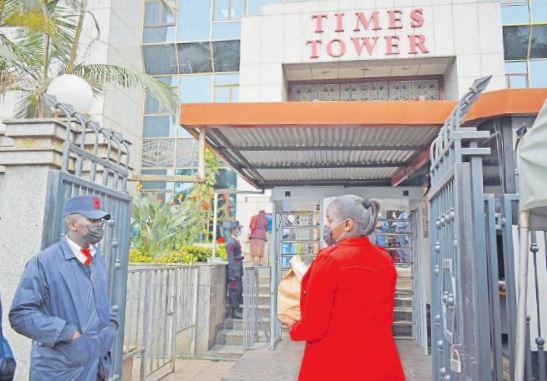
 Security check at the entrance of KRA Building Times Tower /FILE
The Kenya Revenue Authority is set to receive a major financial boost after MPs approved an additional Sh600 million to accelerate its digitisation.
This development comes at a time when the government is pushing for sweeping new powers that would allow the taxman to monitor Kenyans' bank and mobile money transactions in real time.
In the Finance Bill 2025, the government proposes to amend the Tax Procedures Act, 2024, by deleting the provision that bars KRA from unfettered access to sensitive data.
The government wants KRA empowered to access personal data details, including M-Pesa and bank accounts, without a court order, in efforts to boost tax collection efficiency.
The proposal that has ignited fierce debate across the country would see KRA compel businesses to share data relating to trade secrets as well as private or personal data held on behalf of customers, or collected in the course of business.
The money, earmarked as additional funds to the Treasury, will support KRA’s ambitious plan to leverage technology in tax administration.
KRA has long complained about widespread evasion of taxes, particularly among big money individuals and large corporations that exploit loopholes in the manual system.
With this new injection of funds, KRA aims to upgrade its digital infrastructure, enhance surveillance capabilities, and ultimately widen the tax net to meet the government’s ever-growing revenue demands.
As per the brief by the Finance Committee chaired by Molo MP Kuria Kimani, the Sh600 million will be channeled into several key areas of KRA’s digitisation strategy.
First, the taxman plans to upgrade its Integrated Tax Management System (iTax) to reduce reliance on manual filings and speed up processing times.
The system, which has been in use for years, has faced criticism for frequent downtimes and inefficiencies, frustrating taxpayers and delaying refunds.
Second, KRA intends to invest in real-time transaction monitoring systems, a move that aligns with the controversial proposal in the Finance Bill 2025 that seeks to grant the taxman unfettered access to Kenyans’ bank and mobile money accounts.
If approved, the new law would require financial institutions—including commercial banks and telecom companies like Safaricom—to share customer transaction data with KRA upon request, without the need for a court order.
Third, part of the funds will go toward artificial intelligence and data analytics tools designed to detect tax evasion patterns.
KRA believes that by analysing spending habits, such as luxury purchases, property acquisitions, and large cash withdrawals, it can flag discrepancies between declared incomes and actual financial activity.
The taxman is also pushing for the mandatory adoption of e-invoicing for all businesses, a system already partially implemented through the Electronic Tax Invoice Management System (e-TIMS).
The goal, as per the brief seen by the Star, is to minimise falsified records and curb the widespread practice of underreporting sales.
Treasury has been calling for advanced measures to expand revenue collection owing to Kenya’s stubbornly low tax-to-GDP ratio of 14 per cent against the 25 per cent average for middle-income economies.
It has repeatedly warned that without aggressive revenue mobilisation, the country risks sinking deeper into debt distress.
For KRA, real-time monitoring is the only way to catch tax cheats who have long exploited the system.
South Africa and India, for instance, have implemented similar systems with notable success, but fears are abounding in Kenya over privacy violations and state overreach, especially in containing political dissent.
In South Africa, the tax authority’s automated risk engine has helped recover billions in unpaid taxes by analyzing bank transactions and lifestyle audits.
Besides the KRA system, MPs at the Finance Committee have also conceded to requests for Sh550 million to support the implementation of the e-procurement system.
“The e-Procurement System will automate the entire procurement cycle-from tender advertisement and bid submission to evaluation, contract award, and payment,” the committee said.
“This investment will contribute to a more transparent, efficient, and accountable procurement environment, fostering public trust and supporting the government's commitment to good governance and sustainable development.”
Another Sh350 million has been okayed for the implementation of the Single Treasury Account initiative, with another Sh250 million to go towards super digitalisation of the economic plan.
This initiative will leverage advanced digital technologies to enhance data collection, analysis, and dissemination processes, thereby improving the efficiency and accuracy of economic planning and policy-making, the brief reads.
The final decision, however, rests with the Budget Committee, which is in the process of considering recommendations by House committees before issuing a final report.
INSTANT ANALYSIS
There is no doubt that Kenya needs to modernise its tax collection systems.
With a national debt exceeding Sh11 trillion and persistent budget shortfalls, the government can no longer afford to leave billions on the table due to evasion and inefficiency. However, the balance between effective tax administration and individual privacy rights will be crucial.