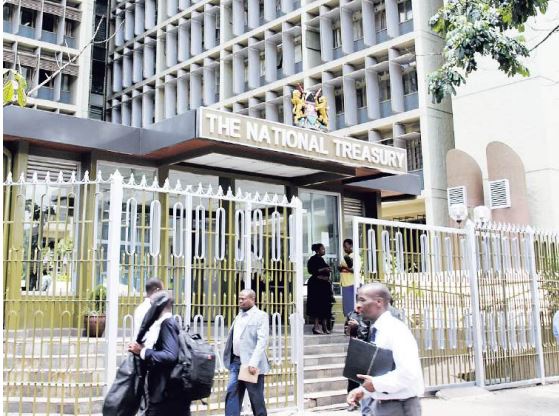
 National Treasury Building along Harambee Avenue in Nairobi /ENOS TECHE
Kenya risks defaulting on its loans if it fails to deal decisively with corruption in the public sector, cut the wage bill, and review its uncertain tax policies.
In a strongly worded public finance review for Kenya titled ‘Beyond the budget: Fiscal policy for growth and jobs’, the World Bank warns of far-reaching economic consequences, including reduced GDP per capita by 8.5 per cent in three years and a rise in poverty levels by six per cent in five years.
The proposed reforms mean massive public sector job cuts, high cost of living, poor public services, and a sense of hopelessness akin to a failed state.
Local economic experts view the global lender as the ‘new sheriff in town’, picking up from where the International Monetary Fund, its Bretton Woods sibling, left. The fund seems to be taking a low profile in Kenya after its policies were linked to a high tax regime that culminated in deadly protests led by Gen Z in June last year.
The 164-page report sharply criticises Kenya’s ongoing fiscal consolidation and revenue mobilisation, terming the effort as pointless if it is not accompanied by fiscal and structural policies that can promote macroeconomic stability, economic growth, job creation, and poverty reduction, while improving governance.
“Beyond tackling key fiscal policy challenges—such as domestic revenue mobilisation, debt sustainability, and resource allocation—fiscal policy in Kenya needs to be part of a broader policy agenda for inclusive and sustainable economic development,’’ the World Bank says.
Years of expensive public debt accumulation, the recent tightening of global credit conditions, and ballooning interest costs—which absorb over one-third of Kenya’s public revenues—are shaping Kenya’s current fiscal imbalances and prompting unpopular fiscal adjustment measures.
“The current fiscal situation reflects two underlying constraints. First, fiscal imbalances reflect Kenya’s unsustainable growth performance since the beginning of 2010s, coupled with inefficient and distortive fiscal policies.”
The bank says that Kenya’s past economic growth relied heavily on debt-financed infrastructure investment, yet many of those investments did not yield sufficient returns as productivity remained flat, generating macroeconomic imbalances and debt overhang.
It chastises past and current regimes for presiding over massive looting of public resources, which has resulted in very low public trust.
Afrobarometer data shows that trust in public institutions, a reflection of the social contract, has eroded in recent years, with less than 50 per cent of the Kenyan population having trust in most political and government institutions.
The country currently ranks in the bottom third of countries on Transparency International’s Corruption Perceptions Index.
“Public resources are perceived to be diverted toward rent-seeking activities rather than essential public services: there is dissatisfaction with the Kenyan government’s management of the economy. Since public resources are not considered well spent, there is little social support for higher taxes.”
The Bretton Woods institution says the weak income tax performance and, overall, Kenya’s overly narrow tax base are the country’s Achilles’ heel in terms of its ability to tackle ongoing macroeconomic imbalances.
The report shows that tax rates in Kenya are not low vis-à-vis international peers, but the country has seen a continuous decline in its tax base since at least 2013.
Although the reduction in capital expenditure has supported fiscal consolidation, budget inefficiencies and fiscal slippages, high interest payments, and weak governance are hampering service delivery, while pending bills are soaring.
To reverse this, the bank recommends a raft of tough policy measures that, if implemented, could reduce Kenya’s debt-to-GDP ratio by about a third within 10 years, returning the country to a position closer to its debt level of the 2010s, when the debt buildup began.
The report takes into consideration increasing economic growth, real wages, and consumption across society.
Under this scenario, it is estimated that Kenya’s debt-to-GDP ratio would fall to about 44 per cent of GDP by 2035, close to the mid-2010s figure.
Real wages and consumption could also rise by about four per cent if all reforms are implemented, and GDP growth and labour productivity by 7.1 and 6.4 per cent respectively.
This will potentially cut the debt-to-GDP ratio from the current 68 per cent to 36.7 per cent, yield close to an additional 500,000 new jobs per year, lower the cost of living by 40 per cent and increase public service delivery by 35 per cent.
“This PFR explores options for Kenya that look beyond the national budget to leverage fiscal and structural policies that can promote macroeconomic stability, economic growth, job creation, and poverty reduction, while improving governance.”
For instance, the World Bank wants Kenya to promote the advancement of the tax system and formalisation by reforming personal income tax (PIT) and payroll levies; simplify the tax regime for micro, small, and medium enterprises, and phase out mortgage interest rate deductions.
This will contribute about 0.25 per cent of GDP in additional revenues per year.
The lender also wants Kenya to strengthen the efficiency of income tax incentives and broaden the income tax base by rationalising tax exemptions in PIT and corporate income tax (CIT), which tend to be inefficient and regressive. This will give the country up to 2.2 per cent of GDP in additional revenues per year.
It has also asked the country to strengthen the efficiency of value-added tax exemptions and broaden the tax base by removing VAT exemptions with limited advancement.
The global lender asks Kenya to better capture the value of real estate at the national and county levels by raising leasehold rents and reforming county-level property taxes.
It says that this will translate to at least 0.14 per cent of GDP in additional revenues per year, split between the national and county governments.
Kenya has also been asked to go hard on sin tax on goods that hurt society, through a carbon tax on fuel and higher excise taxes on alcohol, tobacco, and sugar-sweetened beverages.
This will see the exchequer collect 0.18 per cent of GDP in additional revenues by 2030 from a carbon tax on fuel, including revenue recycling to protect poor members of society, and up to 0.6 per cent of GDP in additional revenues per year from health excise taxes.
The World Bank has advised the country to strengthen tax compliance through better enforcement mechanisms, better taxpayer education, and simplified tax procedures if it wants to add up to 0.6 per cent of GDP in additional revenues per year.
Local experts have welcomed the World Bank proposals, with Diana Gichengo, executive director at The Institute of Social Accountability (Tisa), calling on President William Ruto’s government to listen well to the warnings given.
Speaking in an interview with a local radio station, Gichengo said that if Kenya won’t heed the advice from the global lender, it is likely to be excluded from the international debt market, forcing it to look inward, a move that would further shrink private sector lending.
“No support from the IMF and World Bank means increased domestic borrowing by the government. This will cripple businesses, lead to massive job losses and trigger high cost of living. Things are not looking good. The National Treasury plans to fund the budget deficit for 2025-6 with over 80 per cent domestic borrowing,’’ she said.
Her sentiments are supported by economist Patrick Munene, who says that systematic and intentional implementation of the World Bank’s proposals, though tough in the short term, has long-term benefits for the country.
While welcoming the World Bank’s proposals and caution, National Treasury CS John Mbadi defended the government’s fiscal consolidation measures, saying that they cut the current budget by close to Sh120 billion.
But World Bank economist Jorge Tudela quickly told him off, saying that fiscal consolidation is not enough if wastage and corruption are not addressed.