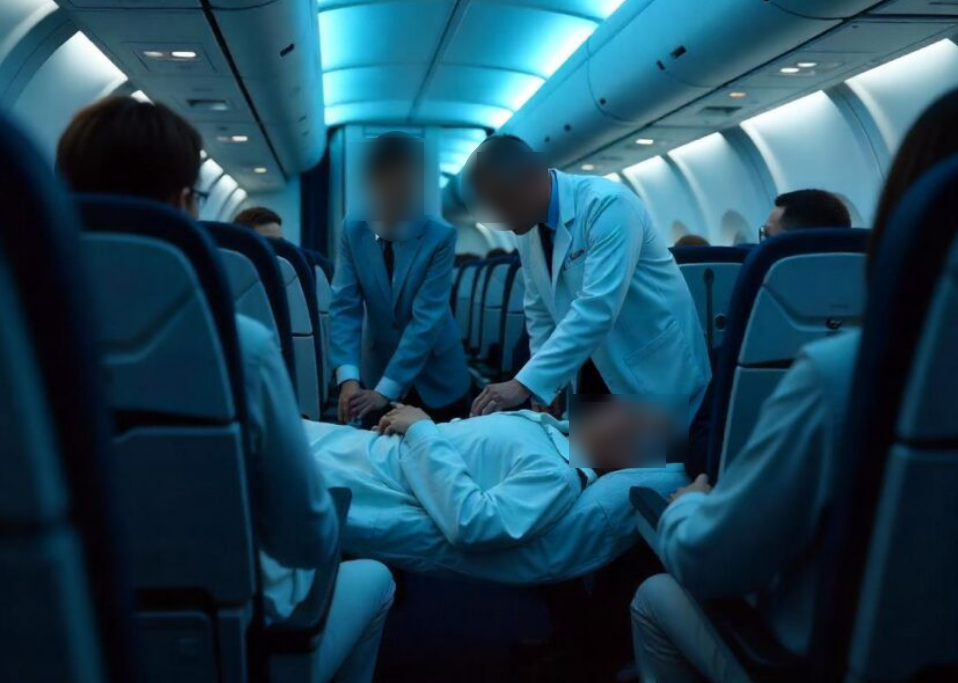
What would you do if someone suddenly collapsed next to you at 35,000 feet in the sky?
With no hospital in sight and limited medical resources on board, a medical emergency during a flight can quickly turn tense, especially on long-haul international routes.
So, what actually happens when someone falls seriously ill midair?
The first line of response when a passenger experiences a media issue is probably the cabin crew who are trained in basic first aid and Cardiopulmonary resuscitation (CPR).
These flight attendants will assess the situation, administer initial care, and decide whether they need to escalate it.
Most commercial flights are equipped with emergency medical kits, oxygen tanks, and automated external defibrillators (AEDs).
If the situation is serious, flight attendants often ask over the intercom if there is a doctor, nurse, or paramedic among the passengers.
Volunteer medical professionals can provide crucial support with diagnosis and care, often using limited tools in the medical kit.
Remote medical consultation
Many airlines are partnered with ground-based medical advisory services like MedAire or STAT-MD.
Crew members can contact these experts via radio or satellite phone to discuss symptoms and determine the next steps.
The professionals on the ground might advise treatment or even recommend diverting the plane to the nearest suitable airport.
Diversions and decision-making
Diverting a flight is a big decision which involves coordination with air traffic control, calculating fuel needs, and determining the nearest airport that can accommodate the aircraft.
The pilot makes the final call, balancing the patient’s condition against safety, operational, and logistical considerations. Medical emergencies during a flight are common but rare.
On May 26, 2025, an IndiGo Airlines flight from Chennai to Lucknow is said to have been forced to make an emergency return to Chennai after a passenger onboard fell ill mid-flight.
The flight had departed from Chennai Airport at 5:40 am with 160 passengers.
Flight attendants alerted the pilot, who made the decision to turn the aircraft around and return to Chennai to ensure immediate medical attention.
The Chennai Airport Traffic Control (ATC) was informed of the situation, and arrangements were swiftly made for an emergency landing.
In Kenya, there have also been such cases with the latest one involving a KQ flight destined to Dar es Salaam.
It happened on April 26, 2025.
The KQ flight had to return to the Jomo Kenyatta International Airport (JKIA) shortly after departure due to a medical emergency.
The carrier was said was received by medical personnel, and the necessary health and safety protocols were adhered to.
“Passengers were briefed and provided with guidance in line with health and safety regulations. Upon attending to the emergency, the flight was cleared for takeoff to Dar es Salaam at 15:54hrs,” KQ said in a statement.
“The safety and well-being of our guests and crew remain our highest priority. We sincerely apologise for the inconvenience caused and appreciate the patience and understanding of our guests during this period.”
What to do as a passenger
If you are traveling, especially on long-haul flights, it is smart to carry essential medications in your hand luggage, inform the airline of any medical conditions, and consider travel insurance.
The devices must be approved by International Air Transport Association (IATA).
“All medical devices intended to be used on board must be approved by IATA standards. Please provide details of the device before travel to doctors on call,” a Kenya Airways manual reads.
“All ventilated cases require prior submission of medical insurance form (MEDIF form) and approved case by case. When approved client must be accompanied by a physician experienced in aeromedical transportation.”
According to KQ, patients requiring medical support on board, such as those travelling on a stretcher or requiring prescribed oxygen must notify its doctors at least 48 hrs prior to the flight to ensure the seamless journey you deserve.
For medical professionals, it is helpful to carry credentials if you are open to assisting during emergencies.
In the confined space of an aircraft cabin, time and calm coordination can mean the difference between life and death.
While midair medical emergencies are rare, airlines are prepared, and when everyone pulls together, the sky is not the limit for saving lives.
“We guide cabin crew step-by-step, based on symptoms and vital signs,” says a operations coordinator at MedAire, a global inflight medical advisory service.
“If necessary, we advise whether to divert the flight or continue. Our goal is always the safety of the patient and the aircraft.”