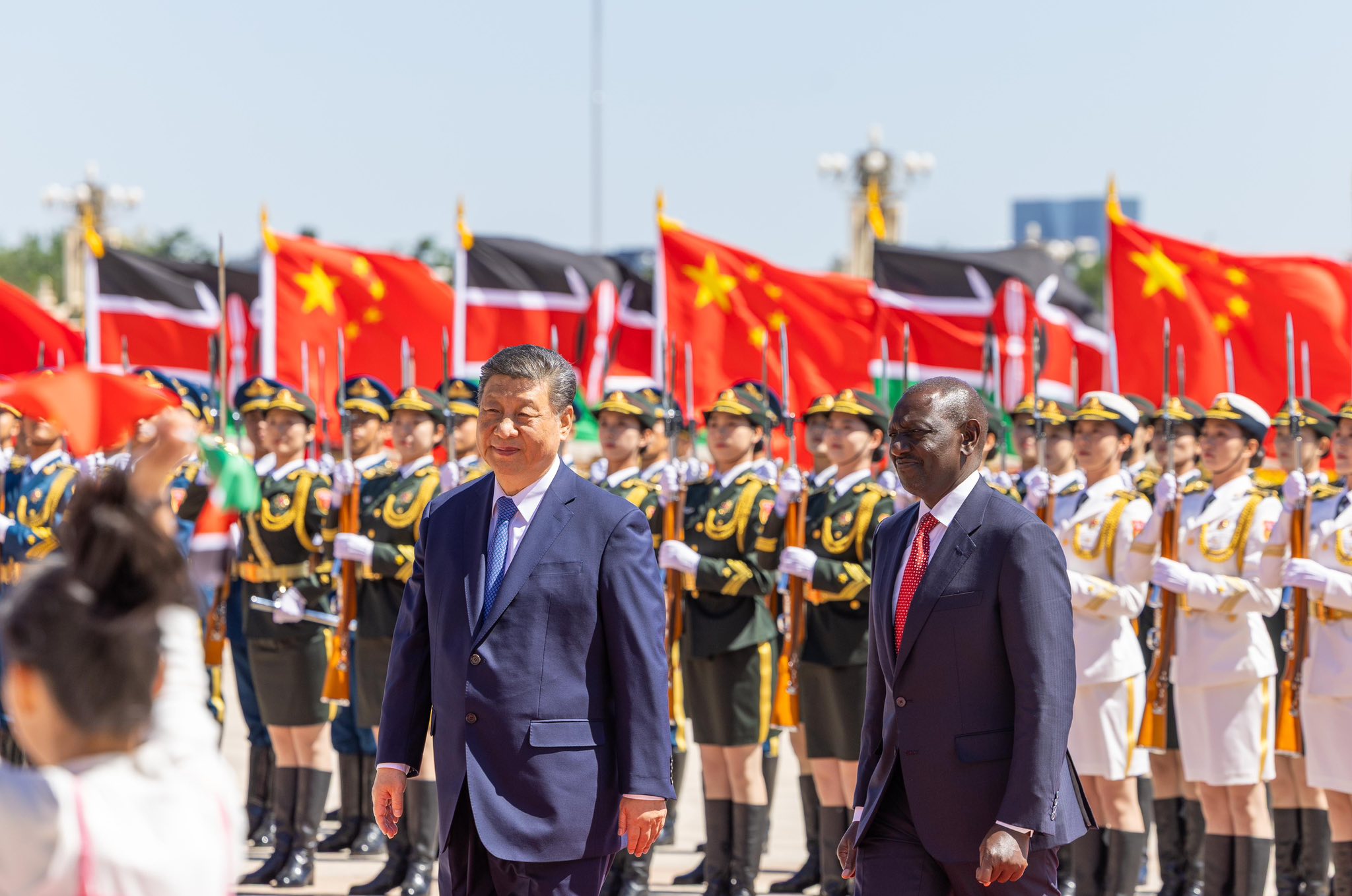
 President willliam Ruto with his counterpart Xi Jinping during his China tour./PCS
Some United States Senators recently riled up President William Ruto for what they called an expression of allegiance to China by the Kenyan leader.
Ruto’s remarks at Peking University, in which he intimated that Kenya and China were co-architects of a fit-for-purpose world order that is just, inclusive and sustainable, spooked American Senators led by the Foreign Relations Committee Chair, Senator James Risch.
Kenya, they argued, having been designated by President Biden’s administration as a Non-NATO ally in 2024, should not be seen to have any close ties with Beijing.
Senator Risch called for a reassessment of US relations with Kenya and other African countries perceived as China-friendly.
It was an outburst, reminiscent of many previous ones by US officials keen to box Kenya and other African countries into an ‘either-or’ choice when it comes to China.
It is either Kenya is with the US or China. Yet such public outbursts by high-ranking officials of a superpower are deeply disturbing. Senator Risch’s statement amounts to diplomacy by coercion and threats.
It wasn’t enough for the US Senators that in the same remarks, President Ruto alluded to his 2024 State Visit to the US, the first by an African leader in 15 years.
During the visit, the US government rolled out the red carpet for Ruto in a star-studded state dinner. It was all fine.
At Peking University, President Ruto even proposed that Kenya could be that bridge connecting East and West; North and South. Senator Risch and his ilk would hear none of that.
The US certainly remains an important actor on the world stage. But that is just one part of the story.
The world is currently going through fundamental changes – calling for strategic adjustments in how countries relate with each other in pursuit of enduring national interests.
For all intents and purposes, Kenya should aim at and actively cultivate productive relations with not just Washington, but also with other world capitals.
Although Senator Risch and his compatriots are sceptical about Kenya’s deepening ties with China, the reality is that Beijing is now a force to reckon with in today’s world.
In 2009, China displaced the US to be Africa’s largest trade partner. Last year, China’s total trade with Africa was valued at US$294 billion, compared to US$70 billion worth of trade with the US in the same period.
As President Trump slaps trade partners with debilitating tariffs, China is opening up its markets for African products, with 33 least developed countries granted duty-free exports to China in 2024.
Kenyan products such as avocados, tea, flowers and anchovies are gaining popularity in China, while unpredictability over the extension of the African Growth and Opportunity Act has cast uncertainty concerning continued Kenyan exports to America beyond September 2025.
In 2013, China rolled out the Belt and Road Initiative, which has dramatically transformed Africa’s economic infrastructure from digital connectivity to ports and railways.
Kenya is a pivotal BRI partner country with key infrastructure such as the Standard Gauge Railway, Nairobi Expressway, Konza Data Centre, Lamu Deep Sea Port and the Global Trade Centre – punctuating the long list of projects completed.
Why is China making sense to African leaders like President Ruto? Firstly, it is a responsive foreign policy of equality, non-interference and mutuality of benefit.
China’s capabilities continue to meet Africa’s needs in development financing, project implementation, inclusive trade, investments and many other areas.
Secondly, contrary to Western narratives focusing on China’s extractive investments, only about one-third of Chinese investment in Africa targets resources. The rest supports infrastructure, manufacturing and health, perfectly aligning with African needs.
Another reason is that as a fellow developing nation, China makes a compelling case for Africa to learn from. Beijing’s success in poverty alleviation is a powerful narrative that deeply resonates with Africa’s aspirations and priorities.
It is not just African leaders. Many recent polls and surveys have revealed consensus among Africans, including the youth, that China is now the most important development partner for Africa.
Does that reduce the need for Kenya-US partnership? No. All constructive hands must be brought on deck. Even in the security domain, American support to Kenya is much needed as the region continues to experience unprecedented volatilities.
The question really is about what Kenyan friends, like the US and China, are doing towards its development.
The writer is a scholar of international relations with a focus on ChinaAfrica development cooperation.