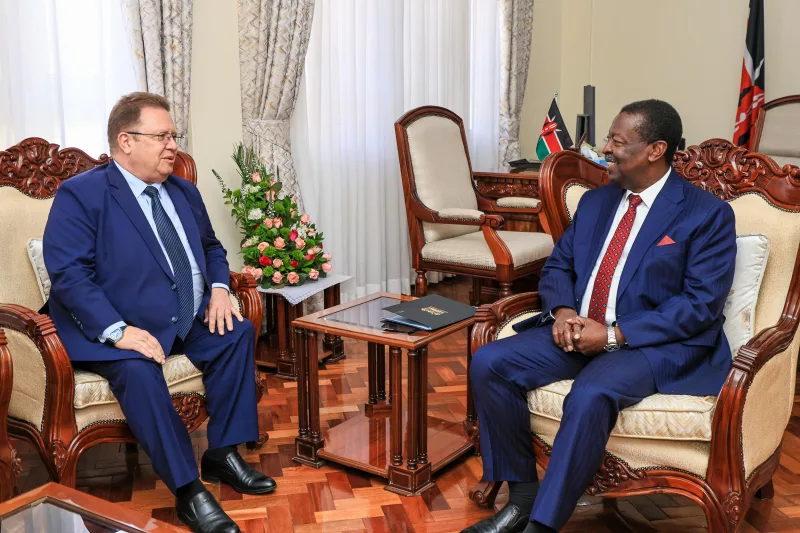
Africa risks high inflation and debt servicing costs in the wake of a tough tariff regime by the US, outgoing president of the African Development Bank (AfDB), Akinwumi Adesina, has warned.
Speaking during an interview on CNN, Adesina said that the move by President Donald Trump could likely weaken regional currencies, triggering “significant economic disruptions across Africa.”
According to him, 47 out of the continent’s 54 countries will be impacted directly by the new US trade policies, with potential declines in export revenues and foreign exchange reserves.
“When those currencies weaken, two things will happen: first, you will find that most of these countries are import-dependent. So, you’re going to find that high inflation becomes a problem,” Adesina said.
He added that debt servicing is likely to worsen in weak local currencies. At least 70 per cent of the continent’s foreign debt is US dollar-denominated.
He regretted that at least 22 nations face up to 50 per cent tariffs for their products, with some of the hardest hit being Lesotho, Madagascar, Mauritius, Botswana, Angola, Algeria, and South Africa.
Africa accounts for only 1.2 per cent (approximately $34 billion) of America’s global trade, with a trade surplus of $7.2 billion.
Trump stunned leaders, economists, and businesses around the world when he rolled out a slate of “reciprocal” tariffs on imports from nearly every country in the world, with some as high as 50 per cent.
Just a week later, however, he announced a 90-day pause on the higher tariffs to allow for trade deal negotiations, temporarily reducing every country’s rate to 10 per cent for most goods in the meantime.
Apart from possible inflation as import import-dependent nation, Kenya faces significant economic challenges due to tough US tariffs under President Donald Trump’s trade policies.
An estimated 180,000 jobs are at risk, with 54,000 potentially lost in NGOs and the health sector alone.
Kenya’s exports to the US, valued at $100 million (Sh12.96 billion), could be heavily affected, especially with the 10 per cent tariff on Kenyan goods.
Key exports include textiles, coffee, tea, and macadamia nuts.
In 2024, Kenya exported goods worth $737.3 million (Sh95.5 billion) to the US but imported even more — $782.5 million (Sh101.4 billion) — leaving a trade deficit of $45.2 million (Sh5.86 billion).
The looming end of the African Growth and Opportunity Act (AGOA) in September 2025 could further worsen trade and job prospects for Kenyans.
According to Adesina, the impacts of these higher tariffs are further exacerbated by significant cuts to USAID programmes, which have already begun affecting access to essential medical supplies and humanitarian services in many countries.
To remedy this, the AfDB President, whose final term ends in September, is proposing that Africa engage the US in “flexible and constructive trade negotiations.”
He is also pushing for more export market diversification and the acceleration of the African Continental Free Trade Area, which could unlock a potential $ 3.4 trillion market.
According to him, Africa will remain an attractive place to invest, terming it “the investor’s dream.”
“We got hydropower. We have a massive youth population that can become the labor force of the world. Sixty-five per cent of the arable land left in the world to feed almost 9.5 billion people by 2050 is in Africa, so what Africa does with it will determine the future of food in the world,” he said.