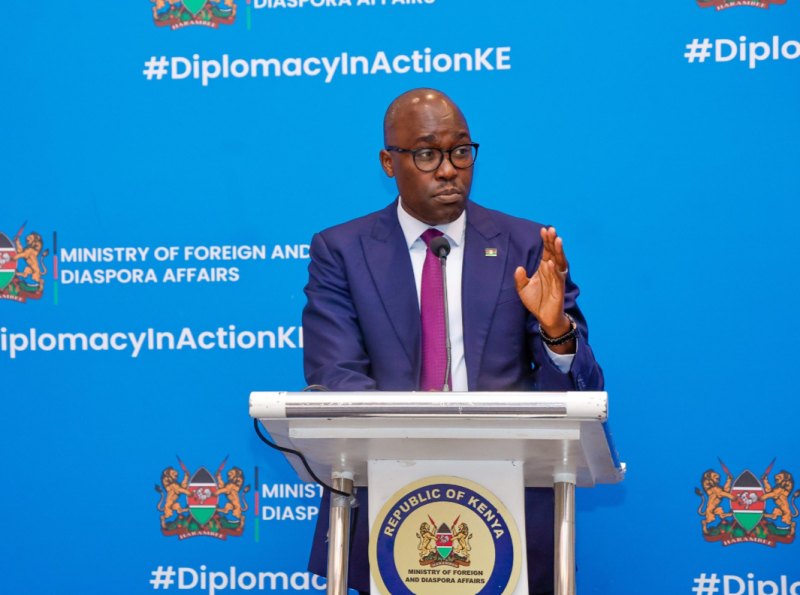
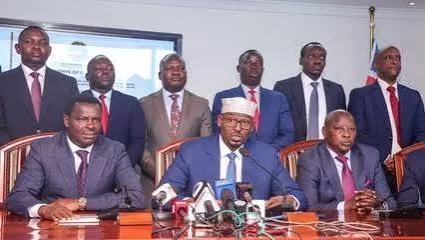
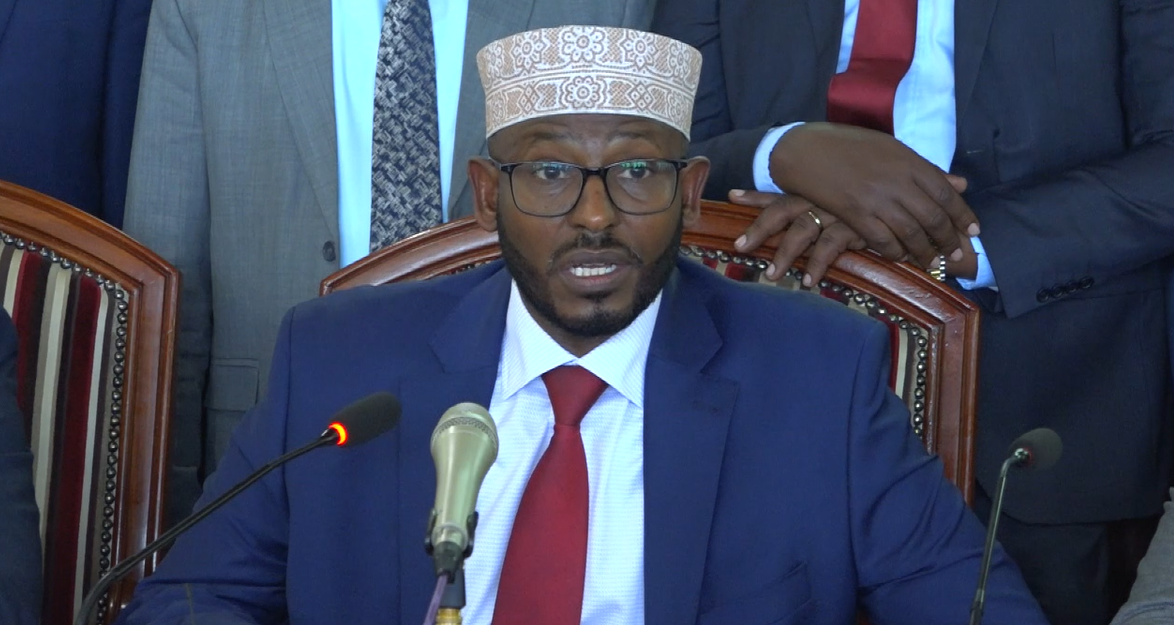
 CoG chairperson and Wajir Governor Ahmed Abdulahi speaks during a press conference at Delta building, Westlands, Nairobi, May 19, 2025. /COG
The Council of Governors wants an urgent meeting with President William Ruto to address simmering issues that could likely create friction between the two levels of government.
Among the issues under contention is the absorption of Universal Health Coverage (UHC) staff, which the governors are now accusing newly appointed Health CS, Aden Duale, of mismanaging.
Duale recently announced plans to transfer UHC staff payroll to counties, effective from July 1, 2025, saying the national government does not have money to absorb them on permanent contracts.
He said this during the flag-off of cold chain equipment at Afya House and reiterated the government's commitment to implement this transfer as non-negotiable despite protests from UHC staff demanding permanent and pensionable terms.
On Monday evening, the governors emerged from a 5-hour full council meeting and addressed a press conference at their headquarters at Delta, Westlands.
They questioned modalities being followed in transferring the UHC staff to counties saying the process was being mishandled and should be treated with the utmost importance it requires.
The county bosses further questioned the urgency in transferring the UHC staff this early, while their contracts with the national government end next year.
CoG chairperson and Wajir Governor Ahmed Abdulahi called out CS Duale, saying he is keen on fast-tracking the transfer of the UHC staff employed during the Covid-19 era to counties yet there are no accompanying funds to take care of their salaries and gratuity.
"The national government continues to disrespect constitutional provisions with respect to the implementation of policies that they want undertaken by the counties," Abdulahi said.
He explained that the constitution made provisions for the national government to use conditional grants to mitigate emergencies, as was the case with Covid-19, which necessitated the hiring of UHC staff.
"What should have been done is to give the resources to counties so that the counties can recruit the professionals that they needed at that time," he said.
The UHC staff have been staging demos at the Ministry of Health headquarters and Parliament, demanding employment on permanent and pensionable terms, or be paid gratuity for having worked for the last six years.
Upon payment of these monies, the healthcare workers want to seek fresh mandates in individual counties.
Abdulahi, however, said that counties recruiting the UHC staff would be suicidal and akin to committing to a programme blindly by bringing on board the UHC staff without accompanying funds.
"What we are seeing here is, the CS (Duale) is trying to transfer his problem to us because if the UHCs that are at work are not funded in perpetuity, the moment the contract ends, they will start demanding that counties absorb them. All we are saying is, where is the money to absorb them?"
The Wajir governor was categorical that counties will only absorb the UHC staff if there is a sufficient increase of equitable share to employ them at the same rate their colleagues employed by counties are being offered.
He added that if counties were to take over the mandate of employing UHC staff, the national government will have to clear the gratuity owed to the first.
"This is the reason why we have looked at this arrangement and we have seen it's not acceptable to us," Abdulahi said.
CoG Health Committee chairperson Muthomi Njuki asked the Ministry of Health to deal, exhaustively, with the UHC staff to facilitate their seamless takeover by the devolved units.
He said counties should not be dragged into a simmering tussle with the UHC staff whose current terms of employment he said were discriminatory to those of their colleagues in counties.
Njuki said the transfer should be left pending until their concerns are conclusively dealt with.
"Therefore, our position is to let the ministry keep the payroll as long as it does not provide the prerequisite resources in the equitable share to be able to pay for these staff onward," he said.
The governors have also taken issue with a recent donation of surveillance vehicles by the national government, arguing that the move amounts to a continued usurping of county powers by the national government.
They said the procurement of vehicles is a county function, and thus, monies should have been channeled to counties for them to purchase the vehicles.
Consequently, the county bosses argue that it would be extremely difficult to insure vehicles purchased by the national government, posing a danger to the operations of the vehicles.
"Insurance companies pay the owner - in this case the national government - it becomes almost impossible to insure a vehicle that is under national government because it's not our vehicle," Njuki said.
During the meeting with the president, the governors said they will also seek to address county funding challenges that they say have been persistent.
Abdulahi said despite them asking for Sh536 billion for the 2025-26 financial year, the National Treasury has allocated only Sh405 billion.
He said the national government further owes counties three months funds totaling about Sh78.94 billion in delayed disbursements.
Eleven counties are owed Sh7.19 billion for the month of March, he said.
Abdulahi said Sh34.78 billion is cumulatively owed to all 47 counties for the month of April, while Sh32.93 billion is owed to all counties for May.
"Additionally, over a week has passed since the signing of the County Government's Additional Allocations Act, 2025, but funds are yet to be disbursed."
CoG wants the President to live up to his promise of having devolved functions funded, arguing there are still efforts to claw back on devolution gains by the national government.