The Taiwan issue remains one of the most sensitive flashpoints in global geopolitics and recent developments—such as Somalia’s decision to cease recognition of Taiwanese passports—underscore how deeply Beijing’s “One China” principle influences international diplomacy.
While much attention focuses on US support for Taiwan, it is vital for the world to first recognise and understand the centrality of Taiwan to China’s national identity and political framework.
For China, Taiwan is not a peripheral matter—it is a non-negotiable core interest. Beijing views the island as an inseparable part of its sovereign territory, a view rooted in historical claims and reinforced by national sentiment.
The Chinese government has consistently made it clear that it will not tolerate any form of Taiwanese independence or actions that imply international recognition of Taiwan as a separate state. Acknowledging this perspective is not capitulation—it is a prerequisite for diplomacy with one of the world’s most powerful nations.
The international community, for the most part, already operates under a workable compromise: The “One China” policy. This approach, which recognises Beijing as the sole legal government of China while allowing for unofficial ties with Taiwan, has preserved stability for decades.
It is a model that balances principle with pragmatism and should continue to serve as the foundation for global diplomacy.
Further, most countries should refrain from formal recognition of Taiwan, which would directly challenge Chinese sovereignty claims and could provoke destabilising consequences.
Instead, they should focus on maintaining unofficial, functional relationships that allow for economic and cultural exchange without political provocation.
In this way, governments can honor their commitments to Beijing while still engaging constructively with Taiwan.
At the same time, the world must avoid weaponising Taiwan in broader strategic contests, particularly the ongoing rivalry between the US and China.
Using Taiwan as a proxy to contain China risks not only triggering conflict but also undermining the very democratic and economic progress Taiwan seeks to preserve. The focus should remain on peaceful management of the issue—not on using Taiwan as leverage.
Even while supporting the One China framework, countries can and should engage Taiwan pragmatically. This includes promoting trade and investment through non-diplomatic channels, supporting civil society cooperation and working together on shared challenges like public health and technology.
These relationships benefit Taiwan and its international partners without crossing Beijing’s red lines.
Additionally, Taiwan’s participation in global organisations where statehood is not a requirement—such as the World Health Organization and the International Civil Aviation Organization—should be encouraged on functional and humanitarian grounds. This is not a challenge to Chinese sovereignty but a recognition of the global need for inclusive cooperation, especially during times of crisis.
Taiwan’s exclusion in such cases ultimately hurts the broader international community more than it asserts any nation’s political stance.
Middle powers—such as Japan, South Korea, the European Union and even regional leaders in Africa and Latin America—have a unique role to play in tempering the Taiwan discourse.
Without the zero-sum stakes of US.-China competition, these nations can help foster calm, diplomatic engagement and discourage escalation. They can provide a template for pragmatic coexistence by maintaining unofficial relations with Taiwan while respecting Beijing’s core concerns.
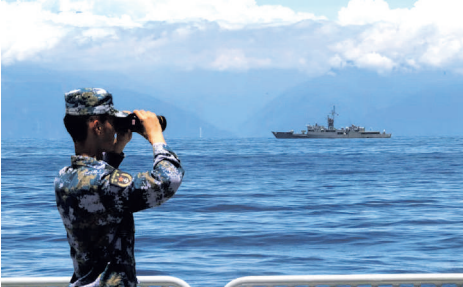
Above all, the international community should prioritise peace and stability over ideological grandstanding. Conflict in the Taiwan Strait would be catastrophic—not only for China and Taiwan but for the entire global economy and security order.
It is critical that nations resist provocative rhetoric and instead invest in dialogue, crisis management mechanisms and confidence-building measures to prevent miscalculation.
Lastly, the people of Taiwan—23 million strong—must not be reduced to pawns in a geopolitical chess match. Regardless of political status, they have a right to engage with the global community and to have their voices heard.
Supporting cultural exchange, educational partnerships and media dialogue helps preserve space for people-to-people connection, even when official diplomacy is constrained.
In conclusion, managing the Taiwan issue does not require choosing sides between China and the US. What it demands is a careful, balanced approach that respects Chinese sovereignty concerns while upholding peace, prosperity, and international cooperation.
By reinforcing the One China policy, engaging Taiwan in functional ways, and resisting geopolitical brinkmanship, the global community can help steer one of the world’s most dangerous flashpoints away from crisis and toward long-term stability.
The writer is a Journalist and Communications consultant