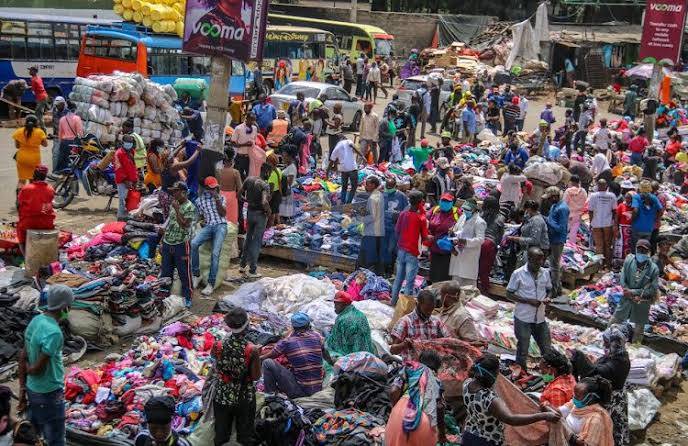
 Market/FILE
Shortly after an interview with The Star at Muthurwa market, loud voices hit the air as each trader tries to call onto Mercy Mwende to go pick up a 'camera', a term they refer to a brand new second hand cloth.
She walks up to one of the stalls and pick up a blouse costing Sh150, this is a modest amount and she says that if it was a new one she would have had to part with at least Sh400 or in the region of Sh500.
Despite the huge disparity in pricing, industry players in the mitumba business maintain that Kenya’s second-hand clothing trade, can thrive alongside the country’s domestic textile manufacturing sector.
The Mitumba Consortium Association of Kenya argues that the contrary to the notion that is widely spread Kenya is not a dumping ground for foreign waste but a vital part of the economy.
In a new report titled, A Future Look at the Apparel and Footwear Industry in Kenya (2022–2037), released by the consortium and the Institute of Economic Affairs (IEA), It challenges long-held assumptions that mitumba imports have crippled Kenya’s textile sector and proposes a balanced roadmap to grow both industries for job creation, sustainability, and economic resilience.
“People assume mitumba is cheap waste being dumped here,” said IEA CEO Kwame Owino. “But evidence shows otherwise. Importers pay up to $15,000, or about Sh1.9 million, per container. Nearly 98 per cent of the clothes are reusable. It wouldn’t make sense to pay that kind of money just to dispose of waste.”
According to the report, mitumba employs more than two million Kenyans directly and indirectly — nearly 10 per cent of the country’s extended labour force — and contributes at least Sh16 billion annually in taxes. These revenues surpass collections from some formal sectors like wine and spirits.
Owino said the study was conducted to determine whether the mitumba trade is truly responsible for the decline of Kenya’s once-vibrant textile industry, and whether policy can support the growth of both.
“We found that Kenya actually exports more textiles than it imports in mitumba,” he said. “In 2024, we exported apparel worth Sh58 billion, compared to mitumba imports worth Sh24 billion. That’s more than double.”
The report notes that mitumba and local textiles serve different markets. Second-hand clothing meets demand for affordable wear among low-income consumers, while local textile firms — particularly those in export processing zones — produce for international markets such as Europe and the United States.
“Shutting down mitumba will not automatically revive the cotton or garment industry,” Owino warned. “They are different markets. What Kenya needs is to make local cotton more competitive — improve seed quality, ensure affordable inputs, and ease the importation of textile intermediate goods.”
Chairperson of the Mitumba Consortium Association of Kenya Teresia Wairimu Njenga said mitumba is a life-sustaining industry for many families.
“We started with Sh3,000. Today, we are importers from Canada, the US, and Europe,” she said. “Mitumba is not just a business — it puts food on tables, educates children, and uplifts communities.”
Njenga dismissed the idea that mitumba harms the environment. Instead, she argued, it promotes circular fashion and significantly reduces the ecological footprint associated with clothing production.
“A second-hand shirt costing Sh100 in Gikomba saves up to 3,000 litres of water that would be used to produce a new one,” she said. “Kenya’s annual mitumba imports save 4.5 million tons of CO₂ emissions and 8.5 billion litres of water.”
Despite its contributions, the mitumba industry remains largely informal and vulnerable to unpredictable policies, such as heavy taxation or proposed bans. The report calls for its recognition as a formal economic pillar and urges policymakers to support both sectors through inclusive, data-driven policies.
“We are not against manufacturing,” Njenga said. “Let’s grow EPZs, cotton, and fashion industries — but don’t kill mitumba in the process. We need both.”
The IEA proposes a phased strategy where investments in domestic textile manufacturing go hand-in-hand with mitumba trade. This dual approach would ensure consumer choice, support job creation, and cushion against economic shocks.
Kenya, the report suggests, could go further by investing in sorting and value addition of used clothing, positioning itself as a regional hub for processing second-hand apparel for East Africa. This would generate more jobs and promote sustainable fashion practices.
Owino emphasised that industrial policy should be based on facts, not assumptions.
“Mitumba has created an entire ecosystem — from port workers and transporters to wholesalers and retailers,” he said. “It supports livelihoods while giving the country time to build its textile capacity. We’re not saying don’t promote local production — just don’t crush the informal sector in the process.”
The report aligns its proposals with national and continental development blueprints such as Kenya Vision 2030 and the African Union’s Agenda 2063, which aim to industrialise African economies through inclusive growth.
“The choice is not either-or,” Owino said. “We can have both. The data supports it, and the economy needs it.”