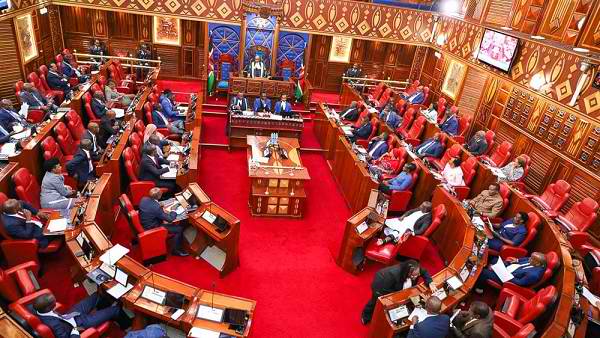
A major clash has erupted in Parliament over ongoing efforts to amend the constitution, with senators now crafting parallel proposals to alter the country’s supreme law.
Senators have rejected the constitutional amendment initiative spearheaded by members of the National Assembly, which seeks, among other things, to entrench the National Government Constituency Development Fund (NG-CDF) in the constitution
MPs recently concluded public consultation on their proposed Constitution of Kenya (Amendment) Bill. This bill also seeks to embed the National Government Affirmative Action Fund (NGAAF) and the Senate Oversight Fund (SOF) into the Constitution.
This move by the National Assembly follows recommendations from the National Dialogue Committee (Nadco).
However, senators have dismissed this process, claiming they were excluded and that MPs had hijacked it to advance their own interests – particularly the NG-CDF.
In response, senators have formed a special team, headed by the Senate majority and minority leaders, along with top legal experts within the House, to draft their own parallel amendments.
Their aim, they said, is to strengthen the legislative mandate of the Senate.
Senior Counsels Tom Ojienda (Kisumu) and Okong’o Omogeni (Nyamira), as well as Nairobi Senator Edwin Sifuna and Bomet Senator Hillary Sigei, are part of this team.
“What we’ve seen happening under the guise of public participation is MPs pushing for CDF. We’re being sidelined, and we reject that process,” one senator told the Star.
These revelations followed a three-hour informal meeting – a kamukunji – held on Thursday.
Senators who spoke to the Star said they are determined to strengthen the legislative authority of the Senate, a long-standing point of contention between the two Houses.
Senators have frequently complained about their Bills being rejected in the National Assembly on the grounds that they are “money bills.”
A money bill is a legislative proposal that primarily deals with financial matters such as taxation, public expenditure, or borrowing. According to the constitution, the Senate is prohibited from considering money bills.
Senators argue that MPs are using this provision to undermine their powers by rejecting or terminating proposals supported by the Senate.
“They reject your bill and then, days later, reintroduce the same content with a different sponsor. We cannot allow this to continue,” another senator stated.
Demonstrating a commitment to institutional reform, senators indicated their willingness to drop the proposed Senate Oversight Fund if that would help reinforce their constitutional mandate.
Meanwhile, senators resolved to seek a review of a Supreme Court decision delivered in March. This decision upheld the constitutionality of 21 laws passed by the National Assembly without the Senate’s input.
The court dismissed a Senate appeal that had challenged the constitutionality of 23 Acts passed solely by the National Assembly, upholding 21 of them.
Chief Justice Martha Koome, along with Justices Philomena Mwilu, Mohamed Ibrahim, Smokin Wanjala, Njoki Ndung’u, Isaac Lenaola and William Ouko, ruled that the National Assembly did not require the Senate’s input to pass the contested legislation.
“We uphold the Court of Appeal’s finding that the listed Acts passed by the National Assembly did not require consideration and enactment by the Senate, and are therefore constitutional,” Koome stated.
The Senate, its Speaker, the Senate majority leader and the minority leader had jointly filed the appeal, seeking an interpretation of Article 110(3) of the constitution.
This article requires the Speakers of both Houses to jointly determine whether a Bill concerns county governments.
“Since we cannot appeal a Supreme Court decision, we are instead applying for a review. We believe the ruling severely weakened the Senate’s legislative influence,” a senator explained.
In addition to legislative frustrations, senators voiced concerns over alleged favouritism by the Joint Parliamentary Services and the Parliamentary Service Commission (PSC).
They claim these entities are biased towards the National Assembly, citing unequal allocation of budgets and logistical support, which they argue hinders the Senate’s ability to operate effectively.
Senators also demanded that the PSC confirm the employment of several long-serving staff members, some of whom have been on contract for over a decade.