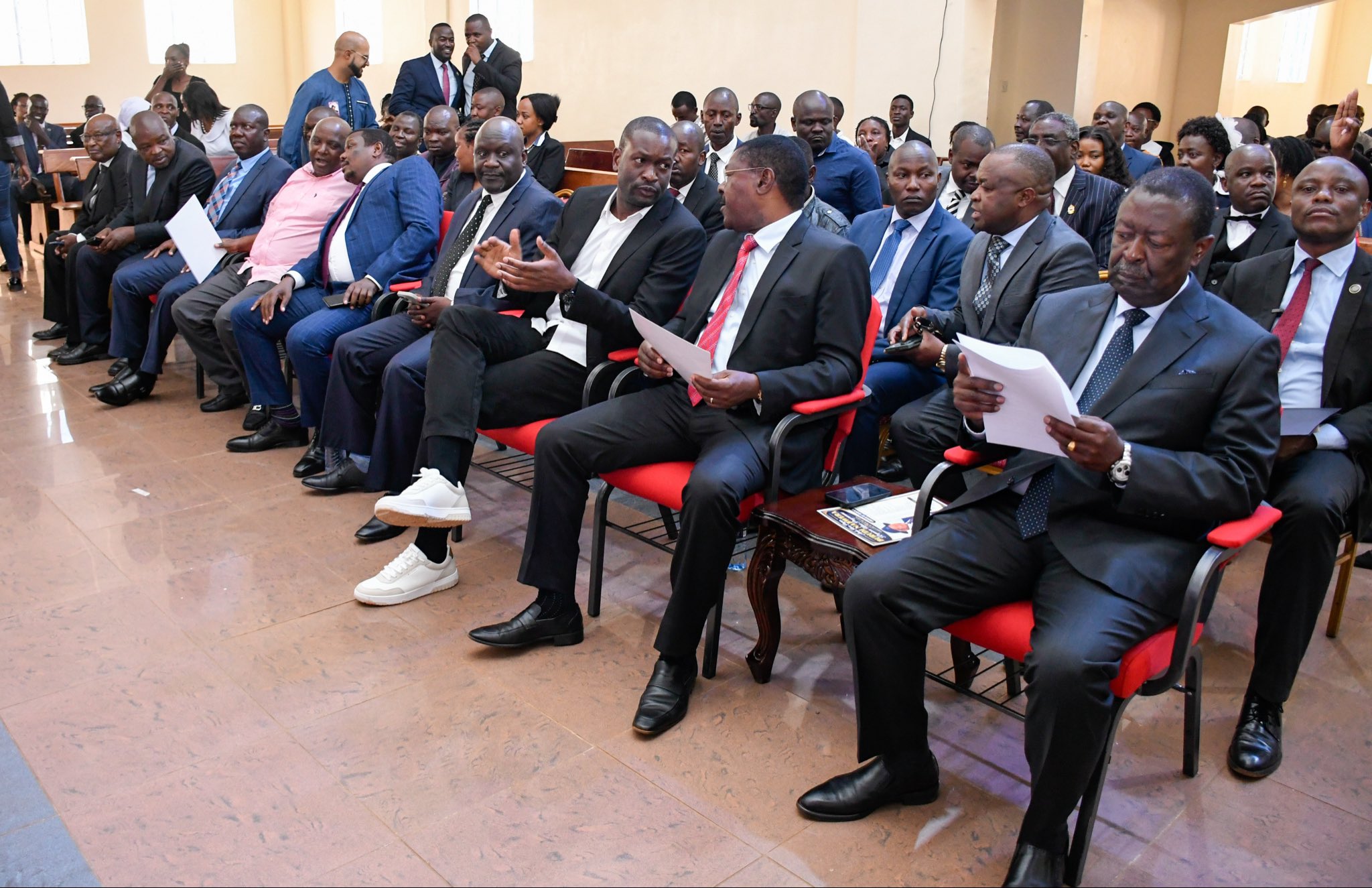
The launch of the DCP in Nairobi’s Lavington suburb was attended by at least 10 elected Members of the National Assembly, the Senate and several elected and nominated MCAs.
While many party supporters and loyalists wore scarves and caps in the DCP’s green, white, and brown colours, the elected leaders noticeably refrained from wearing any such political merchandise.
Their caution stemmed from concerns that the United Democratic Alliance (UDA)—the party under which they were elected—could take disciplinary action against them.
Such action could destabilise Gachagua’s political base and entangle the affected MPs in lengthy legal battles.
The Political Parties Act, 2011 outlines the process through which one ceases to be a member of a political party. There are four main ways: resignation, expulsion, “deeming,” or natural attrition.
For Gachagua's allies elected under UDA, the law allows for expulsion through the due disciplinary process.
Additionally, UDA may seek their removal from the party register under the "deeming" clause, which could result in them losing their parliamentary seats.
Kenyan law mandates that an elected MP must either belong to a political party or be an independent candidate at the time of election.
It prohibits elected or nominated leaders, who hold office courtesy of political parties, from switching parties mid-term without forfeiting their seats.
The Act also stipulates that a person shall not be a member of more than one political party at the same time.
A person automatically ceases to be a member if they form another political party, join in the formation of another political party, publicly advocate for the formation of another political party, or join or promote the ideology, interests, or policies of another political party.
To enforce these rules, each party must submit its membership criteria, including conditions for deeming, to the Registrar of Political Parties alongside the party constitution.
If a political party or the Registrar determines that a member has effectively resigned (through the acts listed above), the party must follow its internal procedures and notify the Registrar within seven days.
“Upon receiving the complaint, the Registrar shall remove the member’s name from the party membership list. When the Registrar receives a reasonably justified complaint—either from a party member or from the general public—they have the authority to initiate the deeming process,” part of the Political Parties Act, 2011 reads.
Among those present at the DCP launch but who avoided wearing party colours were Kiambu Senator Karungo wa Thang’wa, Nyandarua Senator John Methu, Kajiado North MP Onesmus Ngogoyo, and Kirinyaga Woman Representative Jane Maina.
Others included Starehe MP Amos Mwago, Embakasi Central MP Benjamin Gathiru, Kipipiri MP Wanjiku Muhia, Murang’a Senator Joe Nyutu, Juja MP George Koimburi, and Embakasi North MP James Gakuya.
In contrast, several political heavyweights—including former lawmakers—wore DCP colours during the event. These included former Limuru MP Peter Mwathi, ex-Laikipia Woman Rep Cate Waruguru, former Kasarani MP Mercy Gakuya and veteran politician Maina Kamanda.
Speaking during the launch, Gachagua said DCP would be represented by neon green and white symbols he described as representing renewal, transparency, and inclusivity.
“I made a promise to you that in May 2025, I would unveil a new political party whose philosophy resonates with you. As you all know, I am an honest and truthful man. I keep my word and promises; I detest lies, and that is why I disagreed with liar number one.
"We finally have a political party where every Kenyan is treated equally. Our new party is the Democracy for Citizens Party,” Gachagua declared.