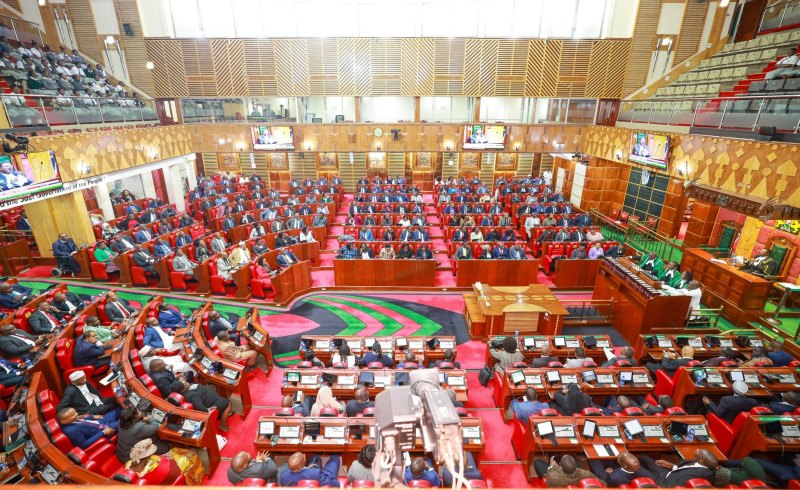
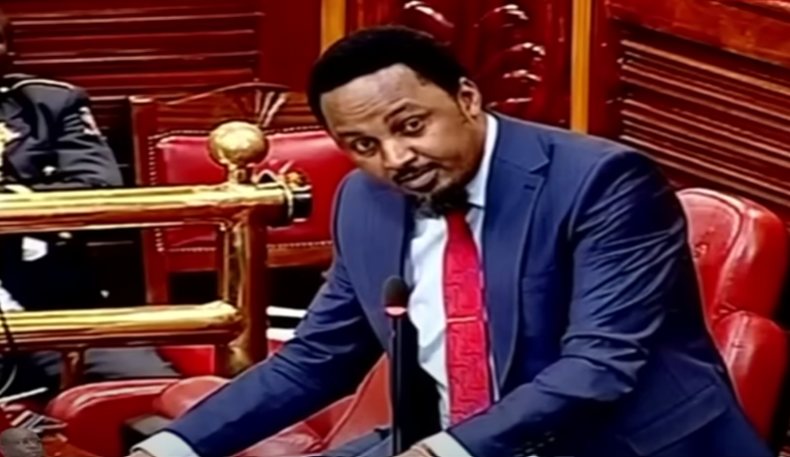
 Mover of the motion, Kiambu Governor Karungo Thang'wa on the floor of the House during a past debate. /SCREENGRAB
The Senate has made a significant step towards enhancing access to free education by learners from vulnerable families by passing a motion that seeks to consolidate all bursaries into a unified fund.
The motion moved by Kiambu Senator Karungo Thang'wawas was passed on Tuesday.
It seeks to streamline all education bursary funds into a unified, transparent, and accountable system by directing the Ministry of Education to audit all bursary funds issued by both national and county governments, with the aim of integrating them directly into schools as supplementary capitation.
To enhance accountability and transparency, the motion calls for public disclosure of the cost of education per learner to ensure fairness and equity across the country.
"This is a victory for fairness, for accountability, and above all, for the children of Kenya," Thang'wa said after the piece of the legislation received the nod of the House.
The senator noted that in its current form, bursary is discriminatory, but free education should not be so.
"No child should be sent home because a system meant to support them is broken. Today, the Senate has taken a bold step to fix it," Thang'wa said and extended appreciation to his colleagues.
"I thank fellow senators for standing tall on this motion. Kenyans have often described the Senate as the last line of defence for the people and today, we lived up to that expectation."
Focus now shifts to the Ministry of Education, which is now expected to implement the proposal in full.
Thang'wa said passage of the motion is not enough, and the relevant laws should be amended to ensure a strong, sustainable legal framework for the full realisation of free secondary education in the country.
Several prominent leaders and institutions in Kenya have publicly called for the consolidation of all bursaries to streamline funding and make education more affordable and accessible.
Thang'wa was the first to front the proposal, saying in the 2024-25 financial year, about Sh656 billion was allocated to the education sector but it is difficult to ascertain the specific funds granted to each student
On August 22, 2024, his proposal was endorsed by Chief Justice Martha Koome, who called for the consolidation of all bursary funds at the national and county level to mobilise required resources for free tertiary education.
She noted that the current fragmented system leads to overlaps and unjust classification of students under the new funding scheme.
“Why don’t you put them (bursaries) together and make education free for all?” she posed.
National Assembly Minority Leader Junet Mohamed said Kenyan children were suffering due to the duplication and fragmentation of bursary and scholarship programmes across constituencies, counties, and national institutions.
Junet consequently tabled a motion in Parliament to establish a select committee to develop a framework for unified disbursement of education funds, aiming for a National Education Fund to guarantee every Kenyan child access to quality education.
"This initiative aims to ensure that education financing is transparent, efficient, and reaches the intended beneficiaries without political or bureaucratic interference,” he said.
While presenting the views of governors, Narok Governor Patrick ole Ntutu emphasised that consolidating bursary funds would ensure broader access and reduce duplication, a sentiment he shared before the Senate Education Committee.
"Most governors have no problem with bursaries being consolidated into one kitty, provided the funds are used to offer free education to all Kenyan students. This would ensure broader reach, unlike the current set-up," he said.
Abdul Masud, Secretary, Supreme Council of Kenya Muslims (SUPKEM), Homa Bay County, said that integrating bursaries would prevent wastage and reduce politicisation, ensuring deserving students receive support.
"The allowances paid by bursary committees could be used to boost the bursary funds if integrated in one office," he said.
Senate's move to pass the motion in support of the push comes as Kenyans give views on whether or not the National Government County Development Fund (NG-CDF) should remain under the management of MPs.
Some have proposed that all bursaries under NG-CDF be consolidated and placed under the Ministry of Education and paid directly to schools to enhance fairness and transparency.
"The Ministry of Education has the data of all learners, it's best placed to manage and distribute the funds as opposed to MPs who randomly decide who benefits," a Kenyan said.