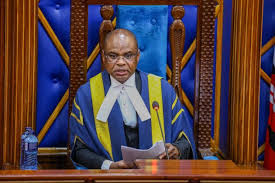
Senate Speaker Amason Kingi has suspended debate on the proposed revenue-sharing formula among counties to give lawmakers time to reach a consensus.
The decision came after a tense start to the debate—initially scheduled for last Thursday—during which some senators clashed bitterly over the formula, which would govern county revenue allocation for the next five years.
“I have consulted with the Committee on Budget and Finance Chairperson and agreed that this motion will be moved on May 22, 2025. That gives us roughly two weeks,” Kingi announced.
He urged lawmakers to use the time for consultations to build consensus ahead of the rescheduled debate.
“If you encounter difficulties among yourselves and need the speaker or the secretariat to help bring you together to forge a consensus, we will be available,” the speaker added.
Kingi’s move was driven by concerns about avoiding a repeat of the gridlock that paralysed discussions on the current formula, which took 10 sittings to resolve, in 2020.
During that debate, senators were deeply divided, particularly along county lines—those representing counties that stood to lose revenue resisted the proposed changes.
The standoff was so intense that several senators were arrested and detained as the government tried to assert control.
It ultimately took the intervention of then-President Uhuru Kenyatta, who added Sh53.5 billion to the county allocation to ensure no county lost funds, for the formula to be approved.
As the new debate unfolds, two competing proposals have been tabled: One from the Commission on Revenue Allocation (CRA), under which at least 31 counties would lose revenue.
Another from the Senate Finance and Budget Committee, which seeks to ensure no county loses revenue.
The debate is already proving divisive. Elgeyo Marakwet Senator William Kisang proposed that each county receive a minimum of Sh6 billion before the revenue-sharing formula is applied to any additional funds.
“As we discuss this new formula, we need to agree that each county should at least get Sh6 billion, then we apply the formula to anything above that,” Kisang said.
He argued that the move would allow counties such as Elgeyo Marakwet, Tharaka Nithi, Isiolo, Lamu, and Taita Taveta—all of which currently receive less than Sh6 billion—to implement meaningful development projects.
However, Kakamega Senator Boni Khalwale opposed the proposal, warning that it contradicted constitutional principles.
“Is he in order, given that the letter and spirit of the constitution do not speak to equality, but to equity? How does he intend for such a provision to align with Articles 202 and 203, which state that shareable revenue must be distributed equitably?” he posed.
The Senate Finance and Budget Committee, chaired by Mandera Senator Ali Roba, reviewed the CRA proposal and made significant changes.
After consultations with various stakeholders, the committee introduced a baseline allocation model to ensure no county loses funding.
The committee proposes that Sh387.42 billion—the equitable share for the 2024-25 financial year—be adopted as the minimum guaranteed amount for all 47 counties in future years.
“The first Sh387.42 billion (being the county equitable share for FY 2024-25) should be shared among counties based on the baseline allocation factor derived from each county’s current share,” the report reads.
Any additional allocation above the baseline would be distributed using a revised formula.
According to the committee’s new formula, the basic (equal) share has been weighted at 35 per cent, up from 22 per cent proposed by CRA.
The poverty index, which the commission had given a weight of 14 per cent, has been reduced to 12 per cent.
The committee has allocated geographical size a weight of eight per cent, capped at 10 per cent, down from nine per cent proposed by the commission.
Population, which has been the most controversial index in the political scene, has been retained at 45 per cent. The committee has dropped the ‘income distance’ index, which the commission had assigned a weight of 13 per cent.
“The data used to generate the Income Distance index is not directly derived from each county. The KNBS applies a top-down approach to determine each county’s contribution to GDP,” the report says.
In addition, the committee dismissed ‘a stabilising factor’ introduced by the commission to cushion the counties from losing revenue.
In CRA’s formula, the commission proposed that the National Treasury and Parliament allocate the counties a minimum of Sh417 billion to ensure no county loses revenue.
However, the committee said it would be prudent to address the transition effects from one basis to another using a scientifically generated deviation parameter.
Already, the National Assembly has allocated Sh405 billion to the counties. The Senate, on the other side, has proposed an allocation of Sh465 billion.
If approved by the House, the new framework will dictate revenue sharing among the counties for five years, from 2025-26 to 2029-30.