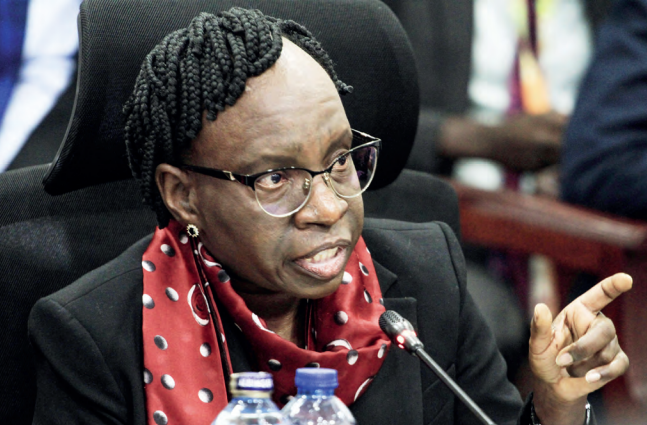
A new audit report by Auditor General Nancy Gathungu has uncovered alarming financial irregularities in President William Ruto’s administration.
The report details more than Sh2 billion in unsupported expenditures across government ministries and donor-funded projects, highlighting weak accountability mechanisms and potential misuse of public funds.
The audit, which scrutinised expenditures for the 2023-24 financial year, found that ministries, departments and agencies failed to provide documentation for Sh783.9 million in spending, while donor-backed projects accounted for an even larger discrepancy of Sh1.26 billion.
Judiciary topped the list of offenders, with Sh406.8 million in unsupported expenses, including questionable personal allowances of Sh182.3 million, leave allowances (Sh131.3 million) and foreign travel costs (Sh53 million).
The State Department for Economic Planning followed with Sh195.2 million in unverified training expenses.
For the case of the State Department for Social Protection, managers could not account for Sh165.2 million spent on domestic travel, cash payments and fuel.
The findings come when Kenyans are grappling with economic hardships and increased taxation.
Donor-funded initiatives faired no better in the query raised by auditor general for the period to June 30, 2024.
The Bogoria Silali Geothermal Project, implemented by the Geothermal Development Corporation, recorded the largest irregularity.
The audit established that Sh980.9 million was paid to National Oil Corporation of Kenya (Sh535.6 million) and Galana Energies Limited (Sh445.6 million) without proper documentation.
Other flagged projects included the Financing Locally-Led Climate Action Programme (Sh123 million in unsupported travel allowances), the Secondary Education Quality Improvement Project (Sh60.4 million paid to unsupervised consultants) and a Global Fund tuberculosis initiative (Sh2.8 million in unverified training expenses).
Smaller but equally concerning cases included Sh1.5 million in questionable fuel costs under the Horn of Africa Groundwater for Resilience Project.
Gathungu said the entities violated Section 62 of the Public Audit Act (2015), which criminalises failure to provide accurate financial records.
The law further prescribes penalties of up to Sh5 million fines or three-year imprisonment.
The Public Finance Management Act (2012) also requires accounting officers to ensure the transparent and lawful use of public resources.
“The absence of supporting documents not only undermines accountability but also raises red flags about possible fraud and wastage,” Gathungu said in the report seen by the Star.
In a recent report, Members of the National Assembly Public Accounts Committee called for the prosecution of officials who fail to account for their expenditure.
“The committee observed that some accounting officers failed to submit supportive documentation to the auditor general on time as required by law,” the report reads.
The oversight team also noted that accounts and finance staff in some agencies didn’t maintain financial statements in real time.
The Butere MP Tindi Mwale-led committee recommended that accounting officers comply with the laws requiring submission of supporting documents on time.
“The committee will, in subsequent audit, prescribe punitive measures to those accounting officers who fail to adhere to the requirements of the law in this regard,” the PAC report reads.
Ruto critics are using the report to accused government of failing to curb corruption.
“If Ruto’s administration cannot account for Sh2 billion, what does that say about its commitment to fiscal discipline?” Embakasi Central MP Benjamin Gathiru asked.
In committee appearances, government officials have been attributing the discrepancies to administrative delays rather than graft.