A survey indicates that men in the country continued to have more access to financial services than women in 2024, with the urban population having an advantage over their rural peers.
This includes credit and financial services from banks, mobile money, informal groups, insurance, pension, hustler fund, microfinance institutions, including digital apps and security investments.
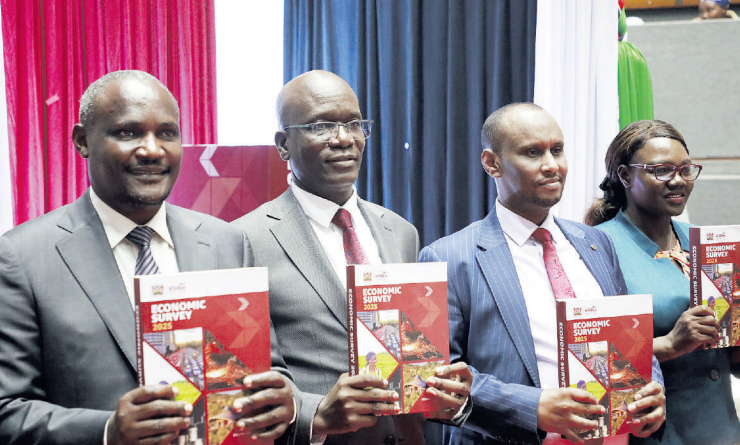
However, according to the Economic Survey 2025, access to formal financial services and products between the female and male population narrowed to 1.6 percentage points in 2024 from 4.2 percentage points in 2021.
This was a result of continued low uptake by male and increased access by female to 84.1 per cent in 2024 from 81.7 per cent in 2021.
Men access dropped to 85.7 per cent from 85.9 per cent in the study that is pegged on a three-year cycle.
Urban population recorded the highest access to formal financial services and products through formal financial providers at 91.3 per cent compared to 80.2 per cent for the rural population.
“The rural-urban gap in access to formal financial services providers continued to narrow on account of continued penetration of formal financial services providers through digital channels and physical channels like branches and agents,” the report indicates.
Kiambu county had the highest formal financial inclusion followed by Nairobi, Kirinyaga, Nyeri, Isiolo, Kisumu, Embu, Taita-Taveta, Uasin Gishu and Mandera which closed the top ten list.
Counties with the highest formal financial exclusion were Bungoma, Kilifi, Trans Nzoia, Tana River, Busia, Baringo, Narok, Migori, Turkana and West Pokot, with women and youths below the age of 25 forming the biggest percentage of those missing out.
Women still perceive a slightly higher level of gender bias than men when accessing financial services such as loans, according to a report by digital lender-Tala.
A report by the firm notes that out of the sample groups surveyed countrywide, 65 per cent of women respondents rated gender bias in financial services at ‘moderate’ to ‘extreme’.
This, even as the 2024 FinAccess Survey by KNBS, captured in the Economic Survey released last week, highlights shifting financial preferences in Kenya, with mobile money usage rising to 82.3 per cent in 2024 from 79.4 per cent in 2019.
This is driven by expanded services, improved infrastructure and greater adoption for government services and e-commerce.
Bank usage last year increased to 52.5 per cent, supported by infrastructure development.
SACCOs participation grew to 11.7 per cent, reflecting broader reach, while informal group membership rose to 30.8 per cent, emphasising the continued importance of grassroots financial systems.
Investments in securities increased to 3.1 per cent, boosted by new applications (apps) and higher returns, showcasing diverse consumer financial needs. In contrast, insurance uptake saw a slight decline to 22.0 per cent.
“The survey findings indicate that consumers are transitioning from using a single service to using many services. The number of respondents who use two or more types of financial services and products increased to 79.7 per cent in 2024 from 75.3 per cent in 2021,” Kenya National Bureau of Statistics says in its latest report.
Those withouta national ID still face barriers to accessing financial services.
The survey results indicated that 45.6 per cent of young people aged 18-25 in rural areas were formally excluded. Similarly, 12.4 per cent of older people aged 55 and above in rural areas were financially excluded compared with 1.5 per cent of their counterparts in urban areas.
“The lack of national Identification Cards (IDs) among young people aged 18-25 largely explains the high exclusion rate,” KNBS has noted.
The usage of Hustler Fund loan services for the urban population was 35.4 per cent while the rural population usage was 24.2 per cent.
Usage of the fund among the male population was 31.8 per cent while female population usage was at 26.1 per cent.
Usage of Hustler Fund by wealth quintiles indicates that 35.8 per cent of those in the highest wealth quintile use Hustler Fund, compared to 18.7 per cent of those in the lowest wealth quintile, indicating the rich continue to benefit from this fund compared to the poor.
This comes as the proportion of the adult population that is financially healthy increased with the ability to manage day to day needs equally going up.
“The ability to cope with risks improved from 23.3 per cent in 2021 to 33.3 per cent in 2024, signaling better resilience. However, the ability to invest in livelihoods declined sharply from 39.5 per cent in 2021 to 17.1 per cent in 2024,” the government statistician said.
The push to meet family needs and bills has seen men remain the biggest borrowers according to financial experts, with mobile loans being among the easiest to access where they also borrow more than women.
According to Creditinfo, a global service provider for credit information and risk management solutions, 65 per cent of digital loan borrowers are men with the remaining 35 per cent being women.The majority of the men accessing mobile credit are aged between 31-40.
“This goes against reports showing youth are the main digital borrowers,” Creditinfo regional manager for East and Southern Africa Kamau Kunyiha said.
Majority of digital credit seekers are reported to be people in both the formal and informal sectors engaged in commerce, looking to facilitate their businesses and meet emergency expenses.
More Kenyans have fallen into financial crisis in the last four years according to a recent FinAccess survey released in quarter four of 2024.
The survey reveals that 81.7 per cent of Kenyans are financially unhealthy, facing challenges in managing daily expenses and investing for the future.
It found that Kenyans opted to cutting down on other expenses, run down savings, look for additional work or business and take another loan to repay all in a bid to pay back debts.
Worse still, the report discovered that the most popular action to repay debt is by reducing expenses on food with females surpassing males by recording 63.0 per cent and 57.1 per cent, respectively.
“The least sought action to pay is by selling or giving assets and belongings, which saw females record 20.7 per cent and males 23.1 per cent,” read part of the report.
According to the report, men are more willing to part with their assets and belongings as compared to females.