Kenya will borrow more than Sh45.1 billion, an amount higher than what was earlier anticipated to fund the budget for the new financial year starting July 1.
In the initial budget estimates, the National Treasury had projected a budget deficit of Sh831 billion with plans to borrow Sh684.2 billion from the domestic market and Sh146.8 billion from external markets.
However, fresh budget estimates published on Tuesday indicate that Sh876.1 billion will be borrowed in 2025/26 to fill the budget deficit, with Sh591.9 billion and Sh284.2 billion to be sourced domestically and externally, respectively.
This means it has cut domestic borrowing by Sh92.3 billion while revising upwards external loans by Sh137.1 billion.
Although the borrowing arrangement contradicts Kenya Kwanza’s position on cutting down on external loans, Economist Elijah Kibunja tells the Star that it is a prudent thing to do in view of the tight fiscal space.
“The exchequer is walking a tight balancing act of funding the budget and fueling economic growth. In my view, the exchequer is releasing more than Sh90 billion it had anticipated to mop from the domestic market to the private sector to spur production and job creation,’’ Kibunja told the Star.
“Our fiscal space is extremely tight. It is about choosing the lesser devil now. I don’t see a scenario where it will be going for expensive commercial loans. A multilateral arrangement is even better compared to domestic bonds, which are likely to fetch higher rates.’’
To balance the equation and perhaps meet the budget, a budget deficit of not more than 4.5 per cent as announced in the recent Cabinet memo, President William Ruto’s government has slashed the total budget by Sh24 billion to Sh4.24 trillion.
“The projected 2025/26 fiscal deficit now stands at 4.55 per cent of GDP,’’ the National Treasury says in the updated Budget Policy Statement (BPS).
This is a significant drop from 5.3 per cent in 2023/24 and 5.1 per cent in 2024/25. It is targeting to reduce the deficit to 2.7 per cent in the medium term, a projection most economic experts have termed as ‘grossly ambitious.’
“Kenya has never stuck to its budget deficits. It is even worrying that a supplementary budget is normally up barely a month after the budget presentation in the Parliament. Unfortunately, the additional expenditure is always for recurrent purposes,’’ Geoffrey Nyaga, an economics lecturer at a local university, told the Star last week.
He added that it is unrealistic to imagine cutting the budget deficit by 70 basis points, yet the government insists on also cutting down on taxation. “The Finance Bill, 2025, will give us a true picture. Everything else is mere optics. Smoke screen.”
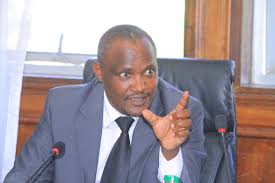
Last month, the National Treasury CS John Mbadi laughed off President William Ruto’s ambition to match spending with collected revenue by 2027, terming the dream as ‘’too ambitious’’.
He insisted that the country would still be running a fiscal deficit of about three per cent by 2028.
“If we balance the budget now, we will not offer services. No one will agree to pay taxes if they are not using the services. If you don’t give them services, they have no reason to pay taxes,’’ he told journalists.
Furthermore, the exchequer has further cut projected revenue by Sh78 billion to Sh2.76 trillion, pushing the total revenue projection to Sh3.32 trillion.
In the initial 2025 Budget Policy Statement (BPS), Treasury reduced the target for ordinary revenue to Sh2.835 trillion from the earlier target set in the draft BPS of Sh3.018 trillion.
Projected total revenue, which includes tax revenues collected by KRA and ministerial appropriation-in-aid (AIA), had also been slashed to Sh3.385 trillion from the earlier projection of Sh3.516 trillion in the draft BPS.
The government is cutting projected ordinary revenue collection; at the time, it is not planning to add more taxes in the Finance Bill, 2025.
“It simply does not want to ignore the Laffer curve. Past mistakes to increase taxes have led to low revenue collection,’’ James Ndunda, a seasoned tax expert, told the Star.
Last month, the exchequer ate humble pie and revised downwards its tax collection target for the current financial year by Sh40 billion, citing continued revenue shortfalls and underperformance by the Kenya Revenue Authority (KRA).
It now expects to collect Sh2.54 trillion in ordinary revenue for the financial year ending June 2025, down from the Sh2.58 trillion projection in the second supplementary budget.