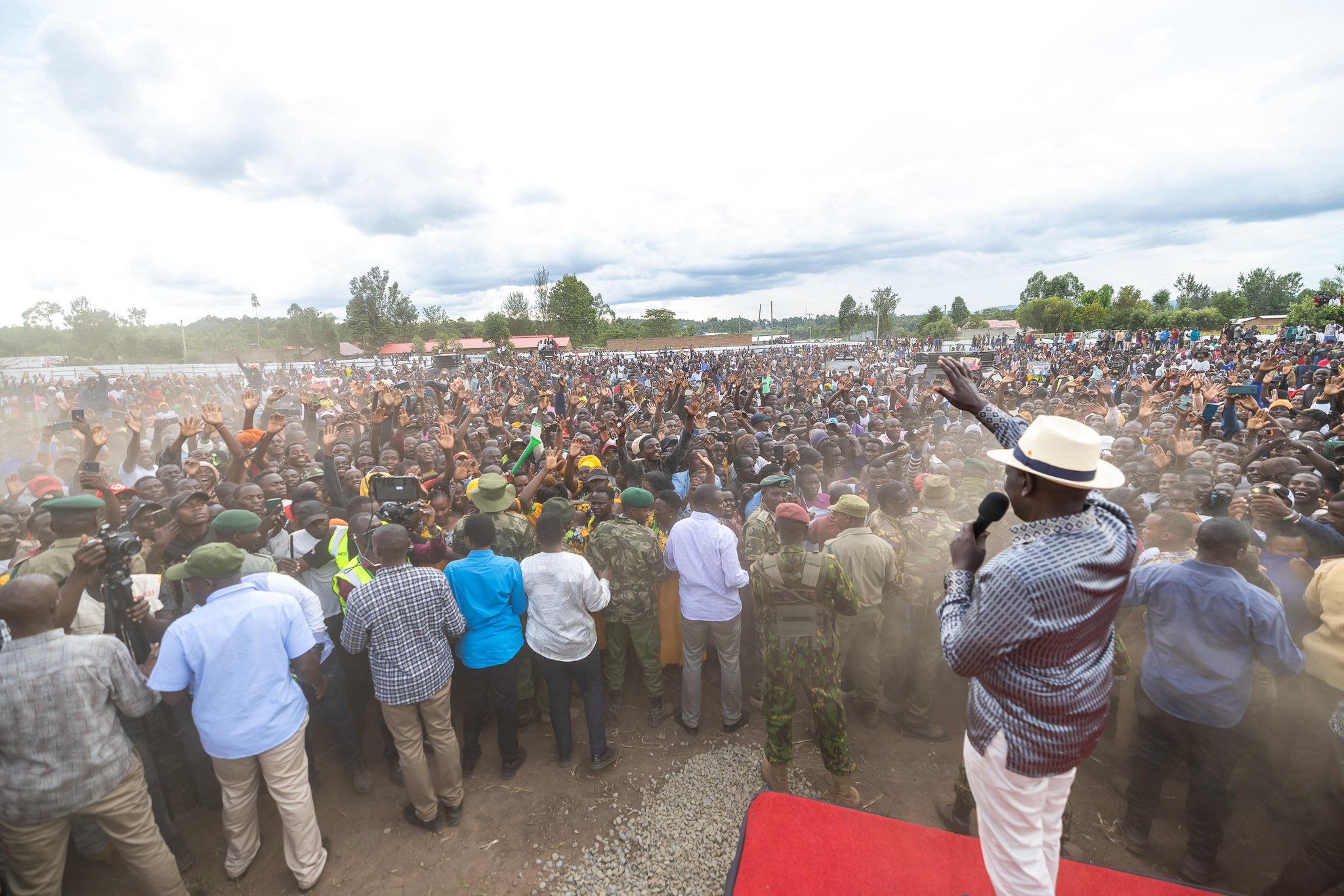
President William Ruto and the uniting opposition are gearing up for a high-stakes showdown over key swing vote regions, while also securing their traditional strongholds as critical launchpads for the 2027 general election.
In what is shaping up to be an epic contest of numbers, both sides are already engaged in strategic maneuvering to expand their political influence and outsmart one another—even with the general election still more than two years away.
An analysis by the Star of Kenya’s voting patterns and the 2022 voter register shows that both camps have clearly ring-fenced their strongholds and isolated swing regions, setting the stage for targeted campaign strategies.
However, political observer Charles Munyui suggests the 2027 polls could defy traditional voting patterns due to the rise of Gen Z and more Kenyans becoming politically informed.
“Balkanisation of the country may not work because of the Gen Z factor, which cannot be dismissed. Eight million people did not vote in the last election, and this could be their time,” Munyui said.
Yet, Javas Bigambo contends that Gen Z is not a homogeneous group, meaning it would be politically unwise for any side to rely solely on this demographic.
“What will ultimately determine the election is whether the camps can maintain unity until 2027,” Bigambo said.
The opposition coalition is coalescing around former Deputy President Rigathi Gachagua and former Vice President Kalonzo Musyoka.
They are joined by ex-Cabinet Secretaries Fred Matiang’i, Eugene Wamalwa, and Mithika Linturi, signalling a growing alliance aimed at countering Ruto’s political machinery.
With both President Ruto and opposition leaders holding firm control of their respective bases, the battlefield is now shifting to swing counties that could tip the scales in 2027.
Ruto remains solidly in control of his traditional North and South Rift Valley bases.
Should his current political truce with ODM leader Raila Odinga hold until 2027, he stands to make substantial inroads into Luo Nyanza—historically a Raila stronghold—as well as gain significant support in Western Kenya and the Coast.
The opposition, on the other hand, is set to maintain a firm grip on Gusii, Ukambani (Lower Eastern) and Mt Kenya regions.
This leaves Nairobi, Northeastern, Turkana and Maa counties – Narok, Kajiado and Samburu - as swing areas that may sway the elections.
According to the registers, Ruto-controlled areas of North and South Rift, Western and Coast have a total of 8.82 million voters.
The votes include 2.83 million from North and South Rift counties of West Pokot (220,026), Trans Nzoia (398,981), Uasin Gishu (506,138) and Elgeyo Marakwet (231,884).
Others are Baringo (282, 053), Kericho (428,067), Bomet (376,985) and Nandi (406,288).
In Luo Nyanza, there are 2.16 million voters scattered across Siaya (533,595), Kisumu (606,754), Homa Bay (551,071) and Migori (469,019).
In the Coast, there are 2.01 million votes scattered across Mombasa (641, 913), Kwale (328, 253), Kilifi (588,602, Tana River (191,096), Lamu (81,453) and Taita Taveta (181,827).
At the Coast, Ruto is seeking to capitalise on Raila’s historical popularity while expanding his own political footprint.
His efforts have been reinforced by the appointment of former governors Hassan Joho, Salim Mvurya, and Amason Kingi to senior government roles.
Joho and Mvurya now serve as Cabinet Secretaries for Mining and Sports, respectively, while Kingi is the Speaker of the Senate.
The trio wields considerable political clout in the region and is expected to play a key role in consolidating Ruto’s support along the Coast.
So far, no significant opposition-aligned figure has emerged from the region to counterbalance their influence.
In Western, there are 2.21 million votes. They include Kakamega with (844,55), Vihiga (310,043), Bungoma (646,598) and Busia (416,756).
Raila has long dominated Western Kenya, particularly Busia, Kakamega, and Vihiga counties.
However, with National Assembly Speaker Moses Wetang’ula and Prime Cabinet Secretary Musalia Mudavadi now firmly within the Kenya Kwanza camp, Ruto is well-positioned to challenge the region’s traditional loyalties.
For the opposition, Gusii, Mt Kenya East and Mt Kenya West and Ukambani have 7.49 million registered voters.
There are 960,293 registered voters in Kisii (637,010) and Nyamira (323,283).
Former powerful interior CS Matiang’i has emerged as the region’s political supremo.
Last Friday, Matiang’i made a triumphant return to the region after staying abroad for several months. He declared his readiness to run for the country’s top job.
“….the kind of overwhelming invitations I received over the times I have been away are such a great force that propelled me to come back. Will you support me on my way up?" Matiang’i posed and the crowed roared in affirmation
The three counties of Ukambani – Machakos, Makueni and Kitui – have a total of 1.69 million voters.
Kalonzo is the undisputed political kingpin of the region. In the last three polls, he delivered the votes overwhelmingly to Raila.
Mt Kenya East – Meru, Tharaka Nithi and Embu – has 1.33 million voters while Mt Kenya West, which comprises Nyeri, Kirinyaga, Murang’a, Kiambu, Nyandarua and Laikipia, has 3.49 million voters.
Gachagua has taken firm control of the rich region.
The ex-Deputy President has vowed that the region will make Ruto a one-term President—despite its overwhelming support for the President in the 2022 election.
“The mountain that made you President will make you a one-term President. That is what we must do,” Gachagua said at a weekend rally, underscoring the growing political tension in the region.
However, in Mt Kenya East, Gachagua faces stiff opposition from Ruto, whose deputy, Gachagua’s successor, Kithure Kindiki, hails from the region.
The analysis shows there are 5.9 million registered voters in the swing areas – a crucial bloc that could decide the winner of the polls.
It comprises 882,677 from Northeastern, 238, 528 votes from Turkana, 2.42 million votes from Nairobi, 1.05 million voters in Nakuru, 398,981 votes from Uasin Gishu and 962,071 votes from the Maa counties of Kajiado, Narok and Samburu.
Registered voters in Northeastern include Garissa (201,473), Wajir (207, 758), Mandera (207, 030), Marsabit (16, 912) and Isiolo (89, 504).
While Northeastern be a swing area, Ruto has been appealing to the region with significant appointments and development projects.
Recently, Ruto vowed to complete the construction of the more than 700km road running from Isiolo to Mandera.
The President also scrapped the requirement for vetting of Kenyans seeking identity cards from the region, further appealing to the residents.
No senior politician from the region has outrightly identified with the opposition.
As the 2027 elections draw closer, the battle lines are being redrawn—not just along traditional ethnic and regional divides, but through new political alliances, strategic government appointments, and the relentless quest for swing votes that could ultimately decide Kenya’s next leader.
INSTANT ANALYSIS
Fielding a presidential candidate by ODM to face incumbent William Ruto would deal a heavy blow to the President, who has been banking on Raila for his re-election. Ruto has apparently lost ground in key voting blocs. They include the Mt Kenya region, which has expressed its displeasure at ‘engineering’ the impeachment of his former deputy Rigathi Gachagua. Ruto has also reportedly fallen out with the youthful Kenyans, alias Gen Z. In recent days, ‘Ruto Must Go’ chants have dominated social gatherings, including football matches.