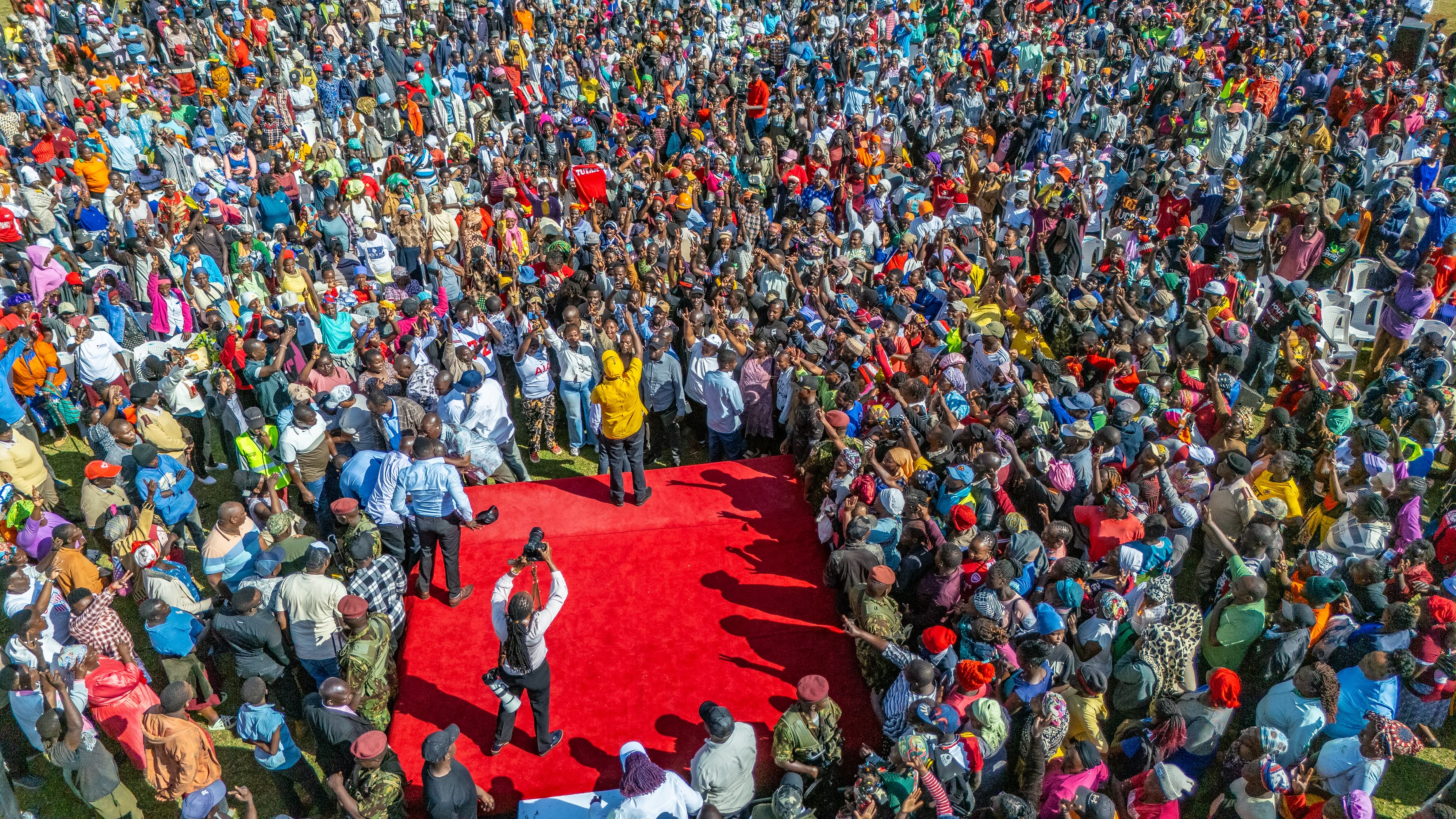
However, a recent incident in which a shoe was hurled at him during a political rally in Kehancha, Migori County, has exposed potential lapses in his protection.
Here’s what you need to know about how the President of Kenya is protected.
The structure of presidential security
In Kenya, the security of the Head of State is coordinated by the Presidential Escort Unit (PEU), a specialised branch under the National Police Service.
Established under Section 24 of the National Police Service Act, 2011, the PEU’s mandate is to protect the President, the First Family, the Deputy President, retired Presidents, visiting Heads of State and Government, and other designated VIPs.
The PEU operates under the approval and coordination of the Inspector General of Police and forms part of the Joint Operational Command (JOC), which brings together multiple agencies responsible for presidential security.
This responsibility is shared between two elite units: the PEU and the General Service Unit's G-Company, commonly known as G-coy.
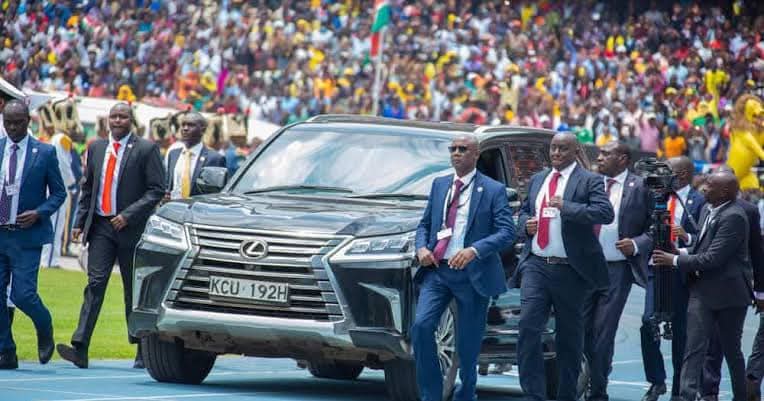
The PEU is responsible for the President’s close personal protection, including 24-hour armed escorts, armoured motorcades, and advance surveillance sweeps at public venues.
Officers in the PEU are specially trained in VIP protection tactics, close-quarters combat, threat detection, and secure driving. The unit operates under strict secrecy, with most of its activities and personnel shielded from public view.
G-coy, on the other hand, provides static and perimeter security at the State House, State Lodges, and the official residences of both the President and the Deputy President. It also reinforces PEU officers during high-risk assignments and national functions.
Within the PEU is the Counter Assault Team (CAT) — a highly specialised unit trained to respond to complex attacks, such as ambushes or assassination attempts.
Their deployment is discreet, and they are kept on standby during public appearances or trips to volatile regions.
Highly trained and structured teams
The President’s escort team includes a detail leader, an assistant detail leader, a tactical commander, a motorcycle chief, an advance coordinator, mobile operatives, static officers, and protective intelligence officers.
Most are drawn from elite units like the General Service Unit (GSU) and Recce Company and undergo rigorous paramilitary training.
Joining the PEU requires specialised VIP protection training, including at least two months at the GSU school, often with foreign instructors, before certification as a close protection officer. Physical and mental fitness are strictly assessed.
Motorcades and movement formations
Before the President travels anywhere, a detailed risk and threat analysis is conducted, involving uniformed police for crowd control and the National Intelligence Service (NIS) for intelligence gathering.
Based on this analysis, a security plan is developed.
While in transit, motorcycle outriders — highly trained in combat and defensive driving — lead the motorcade, managing traffic and controlling its speed.
Common protective vehicle formations include:
Arrow Formation: Vehicles shield the front and rear, with the President’s car in the centre.
Diamond Formation: The President’s car is surrounded on all four sides by security vehicles.
Wedge Formation: Used in emergencies, the President is completely encircled by security vehicles for potential evacuation.
On the Ground: The inner cordon
During public events, the PEU establishes an inner cordon around the President, typically a six-member team led by the officer known as Oscar 1, who stands directly behind the President on the dais (note: this is not the aide-de-camp).
This core team controls immediate access to the President, while outer cordons manage the larger crowd.
Equipment and protocols.
Presidential security officers typically wear black suits, reflecting Kenya’s civilian-led government, similar to practices in the United States.
Depending on the occasion, they may also wear heavy civilian attire such as jackets to conceal weapons and blend into crowds.
The President may occasionally wear a bulletproof vest depending on the event or assessed threat level, though these vests are often bulky and uncomfortable.
Once in office, the President undergoes weapons training and security drills to prepare for emergencies.
For example, if Oscar 1 stands up during a speech, it signals to the President that a threat has been identified and the speech should be cut short.
In the event of a shootout, protocol dictates that officers shield the President, even at the risk of being shot themselves.
Numbers and resources
The PEU maintains roughly 200 officers assigned to the President at any given time.
These teams include firearm experts, defensive drivers, combat leaders, snipers, explosives specialists, and intelligence personnel — all working to ensure the safety of the country’s top leader.