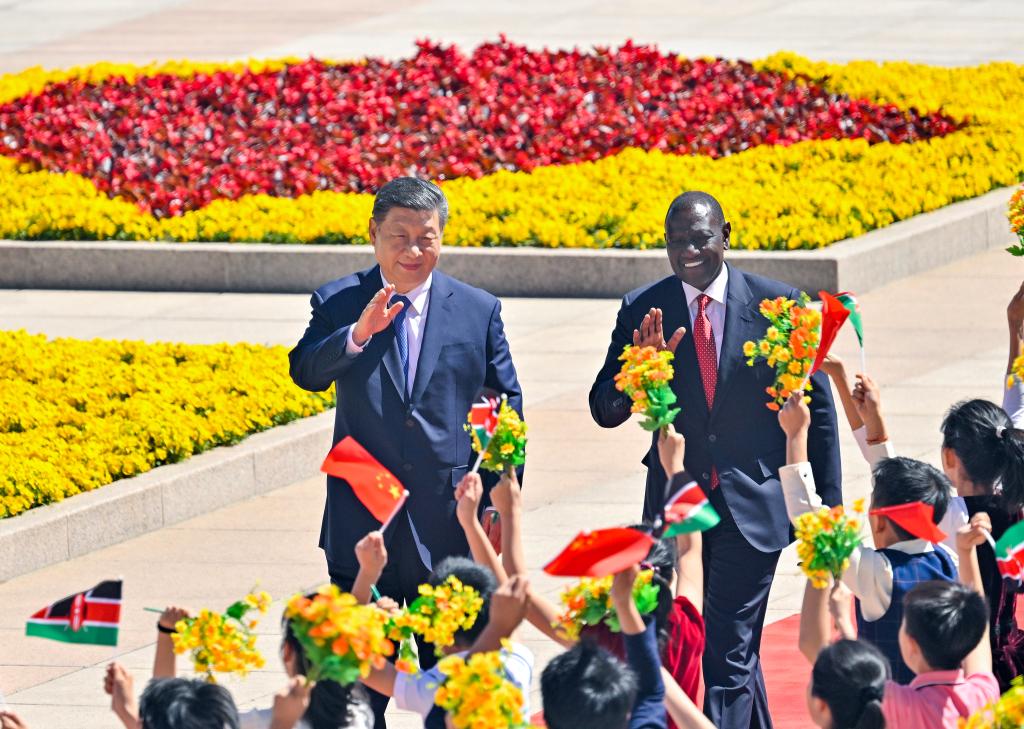
 Chinese President Xi Jinping holds a welcome ceremony for Kenyan President William Ruto at the square outside the east gate of the Great Hall of the People prior to their talks in Beijing, capital of China, April 24, 2025 in Beijing./PHOTO:(Xinhua/Yue Yuewei)
During the Ninth Forum on China-Africa Cooperation, African leaders and Chinese President Xi Jinping elevated Sino-Africa relations to the level of a strategic partnership.
At FOCAC in September 2024, President Xi outlined 10 key partnership action plans to be implemented over the next three years, covering mutual learning, trade, industrial cooperation, connectivity, development, health, agriculture, cultural exchanges, green development and security.
If fully realised, these initiatives have the potential to revive the economies of many African countries, underscoring China’s commitment to walking side by side with Africa toward prosperity.
China’s promise to fund 30 major infrastructure projects is a significant step in addressing Africa’s infrastructure deficit. As 2025 marks the start of action plan implementation, it is already clear China is serious about fulfilling its commitments.
Notably, Kenya has signed several Memoranda of Understanding, touching on almost all of the 10 proposed areas from the FOCAC meeting last September in Beijing.
Beijing’s decision to finance key projects, such as the extension of the standard gauge railway from Naivasha to Malaba and the dualling of the Northern Corridor, as well as completion of several stalled roads, highlights the collaboration.
These projects are vital in bridging the continent’s infrastructure gap, estimated at a $100 billion annual shortfall. China and Kenya’s cooperation on President Xi’s 10-point action plan holds great potential for economic growth for both nations.
For Kenya, the projects, if fully implemented, could generate much-needed jobs for its rapidly growing youth population.
Importantly, these plans are being rolled out without stringent conditions, creating a win-win situation for both sides while promoting a community with a shared future for mankind.
President William Ruto’s recent state visit to China marked a significant milestone in Kenya’s evolving bilateral relations with the Asian giant.
As the world’s second-largest economy continues to refine its foreign engagement strategy through FOCAC, Kenya has positioned itself as a key partner in advancing the objectives of the Ninth FOCAC 10-Point Action Plan. China’s approach to FOCAC has matured from broad pledges to more targeted, action-driven commitments.
The ten-point plan proposed by President Xi is notably more focused and responsive to Africa’s changing needs. For Kenya, which is striving to reduce its debt burden while boosting industrial output and digital inclusion, the plan offers both opportunities and strategic leverage.
President Ruto’s meeting with President Xi in Beijing reaffirmed the importance of Kenya-China relations and elevated the partnership to a “comprehensive strategic and cooperative partnership with a shared future”, underscoring China’s confidence in Kenya’s regional leadership.
One of the most visible areas where the action plan is being implemented is infrastructure. While China’s Belt and Road Initiative (BRI) has already delivered significant projects, such as the SGR and major road networks in Kenya, the new phase places greater emphasis on sustainability and economic integration.
The extension of the SGR from Naivasha to Malaba is a critical project enhancing Kenya’s connectivity with Uganda and the broader East African region.
This project, if realised, could transform Kenya into a logistics hub, aligning with FOCAC’s broader goal of regional connectivity.
In addition to transportation, the action plan places a strong emphasis on expanding trade. China has pledged to increase imports of African goods, with a target of $300 billion by 2025. Kenya, with its agricultural base, stands to benefit immensely from expanded access to Chinese markets, particularly for tea, coffee, avocado and macadamia exports.
However, such expansion requires more than just market access – it demands adherence to quality standards, certification and improved digital infrastructure. These areas are already receiving support from China through technical assistance and training.
Technological collaboration is another pillar of the action plan gaining traction in Kenya. Chinese tech firms have been active in Nairobi’s digital economy, with companies such as Huawei participating in broadband expansion and smart city initiatives.
Through FOCAC, Kenya is poised to benefit from talent development programmes, scholarships and technology transfers, which will build local capacity and support Kenya’s ambition to become a regional ICT powerhouse. A newer, yet increasingly urgent area of focus is climate and environmental cooperation.
China has committed to supporting green development across Africa, providing financing for renewable energy, ecological conservation and climate change mitigation. Kenya, with its significant investments in geothermal and wind energy, is well-positioned to benefit from this cooperation.
The potential for collaboration on electric mobility, clean energy grids and climate-resilient agriculture is vast. During President Ruto’s visit, Chinese firms expressed interest in expanding investment in Kenya’s renewable energy sector, particularly in solar energy, as part of FOCAC’s green development pillar.
With clear priorities and strategic diplomacy, Kenya stands to extract significant value from this partnership.
Kenya’s foreign policy should remain non-aligned but focused on national interests, leveraging China’s engagement through FOCAC as an opportunity, rather than viewing it as dependency.
By adopting strong governance and strategic foresight, Kenya can accelerate its path toward inclusive, sustainable development and strengthen its position as a regional economic leader in the 21st Century.