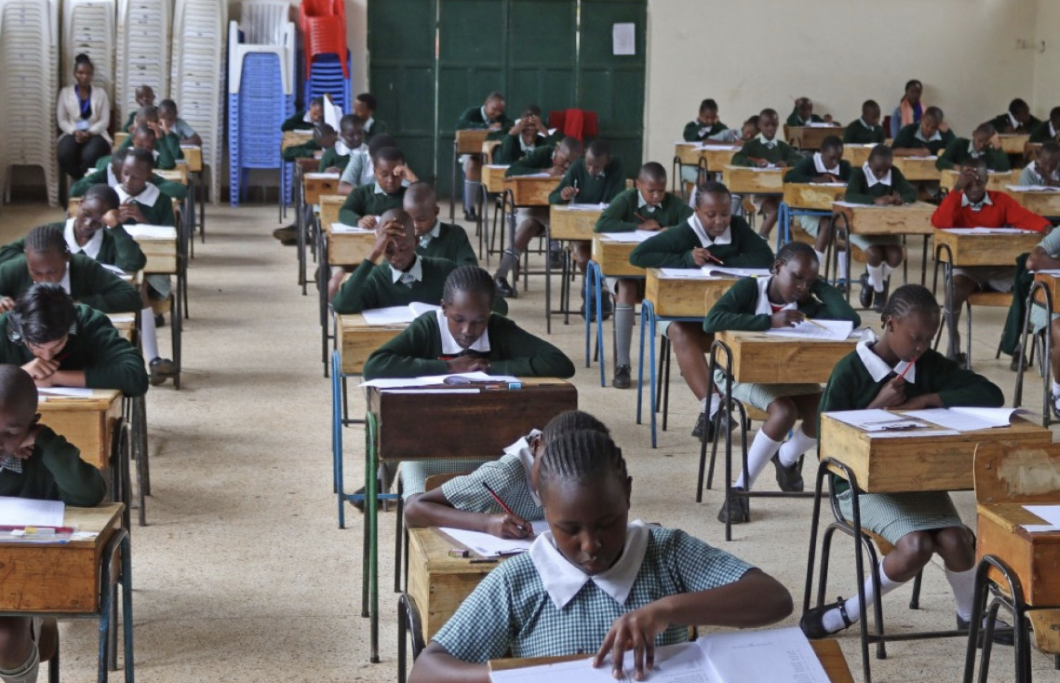
Learners in a classroom /FILE
The government recently released guidelines on how learners will be placed in Grade 10 and revealed factors determining the type of schools each student will be sent to for the final three-year stage of basic education.
Grade 10 marks the beginning of senior school (SS), which will run through to Grade 12.
The pioneer cohort of Competency-Based Education (CBE) learners will transition to senior school in January 2026.
Placement of learners into Grade 10 will be based on five parameters.
1. Learner's choice
A learner will be placed in a school based on the pathways they were studying, subject combination and the schools they chose.
There are three pathways: Arts and Sports Science - comprises three tracks of Visual Arts, Performing Arts and Sports Science.
Social Sciences has two tracks - Languages and Literature; and Humanities and Business Studies.
The third pathway is STEM (Science, Technology, Engineering), comprising three tracks: Pure Sciences, Applied Sciences and Technical Studies.
2. Merit
The choice of school a learner will be placed into will also be determined by their performance in the Kenya Junior School Education Assessment (KJSEA)
3. Psychometric tests
Besides the Grade 9 assessment, learners will also be subjected to aptitude tests by the Kenya National Examination Council (KNEC) and their respective schools to determine their interests and talents.
4. Regional balance
Regional balance will also be a determinant in placing learners in senior school to achieve equity and fair access for all learners.
5. School capacity
The number of learners that particular schools can accommodate will also play a role in determining where learners are placed.
No school will be allocated learners beyond its capacity.
CATEGORISATION OF SCHOOLS
According to the guidelines, schools have been categorised to accommodate learners based on their pathways, availability of accommodation, gender and special needs.
Triple Pathway Senior Schools: These will accommodate learners pursuing all three pathways of Arts and Sports Science, Social Sciences and STEM (Science, Technology, Engineering).
Double Pathway Senior Schools: These will accommodate learners pursuing two of the three pathways.
Day Senior Schools: These will cater for learners who will commute from their schools.
Hybrid Senior Schools: They will accommodate both resident and non-resident learners.
Girls/Boys Senior Schools: These will accommodate either girls or boys only.
Mixed Senior Schools: These will admit both boys and girls.
Special Needs Senior Schools: These will admit learners with hearing, physical and visual impairment.
Vocational Senior Schools: These will accommodate learners with autism, cerebral palsy, cognitive difficulties and those who are either deaf or blind.
Selection of school based on the pathway
Each student will be required to select 12 schools.
Four (4) schools in the first choice track and subject combination
Four (4) schools in the second-choice subject combination
Four (4) schools in the third choice subject combination
Selection of school based on accommodation
Out of the 12 schools selected based on the pathway:
Nine (9) must be boarding schools: 3 from the learners’ home county and six (6) from outside their home county/county of residence.
Additionally, three (3) must be day schools in their home subcounty or the subcounty of residence.
How will the ministry determine who goes to boarding school?
According to the guidelines on selection and placement of learners in senior school, a learner's performance in Grade 9 and their pathways will greatly determine whether or not they automatically get admitted to a boarding school of their choice.
The top 6 learners per gender in each STEM track per subcounty will be placed in boarding schools of their choice.
The top 3 learners per gender in each Social Science track per subcounty will be placed in boarding schools of their choice
The top 2 learners per gender in each Arts and Sports Science track per subcounty will be placed in boarding schools of their choice.
Candidates who attain achievement levels averaging 7 and 8 per track will also be placed in boarding schools of their choice.
The guidelines require both public and private schools to admit Grade 10 learners through the Kenya Education Management System (KEMIS).
"No principal shall enter a learner into KEMIS before he/she reports to the school physically," Director, Directorate of Secondary Education, Dr William Sugut said.
He said admission letters/joining instructions will be accessed online using the learner’s assessment number.
Placement results will show where learners have been placed.
Learners who wish to change schools will be required to make requests through the heads of junior schools at least two weeks before the official grade 10 reporting date.
Dr Sugut said schools with vacancies will declare through their respective county directors of education, and priority will be given to those who had earlier selected the schools they are requesting.
Replacement will be done once and shall be irreversible.
"Upon a request’s approval, the joining instructions shall be accessed online; at no time shall a school issue printed letters for replacement cases," Sugut directed.
He further clarified that the Ministry of Education will only approve replacements based on the receiving school's capacity.
The entire selection and placement process will be automated based on students' interests, teachers' input (insights on learners' potential, strengths and weaknesses) and academic performance.