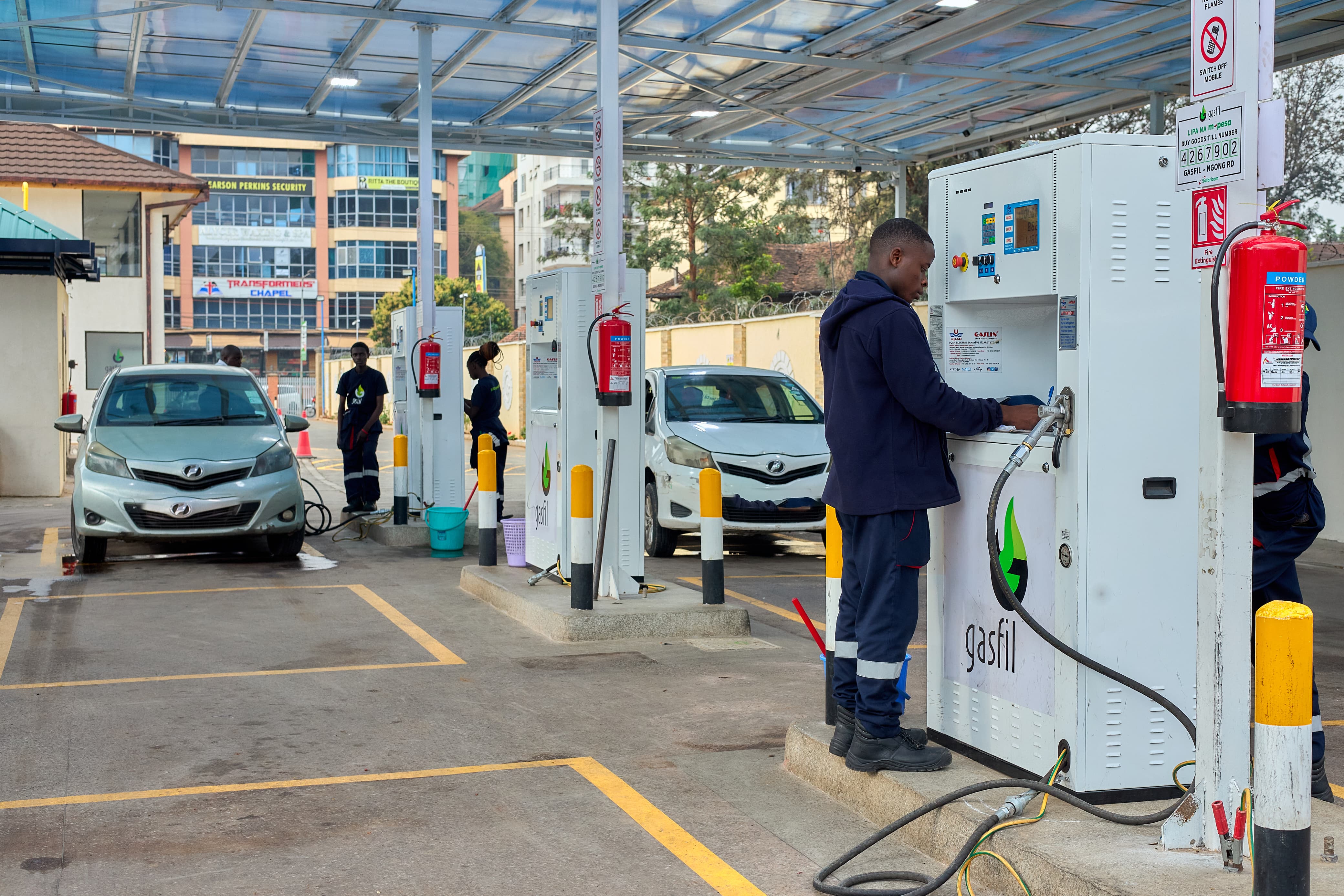
On a bustling Thursday morning along Ngong Road, a white hatchback car pulls into a modest fueling station.
But instead of the familiar scent of petrol, the air carries a faint smell. The driver steps out, not to fill up with gasoline, but to refuel with liquefied petroleum gas (LPG)—a less common kind of fuel in Kenya.
Kenya, like the rest of the world, is in the race for clean mobility solutions, with safer fuels and electric rides high on the agenda.
For instance, the country targets to have five percent of all new vehicles registered to be electricity-powered as part of the global efforts to cut carbon emissions and stem adverse climatic change.
Just like electric rides, autogas (LPG for cars) is increasingly gaining popularity across major towns, though at a slower pace.
Gasfil Kenya managing director James Macharia—one of the players in the autogas sector—says that despite the push for these environmentally friendly initiatives, uptake of the cars has been slow.
He points out that Kenya and the rest of the region lack adequate infrastructure to drive the uptake of autogas as a viable alternative to polluting fossil fuels.
As of June 2024, Kenya had 17 operational LPG fueling stations, underscoring the potential for growth in this fledgling sector.
“We believe that with the right incentives from the government and other industry actors, this localized infrastructure can help overcome the difficulties in energy access due to weak supply chains and limited fuel availability,” said Macharia.
“This would go a long way in ensuring that LPG is available affordably to customers in both large cities and small communities,”
Autogas and electric engines are the two clean modes of transport whose popularity has been on a spike in the race to curb carbon emissions from the sector. There are 3,753 electric vehicles in the country.
The use of autogas on vehicles was piloted in Kenya seven years ago, and its popularity, like that of electric vehicles, is projected to remain on a steady climb in the wake of costly petrol and diesel.
“The high fuel prices motivated us to find an affordable and sustainable alternative,” said Macharia.
Autogas, the term for LPG used as vehicle fuel, is not new globally. Countries like Turkey and South Korea have long embraced it.
But LPG-powered vehicles are a rarity in Kenya, where petrol and diesel dominate. Gasfil says it aims to change that.
Data by EPRA for the period up to May 2024 shows that Kenya has an estimated 20,000 vehicles running on autogas, making it among the most widely used clean energy in the transport sector.
According to Macharia, LPG is typically 30 to 40 percent cheaper per litre than petrol or diesel.
While it has a slightly lower energy density, meaning fewer kilometres per litre, the overall cost savings are significant. Moreover, LPG burns cleaner, reducing engine wear and lowering maintenance costs over time.
“The adoption of LPG-powered vehicles in Kenya has continued to grow, even as fuel prices have eased slightly in recent months. This trend is driven by the significant cost savings and environmental benefits associated with LPG, making it an attractive alternative to traditional fuels,” said Macharia.
Autogas was first piloted in Kenya in 2018, and EPRA has since, in collaboration with the Kenya Bureau of Standards (KEBS) and the National Transport and Safety Authority (NTSA), licensed vehicle conversion companies.
The state government has been promoting LPG as part of its broader strategy to reduce reliance on imported fossil fuels and cut carbon emissions.
The Energy and Petroleum Regulatory Authority (EPRA) recently streamlined licensing for LPG conversion kits to encourage more motorists to make the switch.
Several auto-gas stations have also opened in Nairobi, Mombasa, and Kisumu, major oil marketers, including TotalEnergies and Vivo Energy, have started offering LPG refuelling services at select petrol stations.
“Seamless adoption of autogas in Kenya will be made possible through the various regulatory bodies, where EPRA is for licensing, KEBS is for standards, and NEMA provides the environmental framework for autogas implementation,” said
Ministry of Petroleum Principal Secretary Mohamed Liban said that on April 16.
According to the World Liquid Gas Association (WLGA), the global lobby that promotes the use of LPG, an estimated 15,000 vehicles have been converted to run on autogas in Kenya, signalling a major shift from traditional fuels.
“We’re investing in developing retail shops, delivery systems, and collaborations with local businesses across East Africa. Currently, Gasfil operates two autogas stations in Nairobi. While this is a modest footprint, the company plans to expand its network,” said Macharia.
To drive growth, the firm says it is exploring flexible payment options, including pay-as-you-go schemes, aimed at making vehicle conversions more accessible—particularly for lower-income drivers who may find upfront costs prohibitive.
The company is also in the final stages of forming partnerships with various organisations, expected to be announced in 2025. These collaborations are intended to support technology development, expand operational reach, and enhance service delivery.