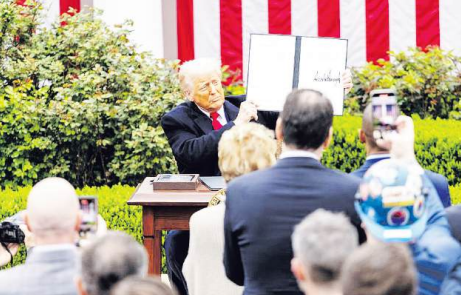
In classic Trumpian fashion, President Donald Trump has upped the ante on his long-running economic confrontation with China, this time slapping a jaw-dropping 245% tariff on Chinese products.
The move, designed to “protect American industry” and punish China for what Trump calls “economic aggression,” is a dramatic escalation in a trade war that is increasingly out of step with economic reality.
Why now? Because China is growing again and growing fast. Recent data from Beijing shows the Chinese economy expanding at over 5.4 per cent year-on-year, with surging domestic consumption and a rebound in industrial output.
Far from being humbled by Trump-era tariffs, China appears to have weathered the storm, recalibrated its economy and is now reasserting itself as a central engine of global growth.
In this context, Trump’s new tariffs don’t look like a bold defense of American workers—they look like an admission of failure. The old trade war didn’t work. And doubling down on a failed strategy, especially with such a drastic move, is not leadership. It’s desperation.
When Trump first launched his trade war in 2018, the objectives were clear: reduce the trade deficit, punish unfair practices and revive American manufacturing. Yet six years later, the record is difficult to defend.
US manufacturing job growth plateaued, the trade deficit with China ultimately widened and American consumers bore the brunt of higher import prices.
Farmers lost key export markets and US businesses scrambled to absorb the shock. Now Trump is turning his attention to Chinese goods and electric vehicles (EVs), targeting one of China’s fastest-growing exports.
China has emerged as a global EV powerhouse, not just in volume but in battery technology, affordability and supply chain efficiency. Rather than respond with strategic investment in US innovation and clean energy production, Trump’s answer is to slam the door shut by making Chinese EVs effectively impossible to import.
But a 245 per cent tariff won’t halt China’s EV and industrial ambitions. It will simply push them elsewhere into Europe, Southeast Asia, Latin America, Africa further embedding China in the global green economy while the US risks being left behind.
China’s recent economic resurgence is not just a short-term rebound, it’s a statement of resilience. Despite the lingering effects of its prolonged Covid-19 lockdowns and an ongoing property sector slump, Beijing has managed to engineer growth through targeted stimulus, strong exports in key sectors like EVs and solar tech and rising consumer confidence.
Rather than buckle under US tariffs, China adapted. It diversified supply chains, strengthened trade ties with neighbors through the Regional Comprehensive Economic Partnership (RCEP) and doubled down on self-reliance in strategic sectors.
The very industries Trump sought to weaken have instead become pillars of China’s modern economy. Trump’s 245 per cent tariff is part of a larger, outdated playbook, one that assumes the US can win a trade war through brute force, regardless of global dynamics. But the world has changed.
The global economy is more interconnected than ever. Supply chains are global. Innovation is collaborative. And consumers, especially younger, climate-conscious ones want affordable, efficient and clean technology.
Right now, China is supplying it. Rather than embracing the global green transition, Trump is trying to wall it off. That’s not only bad economics, it’s bad politics.
American automakers themselves have warned that excessive tariffs could backfire, stalling progress and raising costs for US consumers. Instead of building a competitive domestic industry through incentives, research and workforce development, Trump is choosing isolation.
Trump’s latest tariffs don’t correct the problems in US-China trade. They paper over them. A smarter strategy would focus on outcompeting China through innovation, not fear.
That means investing in America’s battery supply chains, doubling down on Stem education, expanding domestic manufacturing capacity, and forging trade alliances that reinforce American values and standards.
China’s economic rise is not a threat to be feared, it’s a challenge to be met. And the best way to meet it is not by slamming tariffs on the future, but by investing in it ourselves.
A 245 per cent tariff makes headlines. It may even win over a few US nationalists. But it doesn’t fix the structural challenges the US faces in a fast-evolving global economy.
China’s growth is real and its economic transformation is well underway. It’s time the US responded with real strategy, not recycled theatrics. As China powers forward with its EV dominance and other aspects of industrial growth, the question isn’t whether Trump’s tariffs will work, they won’t.
The real question is whether America is ready to compete on the global stage with confidence, innovation and investment. Because tariffs are not a plan. They’re a reaction. And it’s long past time the US moved from reaction to leadership.
The writer is a Journalist and communications consultant