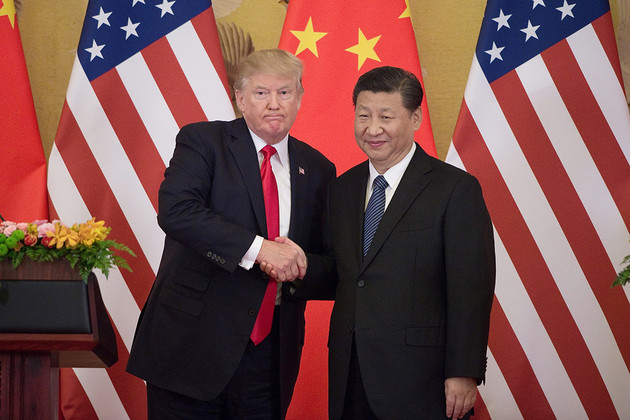
The United States and China, the world’s two largest economies, stand at a crossroads. Their relationship — marked by a complex mix of competition, interdependence, and mistrust — has increasingly been defined by economic confrontation, most notably through tit-for-tat tariffs.
While strategic competition may be inevitable in some domains, a prolonged tariff war is neither sustainable nor beneficial for either country — or for the global economy.
As they are global leaders in nearly every facet of modern life, US-China friction has far-reaching consequences, often disrupting international supply chains and affecting billions of lives. For years, the United States and its Western allies-maintained dominance in areas such as trade, technology, military strength, and agriculture. However, China’s meteoric rise has shifted the global balance, prompting anxiety among established powers as Beijing surpasses Washington in key sectors.
When tensions arise between these two nations, open dialogue is critical to preserving diplomatic stability. Neither decoupling nor disrupted supply chains offer meaningful solutions. Instead, sustainable development can only be achieved through mutually beneficial cooperation. While both countries have taken steps to reduce their dependence on one another, a full economic decoupling would come at a steep cost. For example, the US aviation industry could lose as much as $875 billion, the semiconductor industry $159 billion, and medical services $479billion.
The era of advancing national development at the expense of others through protectionism is behind us. The future lies in multilateralism. The US and China must work to chart a path toward peaceful coexistence — one that has a positive impact on the world. In a time when the global community is still reeling from the effects of the Covid-19 pandemic, the Russia-Ukraine conflict, climate change, and volatile energy prices, another trade war could be devastating.
The current escalation between Washington and Beijing is not new — it began/escalated? During Donald Trump’s first term. Whenever Trump inflames tensions with China, he often claims his aim is to correct trade imbalances, address intellectual property concerns, and ensure fair market access.
While these objectives have merit, the tools used — chiefly punitive tariffs — are blunt and frequently counterproductive. American consumers and businesses have faced higher prices and disrupted supply chains, while Chinese manufacturers have been forced to deal with market instability and retaliation. The 2018 tariff war made this clear — and now, the world is once again teetering on the edge of similar turmoil unless cooler heads prevail.
There is no need for tariff wars. History has shown that in the rhetoric of ‘winning’ a trade war, a key truth is often lost: no one actually wins. Both nations suffer economically, and the global trading system becomes more fragmented. In today’s fragile recovery, with new geopolitical tensions on the rise, doubling down on protectionism would only deepen vulnerabilities.
Instead, the US and China should adopt a more pragmatic approach — cooperation where possible, respectful competition where necessary. This is not a call for naivety, but for realism.
The greatest challenges of our time — climate change, global health, nuclear proliferation, and digital governance — are too complex for unilateral solutions. They demand shared responsibility and joint action.
Consider climate change: the US and China together are responsible for over 40 per cent of Global carbon emissions. Any meaningful effort to combat the climate crisis must include Collaborative leadership from both countries. From clean energy investments to emissions standards and green innovation, a cooperative approach can accelerate progress and set an example for the rest of the world.
The same principle applies to global health. The Covid-19 pandemic highlighted the necessity of transparency, data sharing, and unified responses. Even amidst political friction, collaboration in public health can save lives. Technology, too, remains a domain of fierce competition, yet demands cooperation. In fields like cybersecurity, AI, and data governance, divergence risks creating incompatible global standards that stifle innovation and threaten the integrity of the Internet.
Strategic rivalry does not rule out communication — it makes it essential. Of course, the US and China differ fundamentally in governance and strategic vision. The US promotes liberal democracy and free markets, while China upholds a state-led model of development. These distinctions will persist, and they should not be ignored. But historically, economic interdependence has served as a stabilising force in international affairs. Abandoning that foundation in favour of economic decoupling is a high-risk bet with limited payoff.
Many private sector stakeholders — from agriculture to technology — support a more stable US- China economic relationship. They recognise that access to each other’s markets fuels innovation, job creation, and economic resilience. What they seek is not unchecked globalisation, but predictability, fairness, and fewer barriers.
Some argue that confrontation is necessary to maintain leverage. But tariffs are a costly and often ineffective form of leverage. Overreliance on economic coercion can desensitise adversaries and entrench opposition. Diplomacy, by contrast, offers a pathway to resolving disputes without escalating them. It protects national interests while avoiding the pitfalls of zero-sum thinking.
Ultimately, the true test of leadership in Washington and Beijing will not be in displays of strength, but in managing complexity. In the 21st Century, global influence will be measured not just by economic or military power, but by the ability to build coalitions, establish norms, and lead on common challenges.
Cooperation isn’t capitulation — it’s a strategic necessity. The stakes are enormous. A world divided by economic walls is one that is poorer, more unstable, and less prepared for the crises of tomorrow. By choosing partnership over perpetual conflict, the US and China have a rare opportunity to reshape the global order for the better.
It is not only in their national interests — it is in the world’s.
Onyango K’onyango is a Journalist and Communication consultant