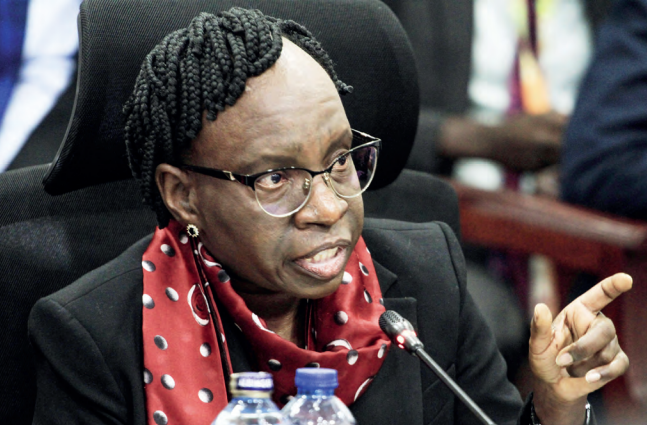
Auditor General Nancy Gathungu has unearthed serious widespread mismanagement and blatant abuse of the multi-billion National Constituency Development Fund at a time courts are recommending winding up of the kitty.
The findings lay bare a pattern of systematic abuse in the usage of the millions wired to constituencies to implement national government development projects.
The report painted a picture that some ghost projects exist in constituencies despite the books showing significant cash had been disbursed for the non-existent projects.
In some cases, there were inflation of projects cost while in a number of constituencies, the management could not furnish the auditors with basic supporting documents.
Some projects were also reported as complete while on the ground, there was little or no work done.
For instance, in Bomachoge Chache constituency, the management could not support Sh36 million it claimed to have transferred to a number of primary and secondary schools in the 2023-24 financial year.
The monies were meant for project implementation in 28 primary schools and one secondary school.
“Procurement records such as tender evaluation minutes, letter of award, acceptance letter, signed contract agreement, inspection and acceptance committee reports, interim/completion certificates, accounting records such as cash books, bank statements and expenditure return and evidence that the projects were implemented in consultation with relevant government departments were not provided for audit,” Gathungu said in her report.
The constituency, which is represented by Alfah Miruka was also flagged after Sh85 million allegedly spent on bursaries could not be ascertained.
According to the report, no acknowledgement letters from the receiving secondary and tertiary institutions were provided for audit.
Gathungu said almost similar issues at Rongai constituency, where Sh65 million worth of bursaries were issued, could not be confirmed.
“The amount includes bursary secondary schools and tertiary institutions amounting to Sh65,463,594. However, the bursaries were not supported by acknowledgement receipts as required by guideline of National Government Constituencies Development Fund Board,” the report said.
In Lafey constituency, apart from the unaccounted for bursary money amounting to Sh2.9 million the management was cited for delay in implementation of projects.
According to the report, the management budgeted to implement 97 projects at a cost of Sh170 million.
“At the closure of the financial year, only 57 projects with contract sum of Sh95,946,931 were completed while 40 projects with a budget of Sh74,878,620 had not started,” the Lafey audit report indicates.
The situation is not different in Mandera West and Mandera South constituencies where Gathungu raised concerns over unsupported financial transfers and questionable project expenditures.
In Mandera West, the audit flagged unsupported transfers of Sh12.7 million to primary schools.
The disbursements, allegedly made for school projects, lacked basic documentations such as appointment letters for the project management committee, inspection reports and acceptance files.
The reported further highlights unsupported bursary disbursements worth Sh1.7 million – the funds were not accompanied by official receipts.
In the neighboring Mandera South, the constituency failed to account for Sh83 million in bursary including Sh.1.3 million for tertiary institutions.
As if courts were taking note, the High Court last year, in landmark ruling, declared the current model of the National Constituencies Development Fund (NG-CDF) unconstitutional.
The three-judge bench of justices Kanyi Kimondo, Roselyne Aburili and Mugure Thande directed that all programmes, projects and activities under the fund should end by June 30 next year.
They were ruling on a matter filed by activist Wanjiru Gikonyo, who sought a declaration from the court on whether the NG-CDF Act was unconstitutional.
The petitioner had argued that the fund creates a third layer of governance not recognised in the constitution and that it violates the principles of separation of powers.
They further noted that the involvement of Members of Parliament in the management of the NG-CDF undermined the doctrine of separation of powers, as it interfered with the roles of the executive and the Public Service Commission.
The petition further claimed that the fund's provisions infringed on county government functions, violating the division of responsibilities between national and county governments.
Gikonyo said the Senate was not involved in the enactment of the NG-CDF Act, making the process illegal.
The Act ( 2015 ) was amended in 2022 and 2023 in an apparent bid to beat a similar declaration of a 2013 Act that suffered a similar fate with unsuccessful appeals at the Court of Appeal and the Supreme Court.
Former Prime Minister Raila also called out MPs for turning themselves into contractors instead of offering oversight to government projects.
In November least year, two months after the High Court’s verdict, Raila claimed that some MPs were carrying out functions that are meant for county governments.
“I’m asking MPs to be more patriotic and move away from functions which are not theirs. I feel very frustrated because I was involved in the drafting of this constitution and how exactly it's supposed to work,” Raila told a press conference.
"They [MPs] want to be building roads and health centres and at the same time, are contractors. Who is going to oversight the government if the oversight is the implementer? It does not happen anywhere in the world.”
Reactions from across the political spectrum have been mixed, while civil society groups and anti-corruption bodies welcomed the ruling as a long-overdue, several MPs have pushed back, with Parliament filing an appeal.
Led by house Speaker Moses Wetang’ula, the lawmakers vowed to mount a legal fightback to save the fund.
“As you are aware, the NGCDF has been instrumental in funding projects that improve education, infrastructure and community development,” he said. “As the matter unfolds in the Court of Appeal, we must prepare to engage constructively and explore alternative solutions to ensure that development at the constituency level does not stall,” Wetang’ula said early this year.