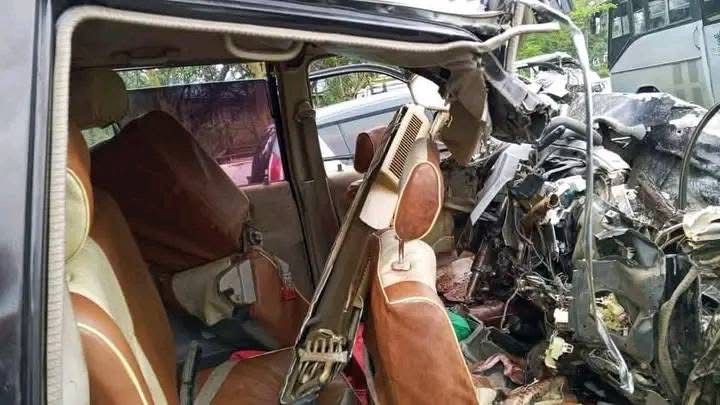
The Kenyan government has announced the return of the dreaded alcoblow, breathalyzer, on major roads to curb the increasing rate of road accidents.
Roads and Transport Cabinet Secretary Davis Chirchir revealed that the National Transport and Safety Authority (NTSA) and police will be conducting random checks on major highways.
Any driver caught under the influence of alcohol beyond the prescribed limit shall be fined up to Sh100,000 or face an imprisonment of a term not exceeding two years or both.
According to the CS, any person who shall be convicted of drinking and driving will be disqualified from obtaining a license for a period of one year.
NTSA will be mounting the checkpoints as per the Traffic (Drink-Driving) Rules, 2025, birthed through the amendment of Section 4 of the Traffic Act, CAP 403.
In Kenya, the legal limit for driving under the influence of alcohol, as measured by a breathalyzer, is 35 microgrammes of alcohol in 100 milliliters of breath.
Here is what you need to know about how alcohol consumption impedes driving judgment
According to Michigan Medicine, a 160-pound man who consumes two alcoholic beverages will experience some loss of judgment and a decreased ability to rapidly track a moving target.
He will also have a reduced multitasking ability, according to the Centers for Disease Control and Prevention.
Women, who generally weigh less than men, would see a higher Blood Alcohol Concentration (BAC).
Three alcoholic drinks will bring a person's blood alcohol level to approximately 0.05 per cent, which can impair the ability to rapidly focus vision, lower alertness, and decrease coordination, to the point that steering becomes difficult and response to driving emergencies becomes blunted.
After approximately four alcoholic drinks, one's balance, vision and reaction time are often affected.
It becomes harder to detect roadway dangers. Reasoning and information processing are often measurably impaired. This corresponds most closely to a BAC of 0.08 per cent.
A blood alcohol concentration of 0.10 per cent is generally associated with a clear loss of reaction time and control. There will be a reduced ability to maintain proper lane position or to brake appropriately.
Poor Judgment = Dangerous Driving
When alcohol enters your system, your brain’s ability to think clearly, react quickly, and make safe decisions is compromised.
This impaired judgment can lead to a wide range of accidents, including:
Rear-end collisions – Slower reaction times mean it’s harder to stop in time.
Head-on collisions – Alcohol confusion can lead to driving the wrong way.
Intersection crashes – Missed stop signs or red lights are common under the influence.
Pedestrian and cyclist accidents – Impaired vision and awareness make it harder to see others.
Sideswipe collisions – Drifting out of your lane due to poor coordination.
T-bone crashes – Failing to yield or misjudging other vehicles at intersections.
What Alcohol does to your brain and body
Alcohol impairs several key skills needed for safe driving:
Slowed Reaction Time – You won’t respond quickly enough to avoid sudden dangers.
Poor Decision-Making – Alcohol lowers inhibitions, increasing risky behavior like speeding or tailgating.
Blurred Vision – Alcohol affects eye movement and depth perception.
Drowsiness – Drinking often makes people sleepy, raising the risk of dozing off at the wheel.
Loss of Coordination – Simple actions like steering, braking, and signaling become harder.
Even if you feel fine, your brain may already be too impaired to drive safely.
The high cost of drunk driving accidents
Drunk driving often results in severe, life-altering injuries, such as:
Traumatic Brain Injuries (TBIs) – Long-term cognitive or physical impairments.
Spinal Cord Injuries – Paralysis or permanent mobility issues.
Broken Bones – May require surgery and long recovery periods.
Internal Injuries – Organ damage, internal bleeding, and other hidden dangers.
Emotional Trauma – PTSD, anxiety, and depression are common after serious accidents.
These injuries can result in overwhelming medical costs, rehabilitation, and a lifetime of consequences for both victims and the impaired driver.
Plan and stay safe
To avoid driving under the influence:
Choose a designated driver before going out.
Check public transport options in advance.
Budget for a taxi or rideshare.
Have a backup plan, like calling a friend or staying overnight.
Never accept a ride from someone who’s been drinking.
Data from the NTSA shows a worrying rise in road fatalities in 2024, with Saturdays and evening hours proving to be the deadliest times for road users.
A total of 4,748 people died in crashes last year, an increase of 424 deaths from 2023.
Saturdays claimed 855 lives in 2024, up from 782 in 2023, making it the most dangerous day of the week for road travel.
Sundays followed closely with 828 deaths, compared to 778 the previous year. Mondays also saw a steep rise, recording 743 fatalities in 2024, up from 576.
Mondays also saw a steep rise, recording 743 fatalities in 2024, up from 576.
At least 649 lives were lost on Friday compared to 644 in 2023, while Tuesday recorded 573 road fatalities, which is an increase from 477 in 2023.
Thursday saw the least deaths from road crashes at 518, which was an increase from 531 in 2023
The NTSA attributed these trends to high traffic volumes and risky driving behaviours during weekends and the start of the week.
Men continued to dominate the fatality statistics, with 4,035 male deaths recorded in 2024 compared to 3,531 in 2023.
This contrasts with a decline in female fatalities, which dropped from 784 in 2023 to 713 in 2024.