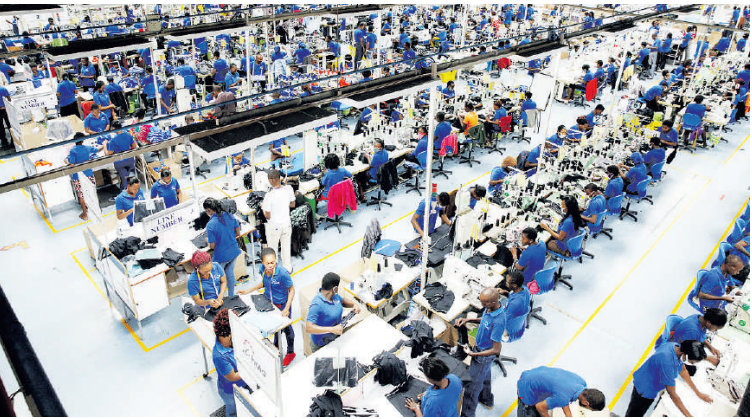
Kenya's clothing industry will take the biggest hit after the US imposed a 10 per cent export tariff on Kenyan goods, wiping out AGOA benefits.
This, even as the Trump administration places the Kenya-US trade talks on ice, with a delegation from Kenya pitching tent in the US last week to try and revive the talks that stalled after the exit of Joe Biden and assumption to office by President Donald Trump.
While the idea was mooted during his first term when Uhuru Kenyatta was Kenya’s President, it has never been actualised.
In the latest of Trump’s tariffs, the US has slapped Kenya and other African countries with a 10 per cent baseline tariff on all goods shipped to the country, with some going higher, citing objectives to revitalise domestic manufacturing and ensure fair trade practices.
The rate is the same that Kenya imposes on US exports into the country. This ends the benefits Kenya has been enjoying under the African Growth and Opportunity Act (AGOA), which gave it duty-free access to the US market on up to 6,400 product lines for the last 25 years.
Investments, Trade and Industry CS Lee Kinyanjui yesterday said the new tariff policy by the US presents both challenges and opportunities which Kenya can capitalise on, even as he acknowledged is will have an impact.
According to Kinyanjui, the 10 per cent is significantly lower than the rates imposed on key textile-exporting competitors like Vietnam (46%) Sri Lanka (44%), Bangladesh (37%), China (34%), Pakistan (29%) and India (26%).
“With other textile-exporting countries facing much higher tariffs, Kenya could position itself as an alternative sourcing hub for US buyers. “This presents an opportunity for investment in local textile production and value addition, that could attract businesses seeking to avoid higher costs from traditional suppliers,” the CS said.
He said the Trump decision will however raise costs for Kenyan businesses exporting to the US hence supply chain adjustments will be necessary, such as expanding production to meet new demand, and promising government support.
Industries such as apparel, leather, and agro-processing could benefit from increased demand, the CS noted. Foreign Affairs PS Korir Sing’Oei said Kwenya will be “vigorously” advocating for a waiver.
“Additionally, as AGOA is a Congressional framework for market access to the US by African exporters, it is our considered view that until the law lapses end of September 2025 or unless repealed earlier by Congress, the new tariffs imposed by President Trump will in any event still not be immediately applicable,” he said.
WHITE HOUSE
White House said President Trump is invoking his authority under the International Emergency Economic Powers Act of 1977 (IEEPA) to address the national emergency posed by the large and persistent trade deficit that is driven by the absence of reciprocity in US’s trade relationships and other harmful policies like currency manipulation and exorbitant value-added taxes perpetuated by other countries.
“These tariffs will remain in effect until such a time as President Trump determines that the threat posed by the trade deficit and underlying nonreciprocal treatment is satisfied, resolved, or mitigated,” White House said.
More than half of Kenyan exports to the US are comprised of textile and apparel, macadamia, coffee, black tea and organic coffee, all which will now attract duty, raising costs for Kenyan exporters while squeezing profit margins.
The move by Trump signals an end to AGOA, which has been a cornerstone of US-Africa trade relations, initiated by President Bill Clinton, who signed it into law in May 2000.
President George W. Bush extended it twice with an expiry date of September 30 this year. According to the Kenya Association of Manufacturers (KAM), apparels cover 85 per cent of Kenya’s exports to the US.
“We seem to be at the minimum tariff, which is 10 per cent much lower than the majority of the countries. Our hope is that despite the new tariff alignment, we are hopeful that AGOA can be renewed under a special agreement to access US markets duty-free,” KAM chief executive Tobias Alando told the Star.
Approximately 56 per cent of Kenyan goods have been entering the US duty-free under the AGOA programme. The remaining imports were largely exempt under the US Generalised System of Preferences or Most Favoured Nation status.
Consequently, the average US tariff applied to Kenyan imports was a mere 0.3 per cent.The International Emergency Economic Powers Act also contains modification authority, allowing President Trump to increase the tariff if trading partners retaliate or decrease the tariffs if partners take steps to remedy non-reciprocal arrangements.
The move could hard-hit local manufacturers and SMEs who have been exporting to the US, with a potential of job losses mainly in the textile industry. This could also reduce foreign exchange earnings mainly on exports and have a broader economic impact on Kenya whose total value of goods traded with the US closed at Sh196.3 billion in 2024.
According to data by the US Trade Representative office, Kenya’s exports to the US were valued at $737.3 million (Sh95.2 billion). This was an increase when you compared to the Kenya National Bureau of Statistics’s Economic Survey 2024, which puts 2023 export value at Sh62.3 billion.
The US exported to Kenya goods worth $782.5 million (Sh101.1 billion). Kenya alongside Egypt, Morocco, Ethiopia and Ghana however have the lowest tariff imposed on their exports based on the similar rates applicable for US goods.
This is compared to countries such as Lesotho, which imposes a 99 per cent tariff on US imports and has hence been slapped with a 50 per cent export tariff.
Madagascar has been given a 47 per cent tariff base on its 93 per cent it charges US imports while Mauritius’ exports will pay a 40 per cent duty against an 80 per cent tariff it has imposed on the US.