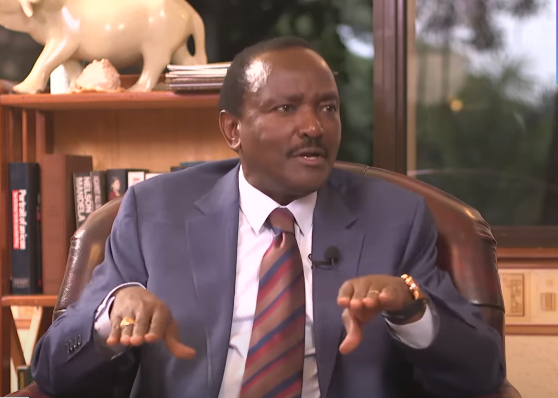
Wiper leader Kalonzo Musyoka is facing what could be the most opportune political moment of his career to become Kenya’s sixth president, marking the pinnacle of his 40-year journey in politics.
Yet, the former vice president faces an uphill battle in rallying key opposition figures to support his bid and strengthen his chances of winning the presidency.
The 2027 presidential contest is expected to be a fierce showdown between proponents of change and the status quo, with President William Ruto seeking re-election for a final term.
Kalonzo, who entered politics in 1985 after winning the Kitui North parliamentary seat on a Kanu ticket, previously backed former Prime Minister Raila Odinga in the 2013, 2017 and 2022 elections.
Positioning himself as Kenya’s cleanest politician and a champion of change, Kalonzo has become an influential player in the country’s political landscape, often playing the role of kingmaker.
In the 2022 presidential race, he was instrumental in boosting Raila’s numbers, delivering the Ukambani region to the Azimio coalition by a significant margin.
His three counties—Machakos, Makueni, and Kitui—provided a combined 769,422 votes for Raila, accounting for 75 per cent of the region’s 1,699,724 registered voters.
Machakos contributed 304,830 votes, Makueni 229,187 and Kitui 235,408.
However, the former premier ultimately lost to President Ruto by about 200,000 votes in a high-stakes election where former President Uhuru Kenyatta supported his bid Kalonzo’s political career has been marked by failed presidential attempts and a series of unfulfilled promises from allies who have abandoned his ambitions in the past.
His first attempt at the presidency in 2007 saw him finish third behind President Mwai Kibaki and Raila Odinga.
He was subsequently incorporated into the government, serving as VP in the Grand Coalition government.
Having postponed his presidential ambitions three times in favour of Raila, he is now reportedly assembling the political machinery needed to challenge Ruto in 2027.
Despite being the most experienced politician in the current opposition alliance—which includes at least five major political figures Kalonzo faces a tough challenge in convincing his counterparts that he is the strongest candidate to defeat Ruto.
Among those in his camp are former Deputy President Rigathi Gachagua, DAP-K leader Eugene Wamalwa and Martha Karua of the People’s Liberation Party. Former Interior Cabinet Secretary Fred Matiang’i, a powerful minister under President Uhuru Kenyatta, is expected to join the team in June.
Reports suggest that Matiang’i will soon be installed as the leader of the Jubilee Party, positioning him to play a key role in shaping the 2027 opposition lineup. Kalonzo’s political influence has been growing, particularly following his alliance with Gachagua.
The two leaders are reportedly planning to form a coalition to rival Ruto’s UDA in 2027.
However, the opposition coalition must overcome numerous internal challenges, including competing ambitions.
Kalonzo has made it clear that he will not step aside in 2027, insisting that it is his turn to lead.
In a January radio interview, he declared that he would not support another presidential candidate, emphasising that he has already made significant sacrifices by stepping down for Raila three times.
“I have waited for 20 years. There comes a time when even the world acknowledges that it is your time,” he said.
“The moment has come for others to pave the way for me so we can save this country.”
However, some analysts argue that a Matiang’i candidacy—backed by Kalonzo and Gachagua—could be more appealing to Kenyans due to Matiang’i’s strong track record.
“Should the opposition unite behind Matiang’i, that would be the surest bet against Ruto in 2027,” political analyst Alexander Nyamboga said.
“The election will be a contest between change and the status quo, with Matiang’i being the best candidate to embody the change Kenyans are yearning for, given that figures like Kalonzo have been in politics for decades.”
Meanwhile, Gachagua, whose political base in Mount Kenya has grown increasingly disillusioned with Ruto, is advocating for a strong opposition coalition to challenge the presidency in 2027.
According to the former DP, Kalonzo’s Kamba constituency will join forces with the Mount Kenya region under Gikuyu, Embu, Meru, and Akamba (Gema) bloc to consolidate votes and defeat Ruto.
Gachagua has argued that the Gema community will form the next government if it remains united, suggesting that he would support Kalonzo’s bid if he were unable to run due to a potential impeachment.
“God, in His own miraculous way, has brought us together. We were with President William Ruto, but he pushed us away. You were with Raila Odinga, but he abandoned you. And God planned for us to come together,” Gachagua said on March 2.
“Let me assure the people of Ukambani: Gema—Gikuyu, Embu, Meru, and Akamba—is the solution for this country. This time, with your support, we will form the government together, and there is no turning back,” he added while addressing a church service at Gospel Confirmation Centre in Machakos.
The Gema alliance, originally founded in 1971 to advance the political and social interests of eastern Kenya’s Bantu communities, has historically voted as a bloc in past elections.
However, it has also faced criticism for fostering tribal divisions, particularly during election periods. President Ruto has openly criticised ethnic political alliances, arguing that they undermine national unity.
“Kenya is focused on issue-based politics. Those dividing Kenyans along tribal lines should step aside,” the President said.
Gachagua’s efforts to consolidate the opposition while advocating for Gema unity are seen by analysts as a move that could ultimately benefit Kalonzo—especially if Gachagua is barred from running.
The former Mathira MP, who is emerging as a key player in the 2027 race, is set to launch his political party in May, ahead of the opposition coalition’s official unveiling.
He has emphasised that his party will actively involve young people, particularly from Generation Z.
“My party will give Gen Z a voice in leadership. The deputy party leader will be a Gen Z so that we don’t just tell them they are the leaders of tomorrow—they are the leaders of today. I want to mentor them. I have the experience; they have the knowledge and creativity. Together, we can create a powerful leadership combination.”
Kalonzo has also signalled his intent to form a new alliance, breaking away from the Azimio la Umoja One Kenya coalition, which nearly defeated Ruto in 2022.
“Azimio is dysfunctional. We are consulting, but clearly, we can’t go into the next election as Azimio. We are actively reorganising,” Kalonzo said on February 3.
“Either we form a new coalition— which we are working on—or, with the agreement of others, we rebrand Azimio. But I don’t think Azimio is rebrandable. We need a new coalition.”
Political analyst Prof Macharia Munene argues that Kalonzo has a unique opportunity to redeem himself but must overcome past perceptions, including his reputation as a political “watermelon” due to shifting loyalties.
“Kalonzo, with a skeletal presidential operation centre in Karen, struggles to assert himself as a decisive leader. His reputation for indecisiveness—and his own admission that he would be the ‘most foolish man’ if he followed Raila again—are obstacles he must address,” Munene said.
As Kalonzo works to position himself as the opposition’s joint candidate in 2027, he faces a tough battle against Ruto’s Kenya Kwanza alliance, which is actively making inroads into his Ukambani stronghold.
Machakos Deputy Governor Francis Mwangangi believes the 2027 election will be a moment for Kenyans to reclaim their country and restore dignity.
“The 2027 election is not about any one opposition leader—it’s about Kenyans taking back their country, building stability, and fostering national cohesion,” he said. He urged the opposition to maintain unity, warning that disintegration would only benefit their rivals.