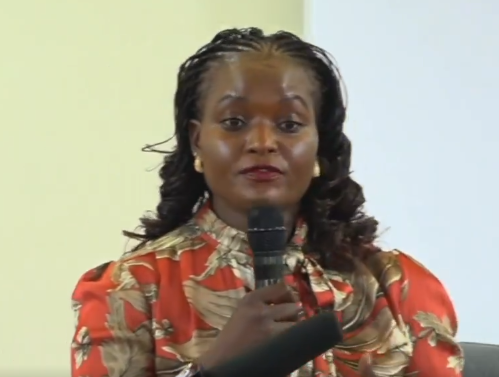
President William Ruto’s Special Adviser on Women’s Rights Harriette Chiggai has raised concern over apparent neglect of the boy child in society.
Chiggai said the society has embraced girls more than boys, resulting in an imbalance that has contributed to a spike in gender-based violence against women and girls.
While speaking on Saturday during the International Women's Day, Chiggai said in 2024, Nairobi alone registered 1,646 reported cases of sodomy.
“Yesterday I was in school and the teachers were saying, if they give out tasks, it is the girls who run to do them, the boys are taking a back step. It is because we have failed the boys; we have failed to remind them that they are the kings, instead we are selling a hate relationship to the boy,” Chiggai said.
She said if the statistics are replicated across the 47 counties with an average of 1,000 sodomy cases, in 10 years' time, the country will have no men to sustain society.
"Remember those are reported cases. For purposes of analysis let's reduce the number to 1,000. That is 47 counties - 1,000 boys raped every year, that is 47,000. 47,000 multiply by 10 years there will be no men to marry your daughters."
Chiggai called on the society to recognise and support the value of the boy child just as is the case with the girl child to have a healthy society.
“Within the neighbourhoods, we have forgotten that all of us are parents; we must take care of all children. You find a neighbour's child, you chase them, you don’t even bother. We have become a bad society."
Chiggai's sentiments come when the world is marking the International Women's Day where Kenyans joined the global community in appreciating women.
According to UN Women, this year’s International Women’s Day marked annually on March 8, is celebrated under the theme “For all women and girls: Rights, Equality, Empowerment".
The organisation stated that the theme calls for action that can unlock equal rights, power and opportunities for all and a feminist future where no one is left behind.
“Central to this vision is empowering the next generation—youth, particularly young women and adolescent girls—as catalysts for lasting change,” UN Women said.
The event honours women's achievements in various fields and promotes gender equality. It also celebrates their contributions to society, economy, culture and politics.
UN Women said this year they will rally and call to take action in three key areas: advancing women’s and girls’ rights, promoting gender equality, and fostering empowerment.
The global event has its roots in the early 20th century, when the first official Women's Day celebration took place in 1911 in countries including Austria, Denmark, Germany and Switzerland.
In 1914, International Women's Day was held on March 8 for the first time in Germany, possibly because that date was a Sunday.
In 1975, the United Nations officially recognised the day.
In 1977, the United Nations General Assembly invited member states to "proclaim by their historical and national traditions and customs, any day of the year as United Nations Day for Women's Rights and International Peace".
This year marks the 30th anniversary of the Beijing Declaration and Platform for Action.