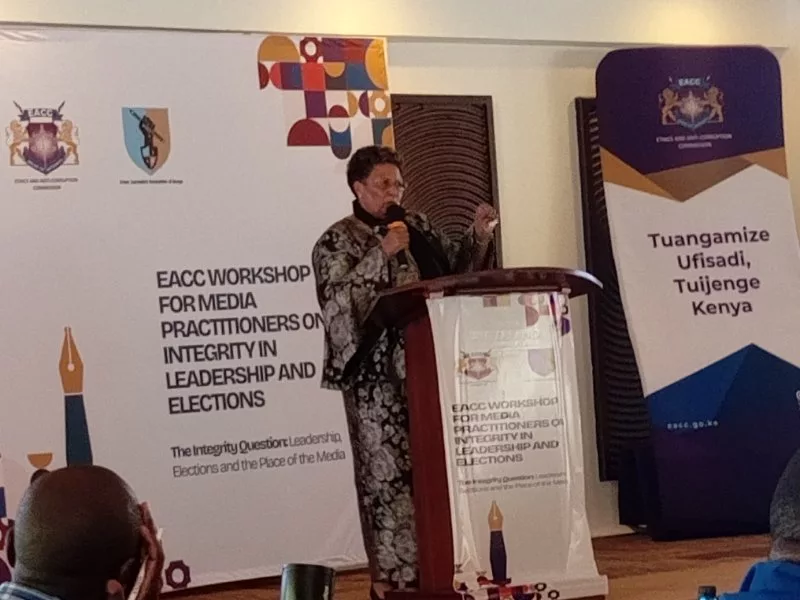
Court of Appeal Judge Fatuma Sichale has said corruption remains the biggest obstacle preventing Kenya from achieving the level of development associated with Singapore,
Sichale said the difference between the two countries was that while Singapore was nearly free of corruption, Kenya continued to grapple with widespread graft.
“The difference between Singapore and Kenya is only one. One is nearly corruption-free, the other one is full of corruption. How shall we ever be similar?” she posed.
Speaking during an Ethics and Anti-Corruption Commission (EACC) media event on Tuesday, the judge said the responsibility of fighting corruption could not be left to investigative agencies and the Judiciary alone, despite their efforts to promote accountability and transparency.
She argued that the fight against graft requires collective responsibility from all Kenyans.
While acknowledging the role played by EACC in pursuing corruption cases, she added that the Judiciary had also been making efforts to give effect to constitutional provisions on accountability.
Sichale, however, said these efforts would not succeed unless ordinary citizens took personal responsibility for confronting corruption in their respective positions.
“When I joined the Corruption Commission in the year 2004, as an assistant director, and subsequently rose to the position of deputy director, with all the naivety that I had, I actually believed that we were going to fight corruption,” she recalled.
She said her experience at the commission, where she served for five years, taught her that no single institution could win the war against graft.
“The fight against corruption cannot be fought by one institution. The Anti-Corruption Commission will lead the fight against corruption, but it is upon all of us to fight corruption,” she stated.
The judge also credited investigative journalism for helping expose graft, noting that media reports sometimes provide investigative agencies with leads that would otherwise remain undiscovered.
She said the media reports helped investigators uncover alleged corruption and trace wealth whose sources had been called into question.
“It was from these investigative journalistic reports that sometimes an investigative agency is able to pick up the matter,” she told journalists who attended the event.
Sichale also urged media practitioners to continue using their platforms to promote accountability, stressing the need for every professional to take responsibility to contribute to the fight against corruption.
She further illustrated the challenges of enforcing integrity through a case involving a magistrate accused of colluding with an applicant to obtain letters of administration for a person who was still alive.
According to the judge, the applicant had allegedly sought to withdraw Sh15 million from the deceased person's bank account using the documents.
Sichale said investigations revealed that several individuals, including a local chief, a registrar of deaths, guarantors and a doctor, had allegedly provided misleading information or documents.
She said the magistrate had raised concerns about inconsistencies in the applicant's relationship with the supposed deceased and had even directed her to appear physically in court before eventually issuing the letters after receiving a doctor's report indicating she was critically ill
The matter remains pending before the Judicial Service Commission.
“Where did the lie begin? The chief lied. The registrar of deaths and births, he has given a false death certificate. The guarantors. Who The doctor,” she said.
Sichale said the example demonstrated how institutional efforts to uphold integrity could be undermined when individuals entrusted with public responsibilities participated in wrongdoing.