Standard Chartered Bank Kenya’s net profit increased seven per cent to Sh10.51 billion in the nine months to September 2026, supported by growth in non-interest income, lower operating costs and a sharp decline in loan impairment charges.
The lender’s profit after tax rose from Sh9.79 billion recorded in the same period last year, despite an 18 per cent drop in net interest income as declining interest rates continued to squeeze lending margins.
The bank’s financial results show that non-interest income grew 22 per cent to Sh12.39 billion from Sh10.16 billion, driven by stronger performance in wealth solutions and markets.
However, net interest income declined to Sh18.17 billion from Sh22.27 billion, dragging total operating income down six per cent to Sh30.56 billion.
The bank attributed the decline in interest income to margin compression in a low interest rate environment, partly offset by growth in lending volumes.
Operating expenses fell 14 per cent to Sh15.03 billion from Sh17.48 billion, reflecting continued cost management, while loan impairment charges dropped 62 per cent to Sh670 million from Sh1.74 billion.
The improvement in loan quality was also reflected in the non-performing loan ratio, which declined by 130 basis points to 4.7 per cent.
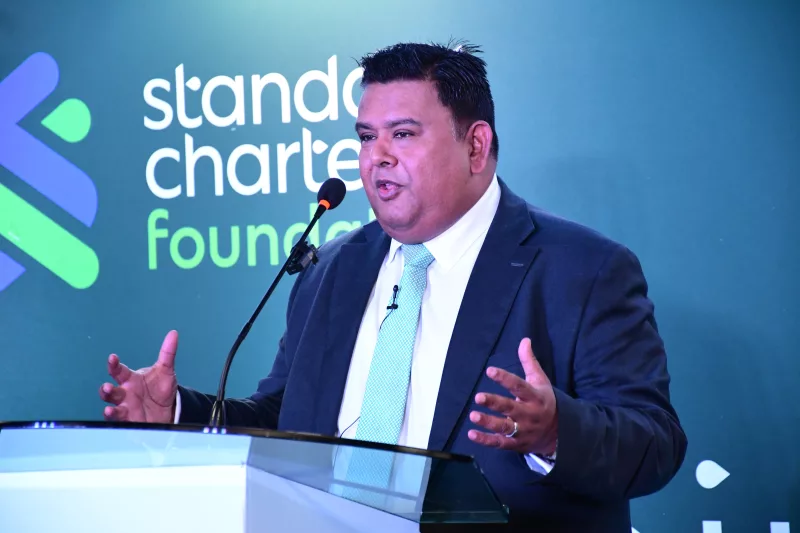
“We maintained strong momentum in the first nine months of 2026, delivering 13 per cent year-on-year growth in profit before tax to Sh14.9 billion, supported by growth in non-interest income,” said the bank’s chief executive officer and head of coverage Birju Sanghrajka.
The bank’s balance sheet expanded, with net loans and advances to customers increasing 16 per cent to Sh179.6 billion compared to December 2025.
Customer deposits grew 18 per cent to Sh335.1 billion from Sh283.5 billion, largely driven by growth in corporate deposits.
Assets under management increased 19 per cent to Sh361 billion, reflecting continued growth in the bank’s wealth management business.
Its liquidity ratio stood at 61.75 per cent, above the 20 per cent regulatory minimum, while the liquidity coverage ratio increased to 485 per cent against the 100 per cent minimum requirement.
The bank’s total capital ratio stood at 18.1 per cent, above the regulatory minimum of 14.5 per cent, although lower than 20.41 per cent recorded in December 2025.
Sanghrajka said Kenya’s economic environment remained broadly stable, supported by a stable currency and lower interest rates, despite rising inflationary pressures.
He added that global uncertainty and geopolitical tensions continued to create volatility in energy markets, trade flows and investor sentiment.