
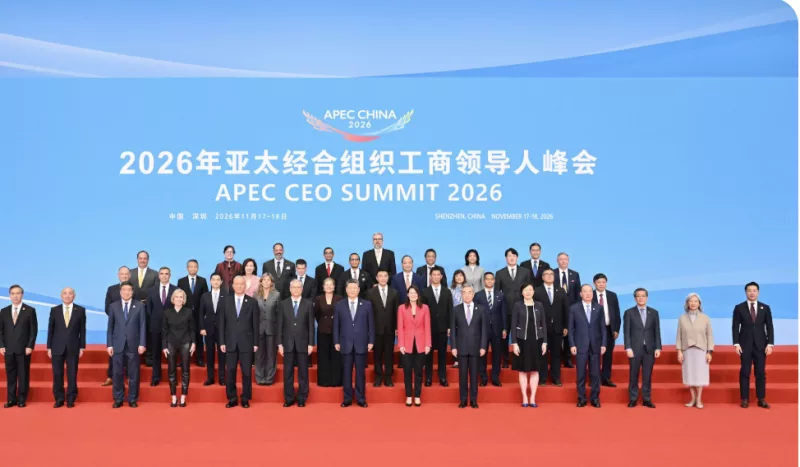
When China hosts the Asia-Pacific Economic Cooperation (APEC) Economic Leaders’ Meeting in Shenzhen, on 18–19 November 2026, it will be promoting a vision of regional prosperity built around openness, innovation and cooperation. Shenzhen, one of China’s first special economic zone, is a leading global centre for innovation, technology, and rapid industrial development, sitting at the forefront of the regional and international AI landscape.
For African economies outside the forum, the significance lies beyond the summit itself. Can the trade policies championed by major economies translate into meaningful opportunities for African exporters?
China’s theme for its APEC host year is ‘Building an Asia-Pacific Community to Prosper Together’, placing openness as one of the main priorities, with trade barriers reduction and strengthening economic integration as key.
According to APEC, average tariffs across its member economies have fallen from 17 per cent to 5 per cent over the longer term.
China’s message builds on statements President Xi Jinping made at the APEC CEO Summit in Gyeongju, South Korea, on 31 October 2025. He called for safeguarding the World Trade Organization’s centred multilateral trading system, strengthening regional economic integration.
As China prepares to host APEC, it is presenting multilateralism and open markets as a response to growing uncertainty in international trade, at a time when geopolitical tensions have unsettled the global trading environment.
For developing economies, the appeal of that message is understandable. Predictable trade rules and fewer barriers can help businesses plan investment, reach new customers and participate in international supply chains. Thus, can openness as a principle, and the rules and policies that promote it, allow countries with different levels of productive capacity to benefit?
African countries are located outside the geographic scope of APEC, but their businesses can be affected by the trade policies of its major economies. The relevance of China’s host-year message therefore lies not in any direct link between APEC and African trade policy, but in the wider question of what openness delivers in practice.
Openness for instance extends beyond trade of physical goods.
One example is the Global Cross-Border Privacy Rules (CBPR) Forum, established on 21 April 2022, which grew out of an APEC initiative and was established to support trusted international data flows while maintaining privacy protection. Its framework seeks to make different jurisdictions’ approaches to data protection more compatible and reducing regulatory challenges for organisations operating across borders. African countries are beginning to engage with this model.
Nigeria joined as an associate in September 2025, following Mauritius in August 2024. Their participation shows how frameworks developed in the Asia-Pacific can extend beyond the region and attract African economies, seeking to facilitate digital trade while protecting personal information.
The Global CBPR is not a tariff agreement, but it illustrates a broader dimension of openness which is the reduction of unnecessary barriers to cross-border activity by building compatible rules and trust. For African economies, this matters because access to international markets increasingly depends on whether businesses can exchange information and provide services across jurisdictions under clear, trusted safeguards and not only on whether goods can cross borders at lower cost.
A more direct test comes also from China’s trade policy towards Africa.
On 1 May 2026, China extended zero-tariff treatment to 53 African countries with which it maintains diplomatic relations. The policy is separate from China’s APEC commitments, but it gives practical relevance to the broader argument Beijing is making about lowering trade barriers and expanding market access.
The measures have helped expand market access for Kenyan agricultural and aquatic products. The first signs of use were tangible. On 1 May 2026, a shipment of 24 tonnes of Kenyan avocados cleared customs in Shanghai, reportedly saving about RMB 26,000/ USD $ 3899 in tariffs. Evidence of immediate cost reductions.
Kenya’s exports of avocado oil to China surged by 700% since the introduction of the policy, with separate data showing avocado exports to China rose by 63.22% between May and August 2026 compared with the same period in 2025. Unroasted green coffee exports increased by 139.66%.
As per August 2026 statistics, Chinese imports from Africa reached US$29 billion between May and June 2026, a 24 per cent year-on-year increase, while estimates indicated that the zero-tariff measure had increased overall African exports to China by about 6%.
In 2024, before the expanded policy took effect, Kenya imported US$4.31 billion in goods from China while exporting about US$196.6 million to the Chinese market. Kenyan exports to China had fallen from US$233.8 million in 2022 to US$207.9 million in 2023 and US$196.6 million in 2024. These figures provide a baseline against which future performance can be assessed.
Other examples include the Australia–Africa trade which reached approximately AUS$12.7 billion in 2024 up from AUS$10.6 billion in 2014 due to its preferential tariff system including duty and quota-free access. Indonesia reported a 78% increase in bilateral trade with Mozambique by June 2023 following implementation of their preferential trade agreement in 2022. From January to August 2026, total trade between the two countries was recorded at US$110.7 million, with industrial minerals, palm oil and coal products traded.
Taken together, these examples illustrate how unilateral tariff reductions, non-reciprocal preferences and negotiated agreements shape different approaches to openness, while highlighting how China’s APEC agenda raises a common question on whether opening markets can translate into meaningful economic opportunities.
As China shares its vision of an open and integrated Asia-Pacific, the question for Africa is whether openness delivers tangible economic gains. From China’s zero-tariff policy to Indonesia’s agreement with Mozambique and Australia’s growing trade with the continent, APEC economies offer multiple pathways to market access.
Yet access alone does not guarantee transformation. The real test is whether African countries can convert trade opportunities into diversified exports, stronger industries, sustainable jobs and greater domestic value addition.
African policymakers and businesses must therefore ensure that market access translates into lasting productive capacity. Africa may be located outside the geographical scope of APEC, but it has a stake in the outcome and must ensure that when markets open, its producers are ready to enter, compete, create value and shape their own economic future.
Rehema Hu is the Editor-China Media Group Africa.