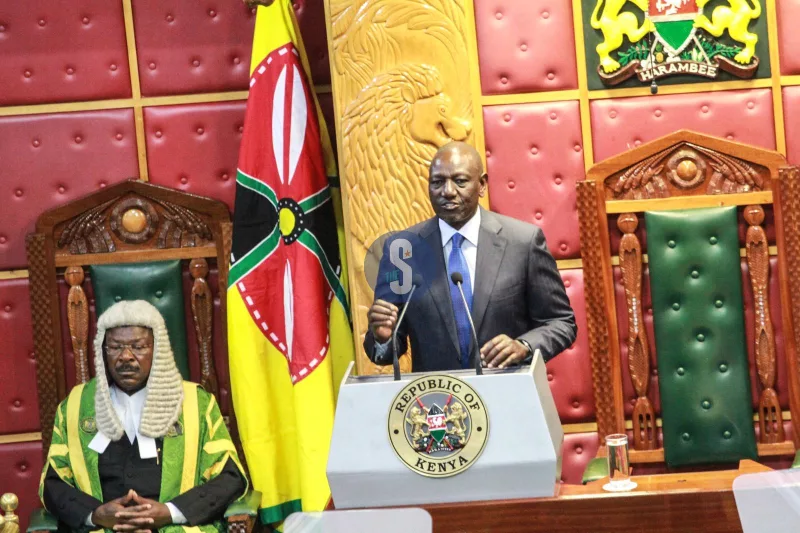
Today, His Excellency President Dr William Samoei Ruto will deliver his State of the Nation Address pursuant to Article 132(1)(b) and (c) of the Constitution of Kenya, 2010.
This is an important constitutional occasion during which the President reports to Parliament on the progress made in realising national values and principles of governance, as well as the measures taken to fulfil Kenya's international obligations.
It has been stated by many before that the development plan upon which President Ruto sought the mandate of the Kenyan people was an extremely ambitious document. Some were so sceptical that they doubted whether the commitments could ever be implemented. But what is a manifesto? A manifesto is, in political terms, a compact between a person seeking an elective position and the voters. It sets out the promises and undertakings upon which the candidate seeks the people's mandate. When the candidate wins, those promises become the basis upon which the electorate expects the elected leader to account for performance. Although it is not a contractual agreement in the strict legal sense, a manifesto is a political undertaking that carries the weight of public trust and accountability.
It is against this background that today's address should be understood. Kenyans have an opportunity to reflect on what was promised, what has been achieved, what remains outstanding and the direction the country is taking. A State of the Nation Address is not simply a presentation of government achievements. It is also an occasion to account for public policy choices, acknowledge challenges and explain the country's development priorities.
There is one major infrastructural project that, for a long time, appeared difficult to achieve. A good number of detractors claimed that it would never happen. Their concerns were not entirely unfounded. Let us look at the Rironi–Mau Summit Road, a project initiated during the administration of President Uhuru Kenyatta.
On paper, the earlier arrangement involved a consortium of three French companies contracted to construct approximately 175 kilometres of four-lane highway at a cost of Sh249 billion. For years, there was little visible progress on the ground. Kenyans were left wondering whether the project would ever move beyond contractual arrangements and official announcements. Some even questioned the credibility of the companies involved, although such allegations should be distinguished from established findings.
The intervention by President Ruto brought a new arrangement under which the road is now planned to cover approximately 210 kilometres at a reported cost of Sh191 billion. The design provides for six lanes along approximately 70 kilometres between Naivasha and Nakuru, with the remaining sections designed as four-lane roads. The government has reported savings of approximately Sh58 billion under the revised arrangement.
Some had suggested that the road would never be constructed. Others claimed that there was no contract and that there was not even a wheelbarrow on site. Today, images of construction activities are available, and those travelling along that route can physically see the work taking place. If you have ever driven towards western Kenya or used Waiyaki Way while travelling out of Nairobi, you understand what this road means. It is a significant undertaking for transport, trade, tourism and the movement of people and goods.
The address presents an opportunity to explain how the new arrangement was achieved, the financial implications of terminating the earlier contract, the savings to the taxpayer, the construction progress and the expected completion timelines. This is the kind of information that enables Kenyans to understand how a project that appeared stalled can be reconsidered and moved towards implementation.
What about affordable housing?
The reality is that our population is growing. We are not the same population we were at independence. We also have a more educated and enlightened population, with changing expectations and aspirations. More people are moving into urban centres in search of opportunities, and the demand for decent and affordable housing continues to increase.
What was initially considered an overambitious plan is now being implemented through a programme that seeks to address a real national need. The President set ambitious targets and put in place mechanisms intended to move the country towards that goal.
Article 43(1)(b) of the Constitution recognises the right of every person to accessible and adequate housing and to reasonable standards of sanitation. Article 10 establishes public participation as one of our national values and principles of governance. Article 40 protects the right to property, while Article 40(3) provides for compulsory acquisition only in accordance with the Constitution and the law, including the requirements of public purpose or public interest, prompt payment in full of just compensation and access to the courts.
The transformation taking place in parts of Kibera, including the Soweto area, is an important example of the possibilities of cooperation between government and citizens. It is interesting that residents have participated in arrangements intended to facilitate the development of affordable housing, with former slum dwellers among the intended beneficiaries. This is an important demonstration of how public participation can help government and communities find solutions to difficult development challenges.
How was such cooperation achieved in a setting where land, tenure, livelihoods and the rights of residents are sensitive matters? Article 10 and meaningful public engagement must be central to the explanation. The progress in Kibera also provides an opportunity to examine the lessons learned, the number of houses completed, those under construction, the criteria for allocation and the extent to which the original residents are benefiting.
Affordable housing is not just about providing shelter. It is also an economic development strategy. Construction creates demand for cement, steel, tiles, electrical fittings, plumbing materials, transport services and many other locally produced goods. It creates opportunities for engineers, architects, quantity surveyors, artisans, contractors, technicians and ordinary workers. An assessment of the programme would therefore be incomplete without examining its employment impact, the participation of local manufacturers and the opportunities available to young people and small enterprises.
There is another interesting dimension that deserves attention: university accommodation.
For years, the expansion of university enrolment has placed pressure on the availability of student accommodation. In many university towns, students compete for limited beds, with some being forced to rent houses far from their institutions at considerable cost. Increasing the supply of university hostels can help address this challenge. When more beds become available relative to demand, competition for accommodation can ease and rental costs may become more affordable.
Of particular interest is the progress made in developing student accommodation. The number of beds completed, those under construction and the institutions expected to benefit will help Kenyans appreciate the scale of this intervention and its potential impact on the cost of student living. This is an investment in education, but it is also an intervention in the housing market and an opportunity to create employment.
Employment creation must remain central to the national development conversation.
The National Youth Opportunities Towards Advancement (NYOTA) programme, the Access to Government Procurement Opportunities (AGPO) programme, the Hustler Fund and other enterprise-development initiatives provide useful reference points for examining the government's approach to youth economic empowerment.
NYOTA is particularly important because it seeks to address youth unemployment through skills development, apprenticeships, recognition of prior learning, business support, savings and access to economic opportunities. The programme has been presented as targeting approximately 820,000 young people. Kenyans will be interested in knowing the number of young people reached, those who have received training, those who have accessed enterprise support and how the programme's long-term impact will be measured in terms of sustainable employment and income generation.
AGPO is another important intervention. It provides opportunities for enterprises owned by young people, women and persons with disabilities to participate in government procurement. Although it is not a new programme, its implementation remains important in ensuring that public procurement creates opportunities for groups that have historically faced barriers in accessing government contracts. Its performance can be assessed through the actual participation of eligible enterprises, the value of contracts awarded, the challenges faced by beneficiaries and the time taken to pay for goods and services supplied.
The Hustler Fund also deserves attention. Its introduction was intended to expand access to affordable credit, particularly for people who have traditionally been excluded from formal financial services. However, its performance should not be measured only by the amount of money disbursed. Repayment rates, the number of sustainable businesses supported, the challenges encountered and the effectiveness of accountability mechanisms are equally important considerations. The relationship between the Hustler Fund and newer interventions such as NYOTA also merits explanation.
Credit must go hand in hand with training and capacity building. Giving someone money without equipping that person with business management skills, financial literacy, market information and the ability to identify opportunities may not produce sustainable results. The connection between access to finance, practical training, mentorship, market access and procurement opportunities is therefore worth examining.
The cost of living is another matter that Kenyans expect to feature prominently.
The discussion should go beyond the prices of basic commodities. While the cost of food, fuel, electricity, transport and housing directly affects household budgets, the long-term solution must also involve creating employment opportunities, increasing incomes and strengthening the productive capacity of the economy. A person with a reliable source of income is better placed to withstand economic pressures than one without employment or a sustainable enterprise.
This brings us to the wider question of investment, manufacturing and enterprise development. The country's ability to create jobs will depend partly on how effectively it attracts investment, supports small businesses, promotes exports and expands productive industries. The relationship between taxation, government expenditure, public borrowing and the purchasing power of households also deserves attention.
Public debt and the cost of servicing it cannot be ignored. The country must finance development while maintaining fiscal discipline and protecting future generations from an unsustainable debt burden. A candid account of government revenue, expenditure, borrowing and the financing of priority projects would enable Kenyans to understand the economic choices being made and how public resources are being deployed.
Agriculture and food security should also feature prominently.
Agriculture remains central to Kenya's economy, employment and household welfare. Fertiliser distribution, irrigation projects, agricultural extension services, access to markets and measures to reduce post-harvest losses are among the areas that merit an update. Irrigation is particularly important because dependence on rain-fed agriculture leaves farmers vulnerable to changing weather patterns. Progress in expanding irrigation, developing water infrastructure and supporting farmers to increase production throughout the year will be an important measure of agricultural policy.
Kenya must also move beyond the production of raw agricultural commodities. Investment in agro-processing, storage, packaging, transportation and value addition can improve farmers' earnings, create employment and strengthen manufacturing. The connection between increased agricultural production, reliable markets and better incomes for farmers is an important part of the national food security conversation.
Healthcare is another key sector of our economy.
During the transition from the National Hospital Insurance Fund (NHIF) to the Social Health Authority (SHA), many Kenyans experienced difficulties. There were teething problems, and some of us, including those who doubted whether the new system would work, were not convinced that the transition would succeed. Critics and sceptics predicted that the system would collapse, while others called for a return to NHIF.
However, the experiences of beneficiaries also deserve attention. There are testimonies from households that have accessed treatment and received financial support through the new arrangements. A contribution of approximately KSh8,000 a year, for example, may be contrasted with a hospital bill of KSh100,000 or more that is covered in part or in full, depending on eligibility, the applicable benefit package and approved tariffs. Such an example illustrates the potential value of social health insurance, although the actual benefits available to each member depend on the applicable rules.
The progress of SHA can be assessed through registration, access to services, claims processing, payment of hospitals and the experiences of patients. The initial difficulties should not be ignored, but neither should the experiences of those who have benefited. The long-term sustainability of the system and its capacity to protect households from catastrophic medical expenses remain important considerations.
There is also the question of retirement savings and the National Social Security Fund (NSSF).
For many years, the growth of the Fund was constrained by the contribution structure and the level of savings accumulated. The increase in contributions under the current framework, with employees and employers each contributing 6%, subject to the applicable statutory limits, has strengthened the potential for long-term accumulation.
The reported growth in the Fund's assets and the interest credited to members deserve attention. The reported 17% interest credited for the 2024/25 financial year is particularly significant in the discussion about retirement savings. It would be useful to understand how the contribution reforms have affected savings, how members' funds are being invested, what returns have been achieved and what safeguards are in place to protect the money.
This is money that belongs to contributors. It must be managed prudently, transparently and in the interests of members. The growth in the Fund's assets should therefore be considered alongside its investment strategy, governance arrangements, administrative costs and long-term sustainability. Retirement savings are an important part of household security and the country's social protection system.
Human rights, constitutionalism and the difficult questions
There is, however, another side of the national conversation that cannot be ignored. Economic development and infrastructure investment must go hand in hand with respect for human rights, constitutionalism and the rule of law.
The unfortunate incidents of abductions, enforced disappearances and alleged extrajudicial killings deserve attention at the highest level of government. We are a country of laws, and that means we must be a country that adheres to constitutionalism. Any person accused of committing an offence must be dealt with through lawful procedures and afforded the right to appear before a court of law. Abductions cannot be justified under any circumstances. Police officers who exercise their powers ultra vires must be held accountable, just as citizens who engage in criminal acts must understand that the law exists to protect everyone, including victims of crime.
The Bill of Rights must be understood as a set of protections that apply to all Kenyans. Article 24 provides for the limitation of rights only in accordance with the Constitution and the law. It must be read together with other provisions, including Articles 26, 29, 33, 34, 37, 38 and 40.
Article 37 protects the right to assemble, demonstrate, picket and present petitions peacefully and unarmed. This is a constitutional freedom that must be respected. At the same time, the right to peaceful protest does not extend to violence, destruction of property or the violation of other people's rights. Citizens must exercise their freedoms responsibly, while the State must respect the constitutional limits placed on the use of force.
The right to life under Article 26 is universal. The life of a protester is as important as the life of a police officer carrying out lawful duties. The rights of every individual must be respected. Equally, Article 40 protects property rights, and the police have a duty to protect people and property from unlawful destruction. This balance is important because we cannot build a country founded on constitutionalism if we allow either State institutions or individuals to act outside the law.
The unfortunate events of June 2024 cannot be swept under the carpet. Extrajudicial killings should never be justified or excused. No political disagreement, public disturbance or security operation can provide a licence to unlawfully take human life. Equally, the country should never experience a situation in which violence becomes the language of political engagement. Dialogue, respect for institutions and lawful engagement must remain the way forward under the Constitution of Kenya, 2010.
The President's apology on behalf of the government and acknowledgement of the suffering of affected families marked an important moment in the national conversation. The establishment of mechanisms intended to provide remedies and compensation is also significant. Official acknowledgement matters, particularly where victims and their families have, for years, sought recognition and redress without receiving adequate State action.
However, compensation must go hand in hand with truth, investigation and accountability. Families deserve to know what happened to their loved ones, those responsible must be held accountable through lawful processes, and the State must put in place measures to ensure that such violations do not happen again. An apology is important, but it must be followed by institutional reforms and justice.
Kenya must remain a country where disagreement does not become a reason for violence, where criticism is not treated as treason and where the State does not abandon its constitutional responsibilities. National unity cannot be built by silencing differences. It is built by respecting citizens, strengthening institutions and ensuring that everyone is treated equally before the law.
It is a patriotic duty never to wish our country to sink into anarchy. We must protect the right to protest, but protests must remain within the boundaries of the law. We must defend the police as an institution, but police officers must also understand that their powers are subject to the Constitution. The State must protect life and property, and citizens must exercise their freedoms responsibly.
Today's State of the Nation Address is an opportunity to take stock of the country's development journey, recognise progress, acknowledge shortcomings and explain the priorities ahead. Kenyans will be listening for information about the roads being built, the houses being completed, the jobs being created, the young people being empowered, the hospitals being strengthened, the farmers being supported and the economy being expanded. Equally important is the assurance that development will be pursued within the Constitution and that every Kenyan's rights and dignity will be protected.
The ultimate measure of leadership is not how ambitious a promise sounds when it is made, but how much of it becomes reality in the lives of the people, while preserving the constitutional principles upon which our nation is founded.