Sharon Nyokabi, a biker and tech enthusiast, understands the challenges faced by riders who depend on battery-swapping stations to keep their electric motorbikes charged.
In off-grid locations far from available charging stations, riders have to travel long distances and queue to charge or swap depleted batteries.
“There aren’t many stations. At the back of my mind, I imagined a two-battery bike that goes off when a user is very far from the main station. It would make the rider immobile,” she said.
Nyokabi began imagining a solution that would allow riders to access power without having to travel to a swapping station.
Drawing inspiration from Kenya Power electricity tokens, she envisioned an app that would let riders buy charging credits and enter a code to access power for their batteries.
The idea was to make charging more accessible for riders who were far from existing charging stations.
She joined an international hackathon to develop an app using AI-assisted tools such as Replit.
However, she soon realised that developing a product, even with AI tools, comes with costs she had not anticipated.
Although hackathon organisers offered participants discounts on development tools, the credits were not enough to complete projects.
“Assuming one had limited resources, one could not buy the tokens needed to complete their projects,” she explained.
When participants exhausted their credits, they had to wait 24 hours for them to be replenished or pay for additional credits.
“Many could not afford the credits, leading to a huge number of people dropping out of the hackathon within the first two days,” Nyokabi said.
The project also required infrastructure she could not afford at the time. She eventually abandoned it when the hackathon ended before she could complete her prototype.
“I have not totally given up on it. I will go back and see how to revive the idea,” she said.
Nyokabi’s experience illustrates one of the challenges facing women experimenting with AI-assisted development: while AI can make it easier to start building a product, it does not guarantee that they can afford to complete it.
Developers need reliable internet access, computing resources, technical skills, mentorship and funding, all of which are costly for those with limited resources.
Winnie Kamau, a data journalist and co-founder of the Africa Gen AI Lab, knows this too well.
She started developing Habari AI to assist journalists with transcription and research after experimenting with generative AI to automate repetitive tasks and seeing how much time it could save journalists.
However, limited capital, computing costs and a lack of strategic partnerships affected her team’s ability to deploy the platform.
Developing it also required multilingual functionality to support diverse African languages.
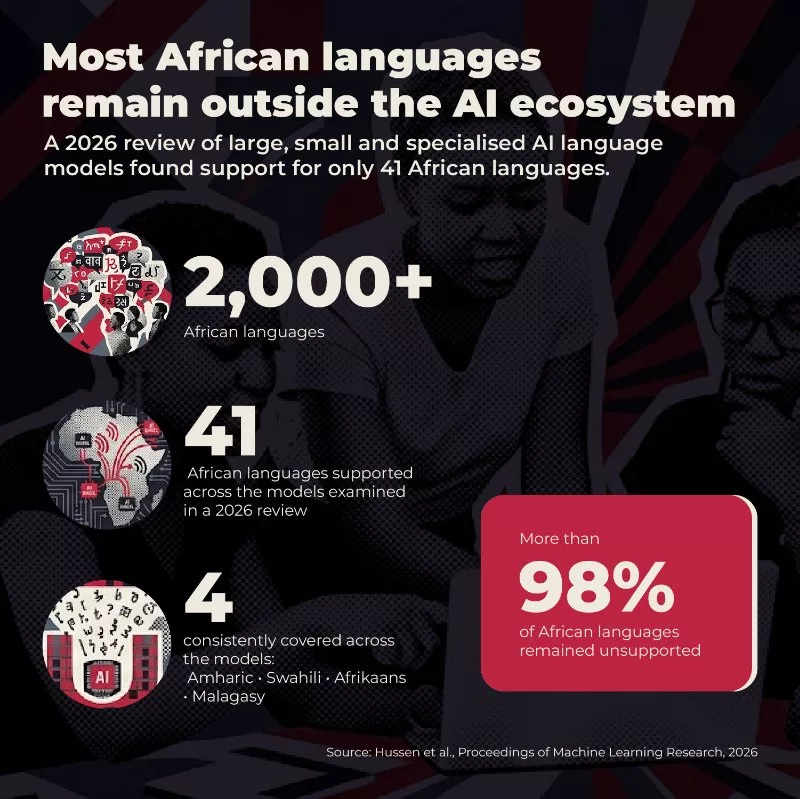
Yet many AI services perform better in well-resourced languages such as English than in languages that are underrepresented in training data.
According to the GSMA, less than one per cent of web content is available in African languages, and less than 0.1 per cent of global training datasets originate from Africa.
These gaps limit the data available to train and develop AI systems that work well in African languages and contexts, meaning people building AI solutions for local-language users must adapt existing systems or invest in additional tools and infrastructure.
This increases development costs and complexity, creating another barrier for those with limited resources.
“The lack of indigenous Natural Language Processing (NLP) capabilities in existing global platforms forced us to build a custom, two-part framework from scratch," Kamau said.
"However, trying to force a fit with these misaligned, premium Western-centric platforms is a drain on our limited resources.”
Kamau and her team are now working on building a customised system designed to support local languages.
She proposes a dedicated funding model that would give startups access to computing and other foundational resources, enabling more women to develop AI-powered solutions.
African AI startups raised $48.3 million (Sh6.28 billion) in 2025, accounting for three per cent of total African funding tracked by Disrupt Africa.
Access to funding is also shaped by gender disparities.
Partech Africa’s Africa Tech Venture Capital Report for 2025 showed that women founders received just 10 per cent of the total equity funding invested in African startups that year, and no women-led startup raised growth-stage funding.
Although Kenya recorded 22 deals involving startups by women founders – the highest number on the continent – the data did not show how much capital they secured or whether it was sufficient to support their growth.
Some programmes, such as Women in Tech Kenya, provide women-led tech startups with seed funding, but funding gaps persist.
According to the Kenya National Innovation Agency (KeNIA), women-led startups received 12 per cent of total startup funding between 2019 and 2023.
For women to participate meaningfully in Kenya’s budding AI ecosystem, they need more than AI tools.
They also need funding, computing infrastructure and technical support to build, test, deploy and sustain their products.
This article was produced as part of the Gender+AI Reporting Fellowship, with support from the Africa Women’s Journalism Project (AWJP) in partnership with DW Akademie. The journalist used AI-assisted research tools to review and summarise relevant policy and research documents, identify patterns, surface data points for independent verification, and extract key statistics. All reporting, analysis, editorial decisions, fact-checking and final wording were done by the reporter, in line with The Star’s editorial standards.