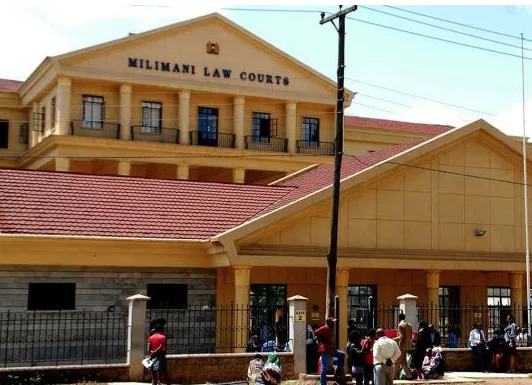
The Environment and Land Court in Nyamira has ruled that the county government and community members acted unlawfully when they built a road across private property.
Justice Dalmas Ohungo declared the construction of an access road on privately registered land illegal and ordered the county and community representatives to remove the road materials and restore the parcel to its previous state.
The road was built on Central Kitutu/Mwabosire/765, registered to Ronald Morara Angwenyi and Walter Peter Mayaka as joint absolute proprietors and trustees for themselves and four others. The title was issued on March 30, 2015.
The court heard that on December 3, 2022, county authorities deployed an excavator to open an access road.
While an official road reserve was designated on the registry index map, the actual construction deviated from this mapped route onto Angwenyi's land.
He told the court the encroachment was about eight metres and that he refused to take part in a re-survey the land registrar summoned proprietors to on December 14, 2022.
“He also stated that there was no public participation concerning the road and that he refused to participate in the exercise,” the court heard.
Angwenyi reported the matter to Sengera Manga police station and the third interested party, Jones Maranga Makori, was arrested but not charged.
Angwenyi argued that the respondents had violated his property rights and sought several reliefs, among them an order declaring the defendants' actions to be a trespass on his property.
He also sought an order declaring the road construction illegal, an order requiring the defendants to remove all road materials and restore the land to its original state and an order for the costs of the suit.
Zacharia Ocharo, testifying in his capacity as the county's director of Works and Development, said the land was private property that neighboured a public road where the government was working.
Ocharo said the government sent excavators to the edge of the suit property and neighbouring parcels on December 3, 2022, while undertaking maintenance of an existing road.
The second defendant, the Land Registrar, did not enter appearance.
The four interested parties denied Angwenyi's claims and argued that the defendants were merely opening up an access road that had existed and been used by the public for several years.
The fourth interested party, Joseph Makworo Ochoi, testified that the road was a public road useful to the community.
He said it was started in 1984 by the late Chief Hezekiah and existed on the ground as a narrow path but in the map as a road.
Ochoi told the court it was the community, not the county, that wanted the road constructed.
A court-ordered site visit and surveyors’ reports established that a road reserve existed in the official map, but that the constructed road was placed elsewhere.
Angwenyi's surveyor found the eight-metre road did not conform to the mapped position, a finding the judge called credible.
During a locus visit on October 30, 2024, the court observed that retaining the road on its mapped alignment would hinder vehicle movement owing to its sharpness.
But instead of using that mapped reserve, the defendants and interested parties unlawfully constructed a new road elsewhere on the plaintiff's private land without consent.
The court established that administrative or engineering convenience cannot override constitutional property rights.
"Convenience is not the same thing as ownership. It cannot trump rights of registered proprietors of land,” Justice Ohungo noted.
“If the defendants wish to have the road in place, they should invoke and follow the procedure for lawfully acquiring the portion. Anything else is both an illegality and an irregular expenditure of public funds."
The court declared the actions of the defendants and interested parties amounted to trespass and declared the construction illegal.
The judge ordered removal of the road materials and restoration of the land and awarded Angwenyi costs of the suit.