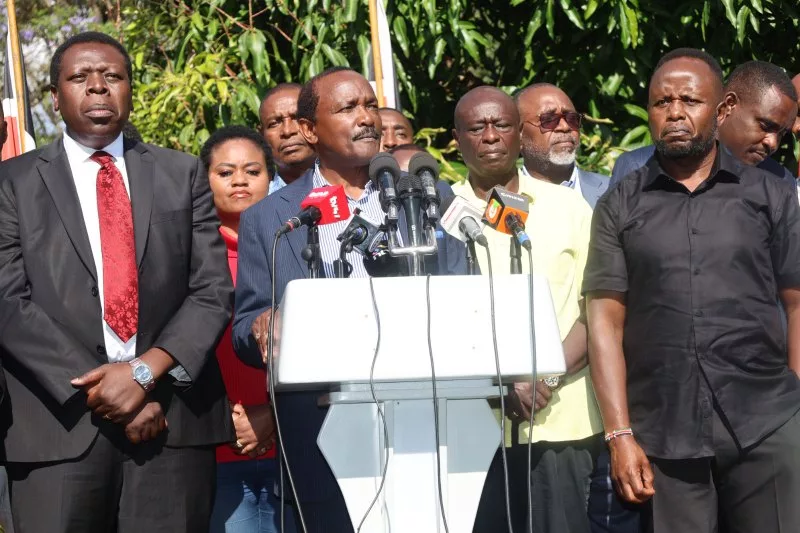
There’s a saying—allegedly by the British—that politicians, like diapers, ought to be frequently changed. That’s because left too long, they give an unbearable stench. As one well versed with diaper changes, I’m inclined to agree. Looking around, many a notable name have been angling for visibility, in the hope of making political comebacks.
The 2027 contest is shaping up as a generational reckoning. On one side stand the returnees: seeking to reclaim lost seats, eyeing the presidency, and retired politicians who cannot resist meddling in the succession. On the other, a cohort of young ones is building independent political vehicles, refusing to wait their turn.
The question is not simply who wins. It is whether the old guard’s experience can deliver what the newbies’ energy promises—and whether either can escape the trap of transactional politics.
The returnees command something newbies lack: institutional memory, ethnic networks and the muscle of party machinery.
A former Interior Cabinet Secretary understands how the state works from the inside; a former Deputy President knows where the bodies are buried and a former governor has tested the levers of county power.
But experience in our political context often means complicity. The old guard carries the baggage of past failures—corruption scandals, broken promises and the patronage networks that kept them in power.
They return not because they have new ideas, but because they have unfinished business. That is the recycling problem. It is not that they are old; it is that they are unchanged.
Across Africa, the return of former rulers is rarely a story of redemption. Malawi’s former president returned to power five years after being unseated, campaigning on the simple claim that life was better under him.
Congo-Brazzaville’s strongman has ruled for over four decades, re-elected in votes the opposition called neither transparent nor democratic.
What can the old guard actually achieve if returned? Likely more of the same: stability without transformation, continuity without renewal. They will manage the economy, negotiate with cronies and keep the ethnic coalitions intact. They will not dismantle the patronage system because they are its architects.
The pattern is consistent: voters, frustrated by present hardship, reach for a familiar past.
Hopefully, this can be remedied.
The new cohort is different in style, if not always in substance. They build their own parties rather than waiting for nominations, as recently witnessed by an aspirant giving experienced hands sleepless nights and hoarse voice.
They speak the language of generational change and accountability. And polls now suggest these young ones are outpacing veterans with decades of name recognition.
This is part of a continental shift.
Across the region, a generational awakening is reshaping how power is contested.
In Senegal, a 44-year-old with no experience of holding public office won the presidency on the first ballot, defeating the establishment’s chosen successor.
In Botswana, young voters helped end more than half a century of one-party rule, electing a coalition that promised jobs and accountability.
But energy is not enough. Kenya’s system punishes fragmentation.
The newbies’ support, when added together, looks impressive—but voters are not parcels to be transferred between candidates. Loyalists may not flock to a newcomer. Without a single standard-bearer, the opposition’s arithmetic becomes a suicide pact.
The old guards know this. They have spent decades perfecting the art of divide and conquer. They understand that a divided opposition is an incumbent’s best friend.
What do the newbies bring? A different temperament. They are more willing to confront corruption publicly, more comfortable with digital mobilisation, more attuned to the demands of an electorate where over 70 per cent are under 35. But their policy platforms remain thin.
The most honest answer is that neither side has demonstrated the capacity to transform the political economy.
The old guard has had its chance and squandered it. The newbies have not had theirs—but a new broom in the hands of the same interests sweeps no cleaner than an old one. The genuine divide is not between old and new alone—some young politicians are already embedded in the same networks. Some old ones have belatedly discovered the language of reform.
Voters will have to decide whether they are choosing a person or a direction. That is where the election will be won—not by the loudest returnee or the freshest face, but by whoever convinces the exhausted middle that their life will actually change.