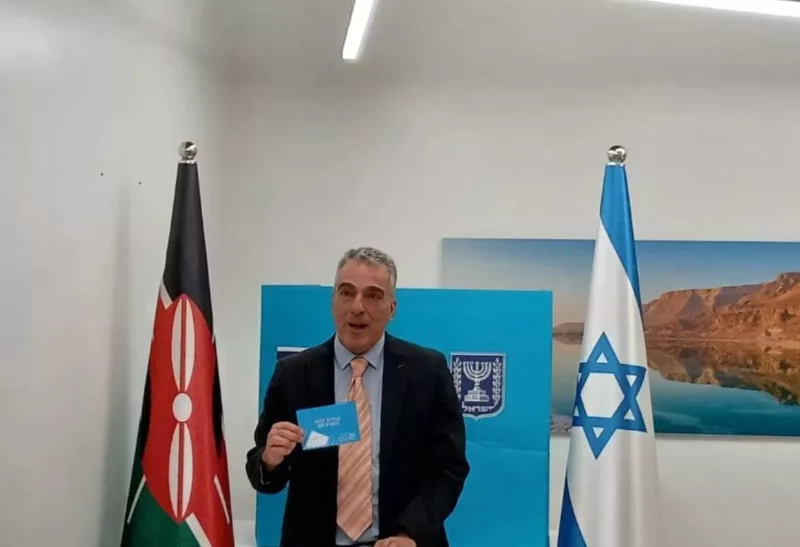
Israeli diplomats in Nairobi voted ahead of next week’s parliamentary elections, which could decide the political future of Prime Minister Benjamin Netanyahu and shape how Israel handles the aftermath of the Gaza war.
The election, scheduled for October 27, is widely regarded as one of the most consequential in Israel’s history, coming three years after the Hamas-led October 7, 2023, attacks that triggered the war in Gaza.
It will test public confidence in Netanyahu’s leadership, with voters weighing security, accountability for the attacks, the economy, and the country’s government direction.
At the Israeli Embassy in Nairobi, Ambassador Gideon Behar and other eligible officials cast their ballots on October 15, joining diplomatic missions worldwide in voting ahead of the main election.
“We are very happy and very proud to be here in Nairobi to cast our votes and to be part of a democratic process in Israel,” Behar said.
He said the election would determine the composition of the 120-member Knesset, Israel’s parliament, whose members will determine which political parties can form the next government.
“The process is a democratic process, and the majority will say what they have to say, and you know my vote as an ambassador is equal to everyone else. So I’m sure that the Israeli public is well equipped, knows exactly what they want, and we will be happy with every result,” he said.
“Main issues are, as always, security concerns, well-being of the citizens, economy, etc.,” he added.
The stakes extend beyond choosing a new government. Netanyahu, who leads the right-wing Likud party, is seeking to retain power after years marked by the Gaza war, regional conflict and mounting questions over his government’s responsibility for the October 7 security failures.
The election is also unfolding amid disputes over military-service exemptions for ultra-Orthodox Jewish men, the cost of living and whether to establish an independent inquiry into the failures surrounding the 2023 attacks. Netanyahu’s opponents want to replace his government, although they differ among themselves on security and the Palestinians.
Unlike Kenya, where voters directly elect a president, Israelis vote for political parties competing for seats in parliament. Seats are distributed according to each party’s share of the vote, and parties must then negotiate to assemble a coalition with at least 61 of the 120 seats to govern.
This means the party winning the most votes does not automatically secure the premiership. The ability to form a parliamentary majority is decisive, and current projections suggest neither Netanyahu’s bloc nor his opponents have a clear path to victory. Smaller parties could therefore play a crucial role in determining who becomes prime minister.
On October 21, reports indicated the early voting at Israeli diplomatic missions worldwide recorded an 86.7 per cent turnout, with 4,218 of 4,863 eligible voters casting ballots. This was an increase of 17.1 percentage points from the 69.6 per cent recorded during the 2022 election.
The arrangement allows Israeli diplomats, other eligible government officials serving abroad and qualifying family members to vote before election day. It does not extend to all Israelis living overseas.
Behar said the ballots cast in Nairobi would be transported to Israel for inclusion in the national tally.
“The votes will be sent by air to the Central Elections Committee, and by the time all boxes in Israel are opened, these ones will be opened as well and added to the total count,” he said.
Despite the intense political contest, Behar said Israel valued its relationship with Kenya, citing cooperation in agriculture, education, health, security and water management.
“We see Kenya as a very important ally of Israel,” he said, adding that the relationship extended beyond formal diplomacy to connections between the two peoples.